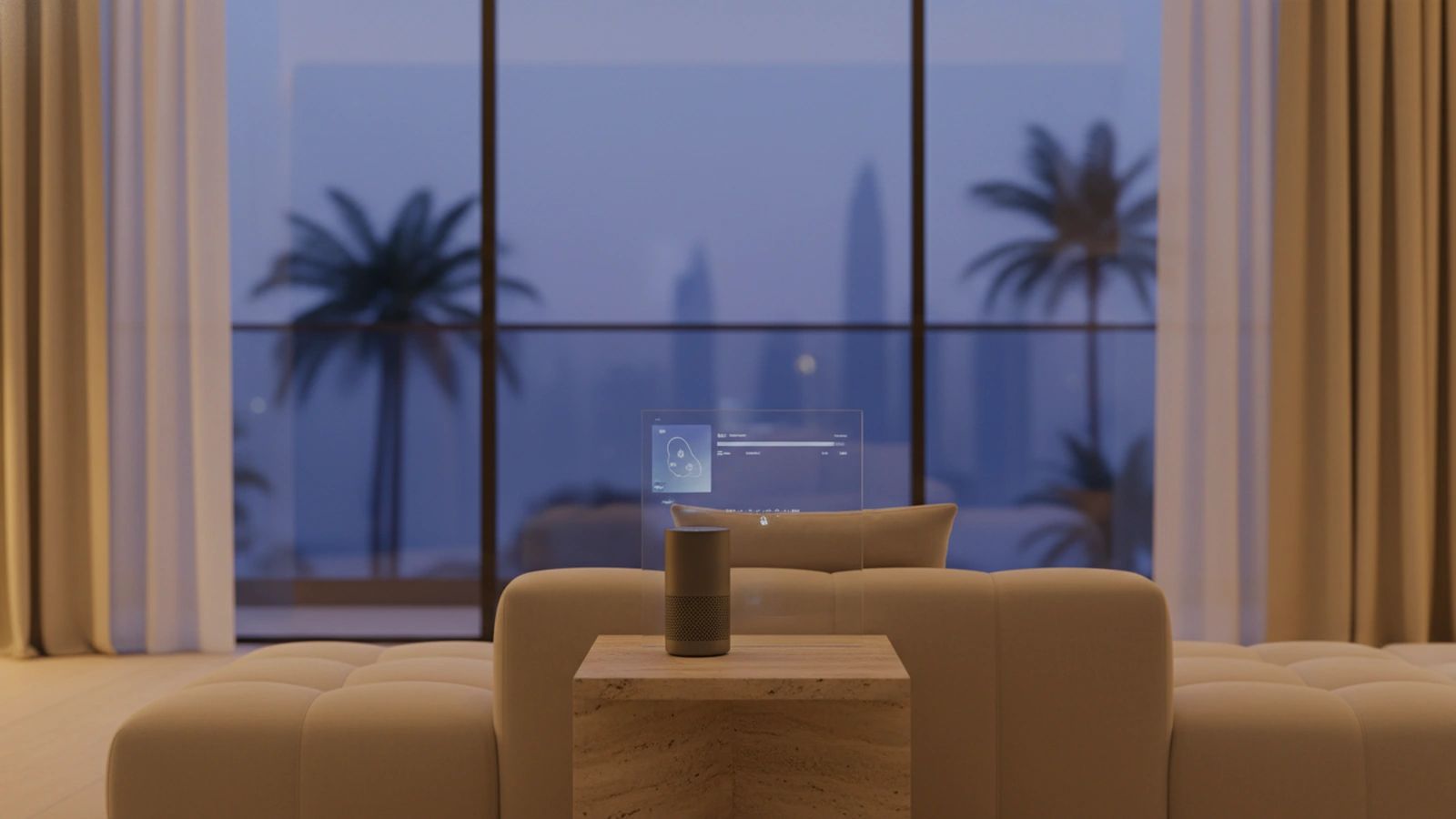
You walk into the villa at 7pm. The lights ramp up to evening levels. The AC has been holding at 26 in unoccupied zones and is already cooling the living room down to 22. The blinds are dropping for privacy. The CCTV is still recording. The doorbell still rings on the panel even though the visitor is at the gate, not the porch. None of this involves anyone tapping a phone. Now imagine the same villa with a 30 second cellular outage at 7:02pm because a 5G cell rebalanced. In a properly designed home, you should not notice.
That last sentence is the entire 5G iot smart home dubai conversation, and it is the part the marketing brochures skip over. 5G is real, IoT device counts are climbing, and the question every villa owner should be asking is not whether to embrace IoT. The question is which parts of the house can fail when the network blips, and which parts cannot.
Where 5G and IoT actually stand in the UAE
Two facts set the stage. The UAE now has 98.5 percent 5G population coverage on at least one major operator, with average 5G download speeds around 275 Mbps. The UAE IoT devices market generated USD 976.7 million in revenue in 2024 and is forecast to grow at a CAGR above 20 percent through 2030. In plain language, the radio is finally good enough to carry a lot of household traffic, and the device shelves at every electronics retailer in Dubai are now stacked with WiFi cameras, smart plugs, smart kettles, smart curtains, and a hundred bridges promising to glue them together.
This is genuine progress for the parts of a smart home that can tolerate occasional unreliability. Streaming a film, downloading a 4K firmware update, video calling a relative in London; all of this benefits from 5G and broad IoT. The trap is assuming that because the radio is fast and the devices are cheap, the radio can be the whole infrastructure.
It cannot, and the reason has nothing to do with bandwidth.
What "reliable" actually means in a home
There is a category difference between "fast on a good day" and "deterministic on every day." A KNX wired bus runs at 9.6 kbps, which is laughably slow by any modern standard. A 5G cell at peak does 275 Mbps. So why are we still installing wired buses in Dubai villas in 2026?
Because every KNX telegram is acknowledged in a few milliseconds, the bus is electrically isolated from the rest of the building's signal noise, and the protocol was designed for command and control rather than streaming. When you press a switch, the light comes on. Not 200 milliseconds later, not after a hub re-pairs, not after a router reboots. Every time. We covered the underlying architecture in the KNX ecosystem piece and the trade-offs against single-vendor platforms in the platform comparison.
Industry comparisons of wired versus wireless smart home systems consistently land on the same point. Wired systems are less prone to interference and connectivity issues; wireless reliability depends heavily on network planning and radio conditions. Both can be very reliable on a good day. Only one stays reliable on every day.
The backbone-and-edge model we install
The right answer is not "wired only" any more than it is "wireless only." It is a backbone-and-edge model. The backbone is KNX, wired, and carries the things that must always work: lights, climate, blinds, scenes, occupancy logic, and the central command layer. The edge is wireless and IP based, and it carries the things that can tolerate a blip: CCTV, video doorbells, voice assistants, music streaming, occasional smart appliances, and IoT integrations we want to experiment with.
Two practical consequences fall out of this. The first is that a 5G or WiFi outage cannot take the house down. Lights still work. AC still holds setpoints. Blinds still respond to the schedule. The dashboard goes into a degraded mode for the IP-side features and the KNX backbone keeps running. The second is that adding a new IoT device, even one from a brand we have not used before, is an additive risk on the edge instead of a load-bearing dependency on the backbone. If the device breaks, you unplug it. The villa carries on.
The May 2026 release of KNX Version 3.0 with KNX IoT extensions made this architecture even cleaner. KNX IoT lets edge devices talk to the wired KNX backbone over IP without being part of it, and without taking the backbone's reliability profile down with them. We expect this to be the dominant pattern in Gulf villas for the next decade.
Where wireless still wins
This is not a piece against wireless. Wireless wins in three places and we use it deliberately. The first is for sensors and controls in rooms that were not pre-wired during construction; KNX RF, Zigbee, and Thread are all reasonable choices depending on device count. The second is for CCTV, where IP cameras over PoE or WiFi are the right tool. The third is for guest-facing devices: streaming sticks, voice assistants, AirPlay speakers.
The rule we apply is simple. If failure means someone has to climb a ladder to reset a hub at 11pm, it does not belong on the backbone. If failure means a guest cannot stream a film, the wireless edge is fine.
Common questions
Will 5G replace home WiFi in Dubai villas?
For a single occupant in a small unit, yes, 5G fixed wireless is already a reasonable primary connection. For a villa with multiple residents, CCTV, smart devices, and a KNX dashboard, 5G is a complement to fibre or a fallback, not a replacement. Latency, indoor penetration, and the pricing per GB still favour wired fibre as the primary.
Does KNX work with Matter and IoT devices?
Yes. KNX IoT was published in its updated form in May 2026 and is designed to interoperate with IP-based device ecosystems. We bring Matter, HomeKit, Google Home, and similar device families to the KNX backbone through gateways, not by replacing it.
If I already have a WiFi-based smart home, is it worth retrofitting KNX?
It depends on what fails for you today. If lights, AC, and blinds work reliably and you only use wireless for entertainment and CCTV, a retrofit is hard to justify. If you find yourself rebooting hubs, re-pairing devices, or losing scenes after a network change, you are paying the wireless tax already; KNX is the way out.
What about latency on a wireless mesh?
A well planned wireless mesh feels instant for everyday use. Each hop adds a small delay, however, and some stacks prioritise energy efficiency over the lowest possible latency. For deterministic behaviour on safety functions or stairwell lighting, the wired bus is the margin you want.
Why this matters in 2026
The pitch from a lot of new entrants is that 5G plus IoT plus a hub equals a smart home. It does, for a definition of smart home that prioritises low cost and quick installation. For a definition that means "everything works the same way every day, regardless of what the network is doing," the architecture has not changed in twenty years. Wire the backbone. Use wireless for the edge.
If you are planning a new villa, or living in one where the wireless layer is starting to feel fragile, we are happy to walk through what a backbone-and-edge design looks like for your specific home. Our page on KNX installation for Dubai homes explains the backbone half of that design.