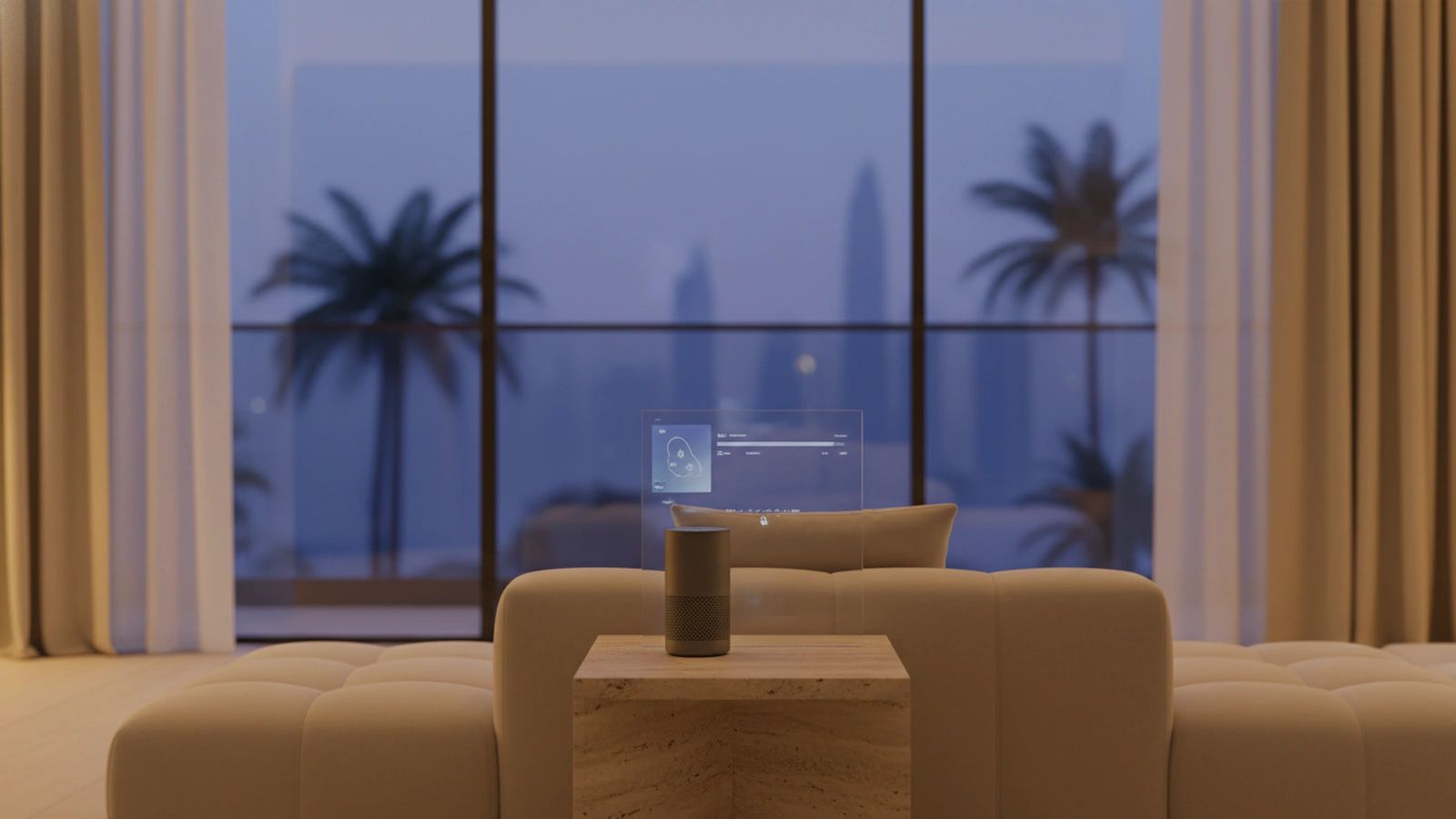
You walk into the villa after midnight, both hands full of grocery bags, and you ask Gemini on the Google Home speaker to turn off the downstairs lights and bring the master bedroom to twenty-two degrees. The lights go out. The bedroom is cooled by the time you reach the staircase. For the first time you do not have to remember which app does which job. That is what the 2026 Gemini upgrade to Google Home is supposed to feel like inside a KNX villa, and on a good day it does.
The harder question, the one nobody is asking publicly, is what happens on a bad day. The internet goes down for forty minutes, the cloud assistant goes silent, and the question you should have asked before installing anything is whether your house still works. In a KNX Dubai villa, the answer is yes. In a villa that has handed all of its logic to a voice assistant, the answer is usually no. The point of this piece is to map the line between the two, and to show where Gemini earns its keep without crossing it.
What changed in Google Home in 2026
Google has been rebuilding Google Home around Gemini. The current generation runs on Gemini 3.1, and the practical effects are real. Voice control of lights and plugs is faster than it was in 2024; Google quotes up to a 1.5 second improvement on common device commands. The assistant is better at deciding when a request is a single instruction and when it is part of a follow-up conversation, which means fewer awkward stops in the middle of a sentence. The Gemini for Home AI automations introduced in 2025 now include camera-triggered routines: a Nest camera that already recognises events like a package being dropped or glass breaking can now kick off a smart home routine the moment it sees one. Gemini Live, the open-ended conversational layer, is rolling out across a wider set of speakers and displays, and the "Gemini built-in" programme is pushing the same engine into third-party speakers through 2026.
For a Dubai villa owner who already lives with a Google Home account, almost all of this is welcome. The interface is friendlier, the responses are smarter, and the speakers are finally fast enough to use as a daily control surface. None of it changes the underlying architecture of the house. That is the part most reviews skip over.
Why a KNX backbone still has to be in charge
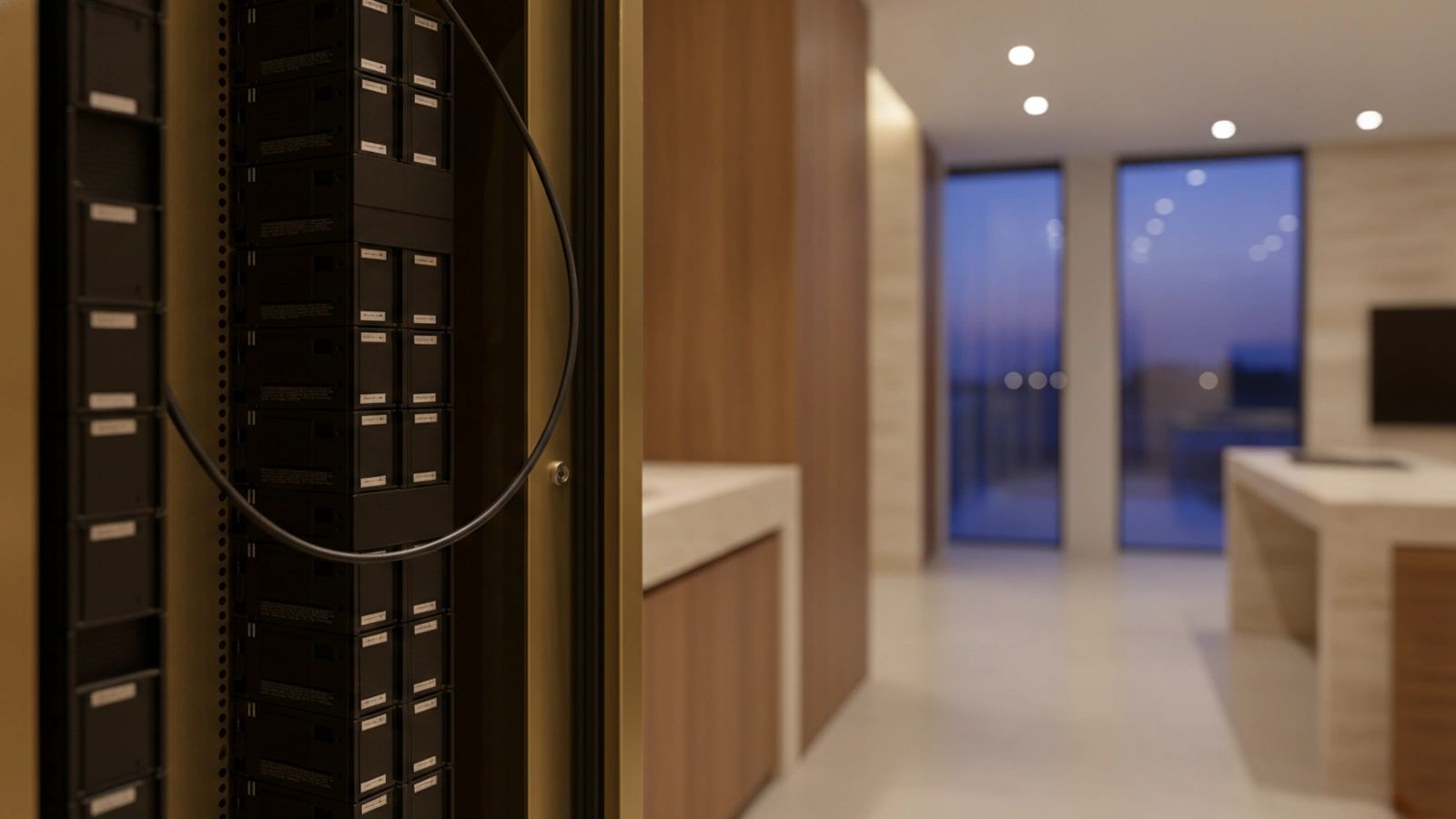
A KNX villa runs on a wired bus that does not care whether the internet is up. Press a switch, the actuator clicks; ask the dashboard, the dashboard answers; trigger the pre-cooling scene, the AC starts cooling. The logic that controls lighting, climate, blinds, and presence lives inside KNX devices, sitting on a green-and-black cable, talking to each other on a protocol formally published as the international standard ISO/IEC 14543-3. We have written separately about how this is evolving in our piece on KNX IoT and the next evolution of a Dubai villa, but the short version is that the wired layer is what gives you the certainty that the house behaves the same on every press, every time.
A cloud voice assistant cannot give you that certainty. It is, by design, dependent on a network round trip and a remote model. When the network is healthy, you barely notice it. When the network blinks, you do. For a primary villa where the family lives every day, that difference matters. Cooling a five-bedroom house in August is not a feature you want gated behind a cloud login.
This is the architectural rule we apply to every villa we commission. KNX runs the house. Anything above KNX, including Google Home, Gemini, dashboards, and Matter bridges, is an interface, not a controller. Interfaces can come and go without breaking the villa.
Where Gemini genuinely helps
With that frame in place, Gemini's role becomes much easier to use well.
The first role is voice as an interface, not as logic. Walking into the villa with hands full and asking the speaker to switch off downstairs and pre-cool the master is a faster experience than tapping a phone. The command lands in Google Home; Google Home asks the KNX integration to execute; KNX flips actuators on the bus. The voice was the trigger; KNX did the work. If the speaker goes offline, the switches and the dashboard still run the house. You lose the convenience, not the function.
The second role is summarisation. Gemini can read what the cameras saw and turn it into a sentence. "There were two deliveries this afternoon and the garden gate was opened at 5:42 pm." That kind of answer, drawn from camera events and timestamps, is what AI does well. It is not a controller; it is a reader. You ask it what happened, it tells you. The CCTV layer and the access logs in the villa are still authoritative on their own; Gemini is making them easier to consume.
The third role is gentle automation around moments the wired logic does not need to govern. A camera that recognises a package and kicks off a "I will be home in twenty minutes" reminder is a sensible Gemini-side routine. A camera that recognises glass breaking and starts a notification chain is also reasonable as a Gemini-side trigger, layered on top of the KNX alarm logic, not replacing it. The principle is that AI can add layers; it should not replace layers.
The fourth role is conversational discovery. New owners learn what a villa can do faster when they can ask. "What scenes are available in the master bedroom?" is the kind of question Gemini Live answers well, and it shortens the onboarding curve. For a guest staying in the villa, that is a real upgrade over hunting through an app.
Where Gemini should not be in charge
The rules of thumb we use when commissioning a Gemini-aware KNX villa in Dubai are these.
Anything that controls cooling stays in KNX. Pre-cooling logic, AC zoning, occupancy-based setpoints, and DEWA-aware schedules belong on the bus where they cannot be interrupted by a cloud outage. We wrote about the DEWA piece in detail in our AC zoning and DEWA savings guide; the same principle applies here. The savings only show up if the rules execute every day.
Anything that controls security stays in KNX, with AI as an additional sensor, not a replacement. A package on the doorstep is a Gemini hint; a forced entry is a KNX security event. The hierarchy matters.
Anything that controls blinds, shading, and solar gain stays in KNX. Shading is part of how a Dubai villa survives summer; cloud-dependent shading is a category mistake.
Anything that affects the safety of the house, including gas, water valves, and electrical loads above the basic plug level, stays in KNX. Gemini can report a leak detected by a sensor; the valve closes because KNX told it to.
Finally, the Matter bridge between Google Home and the KNX side should be set up so that the bridge is one-way safe. Devices on the KNX bus expose themselves to Google Home for voice control, but Google Home cannot reconfigure how those devices behave at the KNX layer. Our piece on Matter in a KNX house in 2026 covers how this is architected on a live villa.
What this looks like at the wall
In a villa we commission this way, you can speak to Gemini from any room, you can ask it to summarise what the cameras saw, and you can run scenes by voice that would otherwise take two taps in a dashboard. You can also unplug the internet for an hour and the villa still cools, the lights still dim on schedule, the blinds still track the sun, and the gate still opens. That is the test we apply at handover, and it is the test we recommend any owner apply before they sign off on a Gemini-aware system from anyone.
Frequently asked questions
Does Gemini Google Home work with KNX in Dubai?
Yes. Google Home, with Gemini features enabled, can control KNX devices through a Matter bridge or through a vendor integration on the dashboard layer. The KNX logic itself runs on the wired bus; Gemini is the voice interface in front of it.
Will Gemini control my AC if the internet is down?
No. Cloud assistants need a network round trip to respond. In a KNX villa, the AC schedules and zoning logic continue to run on the bus regardless of the internet, so the cooling does not stop when the assistant does.
Is Gemini smart home control private enough for a villa?
Voice commands and camera summaries handled by Gemini travel to Google's cloud for processing. Anything you want to keep entirely local should stay inside the KNX layer and the on-site dashboard. We treat the cloud assistant as an interface, not as a data sink for sensitive sensors.
What is the difference between Gemini for Home and Google Assistant?
Gemini for Home replaces the older Google Assistant on supported Google Home devices and adds AI capabilities including conversational follow-ups, camera-event automations, and faster device commands. Older Assistant features continue to work where Gemini for Home has not yet rolled out.
Should I rip out my KNX dashboard if I have Gemini?
No. The dashboard is the resilient local interface and the place where the villa is configured. Gemini is a fast, friendly addition on top of it. The two are complementary.
A note on how we set this up
We are a Dubai-based KNX integrator. We commission Gemini-aware KNX villas with the wired backbone in charge of everything that has to keep working when the internet does not, and with Google Home sitting on top as the voice interface owners actually enjoy using. If you are planning a villa and want a system that gets both right, we are happy to talk through what that looks like for your home.