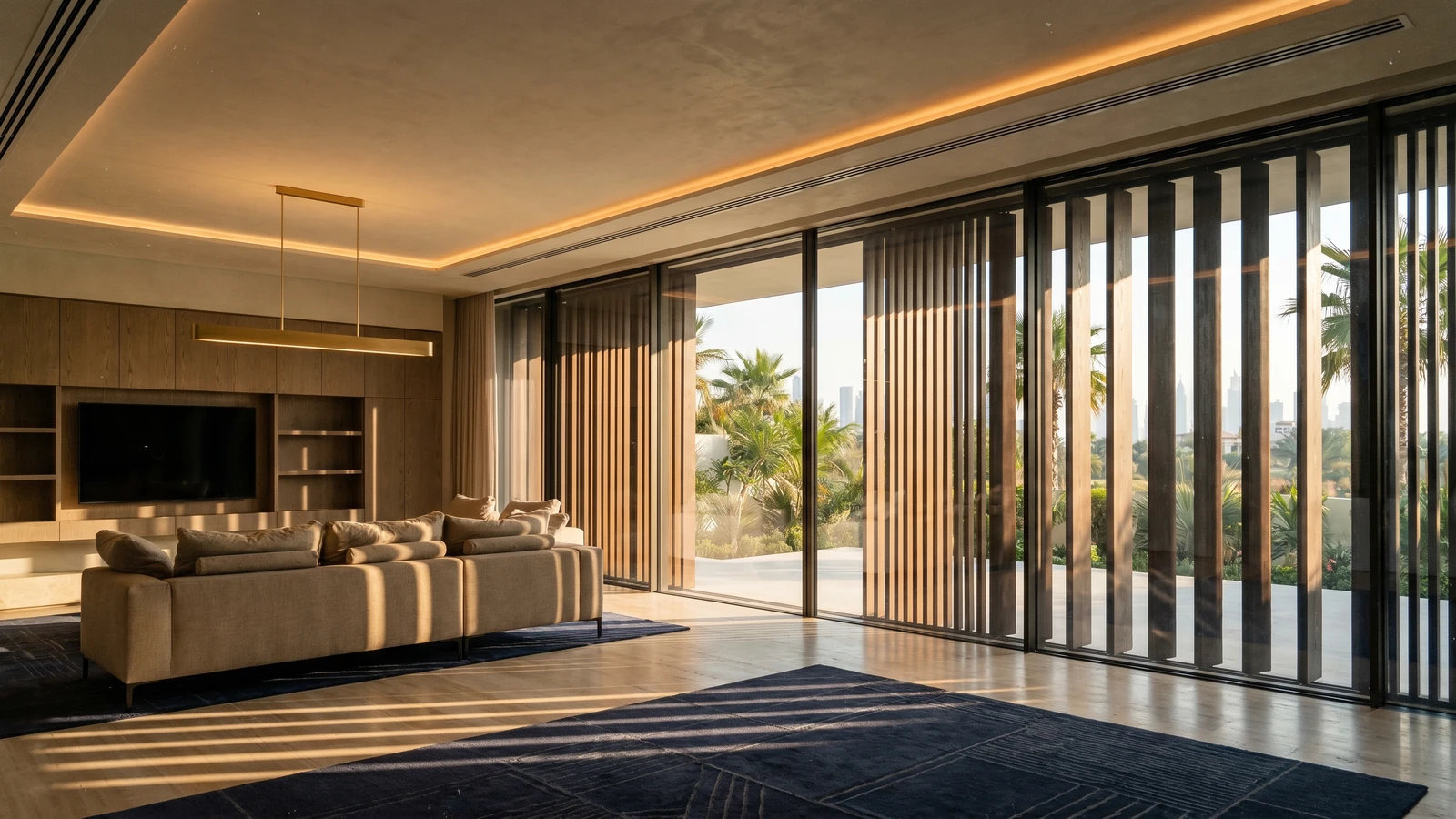
You hand your architect the brief for a new villa in Al Barari. Six months later the design is locked, the contractor is mobilised, and the building permit application goes in. It comes back rejected. The reason on the rejection letter is unfamiliar: the design does not clear Al Sa'fat 2.0 Silver, the new minimum tier under Dubai Municipality's updated green building system. The Sustainable Materials Passport for the structural package is also missing.
This is not a hypothetical. From 2026, Al Sa'fat 2.0 Silver is the floor for every new building permit issued by Dubai Municipality; the Sustainable Materials Passport became a mandatory submission earlier in the year. The rules cover thermal performance, water, materials, and a long list of building systems. Most of those systems are exactly the ones we install: lighting, climate control, blinds, energy management. The way you specify and programme them now feeds directly into whether your villa gets approved, and how it scores.
We have spent the last few months reading the regulation in detail and re-checking how our default specifications stack up against it. This piece is a plain-English walkthrough of what changed, where automation actually carries weight in the scoring, and the four-level mental model we use when we plan a project against Al Sa'fat 2.0.
What actually changed in 2026
Al Sa'fat is Dubai Municipality's green building rating system. It is not new. What changed in 2026 is the bar.
The system runs on four tiers: Bronze, Silver, Gold, Platinum. Each tier mixes mandatory prerequisites with a points pool you draw from across categories like ecology, building vitality, resources, materials, and waste. Before 2026, Bronze was effectively the working minimum on most projects. From 2026, Silver is the mandatory minimum for every new building permit. (Dubai Municipality; Al Sa'fat 2.0 Compliance Guide, Dar Al Naseeb, 2026)
That is a real jump in stringency. The envelope and systems thresholds tighten in step with it. External walls cap at 0.57 W/m²K. Roof and ceiling cap at 0.30 W/m²K. Glazing caps at 2.0 W/m²K with a Solar Heat Gain Coefficient of 0.25 or lower. Those are envelope numbers, not automation numbers, but they tell you something important: the building will arrive in your hands already designed to keep heat out. The systems we layer on top of it have to match that intent, not undermine it.
Separately, the Sustainable Materials Passport is now required at submission. It is a digital ledger of every structural material in the building, with quantities, suppliers, and embodied carbon data, prepared by the engineering consultant and submitted to Dubai Municipality's registry. (Al Sa'fat 2.0 Compliance Guide, Dar Al Naseeb, 2026) It is the consultant's deliverable, not the automation integrator's, but it influences what makes it onto your project early; that includes containment, cable, and the materials in our panels.
Why automation carries more weight under Silver than under Bronze
Silver does not award points for "having a smart home." It awards points for performance and verification. That is a very different game.
When a building has an automation system, a few things become testable that otherwise would not be. Setpoints can be enforced and recorded. Lighting can be dimmed and scheduled, not just switched. Shading can be driven by sun position, not by an owner remembering to lower a blind. Energy can be measured at the circuit, at the room, and at the appliance. The same systems that make a villa more comfortable also produce the evidence a green building rating wants to see.
We see the mandatory move to Silver as a quiet promotion for our category. For years, the energy story for smart automation in the UAE has had to be sold on its own terms. Now the regulation pulls in the same direction.
A four-stage way to think about your villa against Al Sa'fat 2.0
We use a four-stage progression when we walk an owner or consultant through what their automation specification needs to do under the new rules. It is not a Dubai Municipality framework. It is ours. It is meant to make the choices in front of you concrete.
Stage 1: meet the minimum
Stage 1 is everything you must do to get the building permit. It is not a high bar; it is also not negotiable.
For the systems side, this looks like: separately switched and dimmed lighting circuits, room-by-room thermostatic control with reasonable setpoint discipline, automatic exterior lighting control that does not run mid-afternoon, and the basic energy metering Dubai Municipality wants to see. Most of this can be delivered with KNX as the wired backbone and a relatively conservative custom dashboard on top. You are not yet earning extra points. You are simply not losing them.
If your villa is being designed today and the automation specification looks "minimal," check that minimal still clears Silver. Older default specifications were written against Bronze; they no longer pass.
Stage 2: claim the easy points
Stage 2 is where most of our Silver and lower-Gold work sits. You take the systems already in the design and use them to claim the points that are sitting on the table.
Daylight harvesting in living spaces. Occupancy-driven control in service rooms, gyms, and majlises that are used in bursts. Automated shading tied to solar gain rather than time of day. Setpoint scheduling for cooling that respects when the house is actually empty. Submetering for major loads so consumption can be reviewed monthly. (DEWA, Set Your AC to 24°C; UAE residential cooling load research, NCBI PMC)
The cost delta over a Stage 1 design is small once cabling is already in. The points are substantial.
Stage 3: go after Gold
Stage 3 is for owners who care about the rating itself, or who are building to a brief that asks for Gold.
This is where we add closed-loop logic across the systems. The cooling system pre-cools the ground floor in the late afternoon, drawing on the building's thermal mass before the evening occupancy peak. Shading reacts to forecast peak temperature, not just current sun position. Lighting circuits run on circadian curves that pull warmer and dimmer after sunset. Energy is monitored at the panel level and reported to the owner monthly with year-on-year comparisons. We have done this on villas in Emirates Hills and we will do it again. None of it is exotic; it is disciplined integration. (KNX Association, KNX IoT and energy management releases at ISE 2026)
Stage 4: Platinum and predictive
Stage 4 is the destination, and it is where the predictive and AI-assisted side of the local orchestration layer starts to earn its keep.
The system stops reacting and starts anticipating. Cooling demand is forecast from weather, occupancy patterns, and the building's own thermal response. Shading and lighting move ahead of the sun. Anomaly detection flags a chiller drawing more than it should before the owner notices the bill. Reporting is automated and clean enough that the rating consultant can pull verification straight from the dashboard. That reporting layer is part of our energy monitoring and management service.
Most villas will not need Platinum. Some owners will want it. The point of naming the stage is to make clear what is possible, so the wiring and topology decisions you make at Stage 1 do not lock you out of it later.
Where this leaves the typical villa owner
If you are building, you will not have a choice about Stage 1. Your consultant is already designing to Silver, or you will not get your permit.
The question is whether you stop there. The honest answer is that the marginal cost of moving from Stage 1 to Stage 2 is small when the cabling and the panel architecture are already going in. The marginal cost of retrofitting Stage 2 into a Stage 1 villa five years later is several times higher, because the conduit, the trunking, and the panel space were not provisioned for it. We are repeatedly asked to retrofit blind motors, current transformer clamps, and presence sensors into villas that were finished without them. It works, and we are good at it. It also costs more than it should have.
The cleanest path through Al Sa'fat 2.0 is to design the automation to Stage 2 at minimum on day one, and to leave room in the panel and the conduit to climb to Stage 3 later if the owner wants to.
Where this matters less
Not every property is a permit-driven new build. If you are fitting out an apartment that already has a valid permit and a finished envelope, Al Sa'fat 2.0 does not retroactively apply. The same is true for most office and showroom fit-outs inside completed shells. The regulation drives the moment of permit issue; once the permit is issued, the obligations stop ratcheting up on you.
That said, the direction of travel is clear. We expect future permit cycles and future tenancy contracts in the UAE to lean more heavily on the data these systems produce. Designing for it now is cheaper than scrambling for it later.
A note for consultants and contractors
If you are a consultant or main contractor reading this, the part of the regulation that quietly raises the most coordination questions is the Sustainable Materials Passport. We are already being asked for embodied carbon data on cable runs and panel materials on Silver-tier projects. We are happy to supply it. The earlier the automation integrator is brought into the consultant coordination loop, the cleaner that data is when it lands in the passport; brought in late, it tends to be a scramble.
Where Haus Logic fits
We have been a KNX Partner since 2014 and we have spent the last twelve years building villas, offices, and mixed-use buildings to the standard that Al Sa'fat 2.0 is now codifying. KNX as the wired backbone. A custom Haus Logic dashboard as the orchestration and monitoring layer above it. Energy monitoring as a default, not an upsell. Verification that the system actually does what the design said it would.
If you are about to file a permit for a new villa, or your consultant has flagged that the design needs more on the systems side to clear Silver, we are happy to walk through the specification with you. A short conversation early can keep the project on track and avoid the harder retrofit later. The earlier you book that conversation, the more options stay open.
Email: projects@hauslogic.io
Phone and WhatsApp: +971 54 764 6619