You hear the same three names every time someone mentions Dubai smart building incentives; Shams Dubai, Al Sa'fat, Etihad ESCO. Each one is real, each one matters, and each one is also wrapped in enough marketing language that the actual question rarely gets a clean answer. The actual question is simple. As a villa owner in 2026, what do these programs actually return to me, what do they require of me, and which decisions sit downstream of all three at the same time?
What Dubai smart building incentives villa owners can claim in 2026
Quick answer. Dubai smart building incentives in 2026 cluster into three programs villa owners should know. Shams Dubai (DEWA) lets you install rooftop solar with net metering and no connection fee for systems under 10 kW. Al Sa'fat 2.0 (Dubai Municipality) makes Silver-level green compliance mandatory for new villa permits in 2026, with reduced municipal fees and expedited permitting for Gold and Platinum. Etihad ESCO finances retrofits for energy and water savings, with repayment from the savings themselves. Smart-home automation sits underneath all three; it is the layer that turns compliance into a measurable monthly bill change.
Shams Dubai: the DEWA solar program
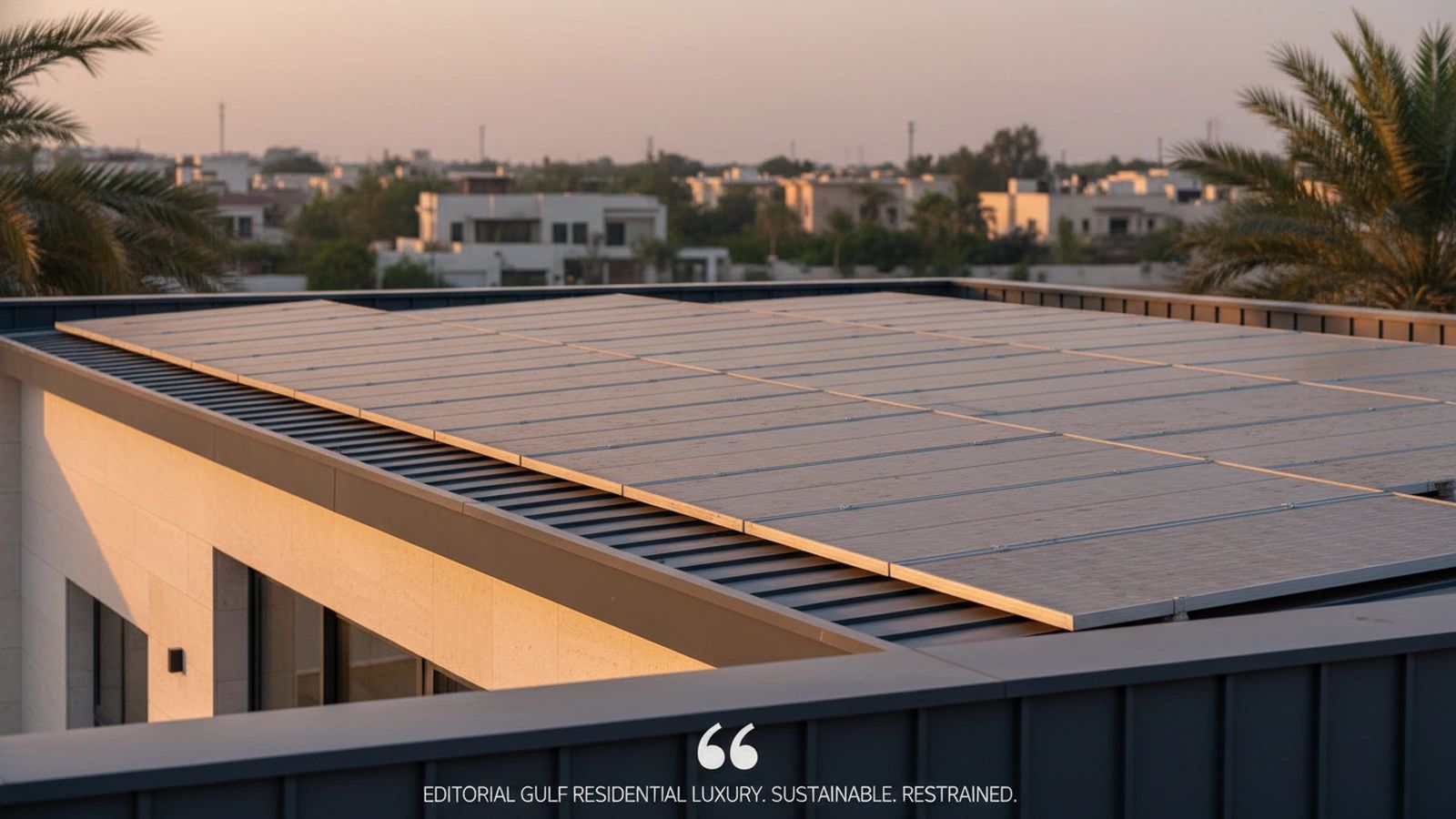
Shams Dubai is DEWA's grid-connected rooftop solar initiative, launched in 2015. The mechanics are straightforward. You install a PV system on your villa roof; DEWA's connection meter measures both consumption and export; excess generation flows back to the grid and earns credit against your bill. Industry guidance from DEWA-approved installers indicates that residential systems under 10 kW currently waive the standard connection fee, and exported energy earns a credit applied to subsequent monthly bills.
What this returns at the villa level. A typical Dubai villa with a 5 to 10 kW PV system can reduce its DEWA electricity bill by a meaningful fraction; industry sources put the typical payback period for residential solar in Dubai at 7 to 10 years, after which the system continues to generate for the balance of its 25-year design life. The size that fits your roof depends on shaded area, panel orientation, and how much daytime load your villa runs. The number that matters is not the headline kWh figure on the spec sheet; it is the export pattern, because exported kWh and self-consumed kWh contribute to your savings differently.
This is where a smart home pays attention. If your villa shifts heavy loads (pool pump, EV charging, laundry, water heating) into daylight hours, more of the solar generation is consumed on-site, which is the highest-value kWh. Without scheduling logic, those loads run on whatever cycle was set on installation day in 2014 and the solar export just leaves the property. The dashboard layer that runs your KNX system can move that needle. We covered the broader climate-control angle in our predictive comfort piece; the same logic applies to every controllable load in the house.
Al Sa'fat 2.0: the Dubai Municipality green building system
Al Sa'fat is Dubai Municipality's green building rating system, originally introduced in 2014 and now in version 2.0. The system grades buildings on four tiers: Bronze, Silver, Gold, and Platinum. The critical change for 2026 is that Silver is mandatory for every new Dubai Municipality building permit. Bronze is no longer the floor; Silver is.
For private villas, this matters whether you are building new or renovating. Industry guidance indicates that structural additions exceeding 50% of existing BUA also trigger Al Sa'fat 2.0 Silver compliance, which means a major extension to an existing villa is no longer a way to avoid the framework. The Sustainability Statement is now part of the Building Permit System submission; the Building Completion Certificate is gated on confirmed compliance.
The technical envelope rules are tight. External walls must hit a U-value of 0.57 W/m²K or better; roofs and ceilings 0.30 W/m²K or better; glazing 2.0 W/m²K or better with a Solar Heat Gain Coefficient of 0.25 or lower. New villa construction also targets 20% energy savings against baseline, plus water-efficient fixtures and low-VOC materials.
What this returns at the villa level. Silver is the entry ticket. The financial upside sits at Gold and Platinum, where Dubai Municipality offers reduced municipal fees, expedited permitting, and access to low-interest green financing to cover the cost gap of higher-spec materials and systems. The Silver Sa'fa certificate, once issued for a private villa, is valid indefinitely. That permanence is part of the value; you do not re-certify every few years.
Where smart home and Al Sa'fat meet. The 20% energy-savings target is dramatically easier to hit with proper lighting control, climate scheduling, and per-zone occupancy logic than with envelope optimisation alone. The envelope rules cut heat gain; the automation cuts wasted run-time on cooling and lighting. They compound. Our Al Sa'fat 2.0 compliance article covers the automation overlap in more detail.
Etihad ESCO: the retrofit financing model
Etihad ESCO is DEWA's energy services company, established in 2013. It operates as a Super ESCO that finances and delivers retrofits, then recovers the cost from the guaranteed savings over the contract period. The model has historically focused on government buildings and large commercial assets; the residential track-record includes a notable program that installed PV, LED lighting, and water-saving fixtures across thousands of Emirati villas in Dubai.
What this returns at the villa level. The Etihad ESCO mechanism is more relevant if your villa is part of a wider portfolio (a community, a developer-managed compound) or a UAE national homeowner programme than for a standalone owner today, but the framework is worth knowing because the Energy Performance Contracting (EPC) approach is the template Dubai is scaling. You commit no upfront capital; the savings pay back the work over time.
The three programs in one decision
A villa owner planning a renovation or new build in Dubai in 2026 is making three decisions at once whether they realise it or not. Al Sa'fat 2.0 sets the floor on envelope and equipment. Shams Dubai sets the upside on energy generation. Etihad ESCO and similar financing structures set the path on cash flow. Smart-home automation runs underneath all three because it is what makes compliance measurable, solar self-consumption optimal, and retrofit savings provable on a monthly basis.
What we typically see in our villa projects when these conversations happen separately is duplicated work; the design team designs to Al Sa'fat, the solar contractor designs to maximum panel count, the automation gets added at the end as a finishing-touch line item. Done that way, the three programs do not compound. Done together, with the dashboard layer designed in early, they do. The villa value piece covers how this lands on resale.
FAQ
Are Dubai smart building incentives only for new villas?
No. Shams Dubai applies to existing villas with suitable roof space. Al Sa'fat 2.0 Silver compliance is triggered for new permits and major structural extensions, and Etihad ESCO retrofits target existing stock specifically.
Is there a DEWA smart home rebate per se in 2026?
There is no direct cash rebate from DEWA for installing a smart home automation system in 2026. The financial return comes via Shams Dubai net metering credits on your electricity bill and through reduced consumption that lower bills directly.
What are the Al Sa'fat incentives for a villa above the Silver mandatory tier?
Gold and Platinum villas may qualify for reduced municipal fees, expedited permit approvals, and access to low-interest green financing. The exact incentive package is administered by Dubai Municipality and varies by project type.
Does a smart home help with Al Sa'fat compliance?
Yes. The 20% energy-savings target for new villas is straightforward to hit when lighting, climate, and shading are automated against occupancy and daylight. Envelope rules cut peak load; automation cuts wasted run-time. They compound.
Can a single contractor handle Shams Dubai, Al Sa'fat, and automation together?
Rarely under one roof, but the design coordination matters. We typically partner with solar installers and Al Sa'fat consultants while leading the automation backbone, with KNX wired and the dashboard layer specified during the design phase rather than retrofitted at handover. See our villa energy management service for what that dashboard layer includes.
If you are planning a villa renovation or new build and want to walk through how these three programs intersect on your specific project, we are happy to help. Reach us at projects@hauslogic.io or +971 54 764 6619.