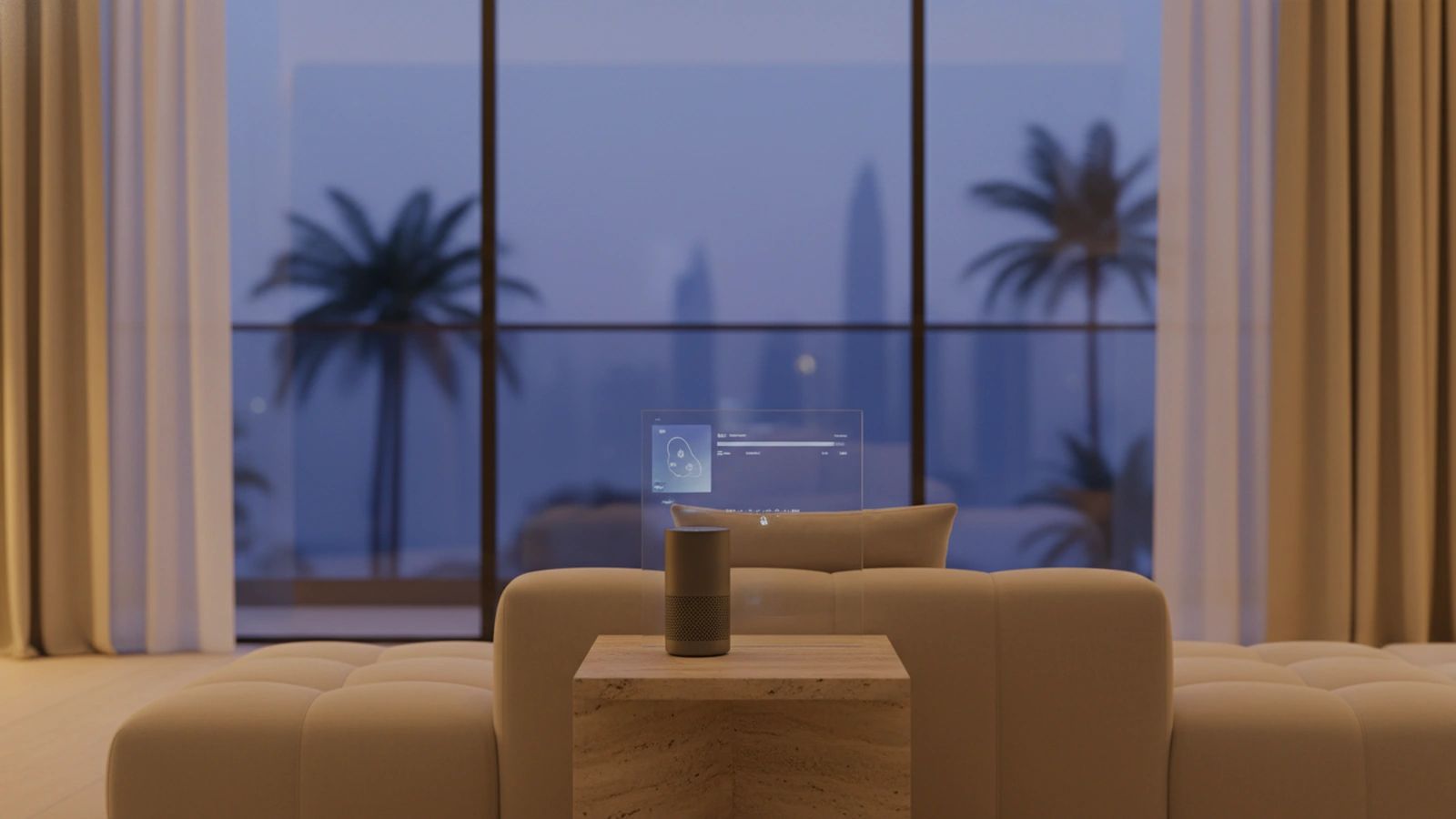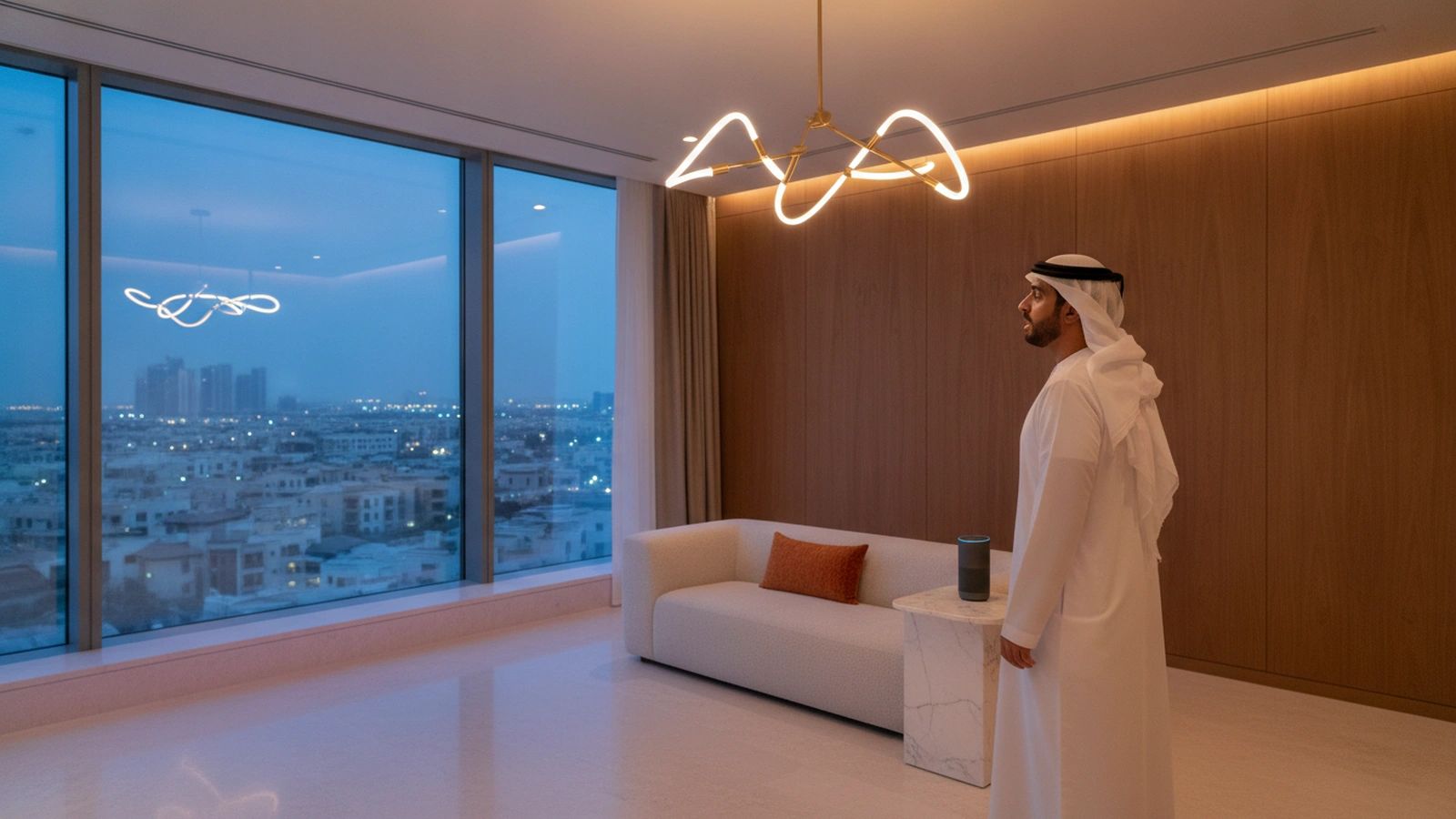
Your father visits your villa for the weekend. He walks into the majlis, asks the room in Arabic to turn on the lights, and nothing happens. You repeat the same request in English and the scene fires instantly. In a city where most households move between Arabic and English in the same sentence, that small failure says something important: the smart home industry has not kept pace with how Dubai actually speaks.
If you are evaluating Arabic voice control for a smart home in Dubai, the honest starting point is this: in 2026, only one of the three major voice platforms natively speaks Arabic on a smart speaker. The other two either limit Arabic to the phone in your pocket or do not offer it at all. Which platform you choose decides whether half your household can talk to the house.
Arabic Voice Control in a Dubai Smart Home, the 2026 Scorecard
Alexa: the only smart speaker that answers in Khaleeji
Amazon announced Alexa for the UAE in December 2021 with a localized Arabic experience, and it remains the only major platform whose speakers hold a conversation in Arabic. The implementation went deeper than a translation layer: Alexa understands both Modern Standard Arabic and Khaleeji, and replies in MSA for formal information requests while using Khaleeji for casual confirmations. At launch it carried nearly 200 regional skills, including one from DEWA.
For a bilingual villa this matters in practice, not just on a spec sheet. A household member can ask for lights, climate, or prayer times in the dialect they actually speak at home, and the device responds in kind. An Amazon-commissioned survey of UAE and Saudi users published in 2025 reported that a majority want assistants to understand local accents and expressions, with Khaleeji the most requested dialect. The demand is not niche; it is the mainstream of this market.
Google: capable assistant, but the speakers still skip Arabic
Google Assistant on Android phones has handled Arabic for years. The speakers are a different story. Google's own language list for Nest speakers and displays still leaves Arabic out, and the new Gemini for Home assistant, which is gradually replacing Assistant on Google's speakers, launched its rollout with ten languages across sixteen countries, none of them Arabic. Translation features inside Gemini do cover Arabic, but translating a phrase is not the same as running your home in it.
We covered what Gemini does and does not bring to a KNX household in Gemini in Google Home: Where It Helps, and Where It Stops. The short version stands: strong reasoning in English, no Arabic voice path on the speaker hardware yet.
Apple: Siri speaks Arabic on your iPhone, but HomePod stays silent
Siri has supported Arabic since iOS 9.2 back in 2015, and an iPhone set to Arabic will happily run HomeKit scenes by voice. The gap is the speaker on the shelf: Apple's published HomePod language list still does not include Arabic. So an Apple-centred villa gets Arabic voice control only through a phone or watch, not through the room itself. For many households that is workable. For a guest, a parent, or a child without a configured device, it is not.
Why the Speaker Is the Wrong Place to Anchor the Decision
Here is the trap we see villa owners walk into: they pick the automation platform based on which voice assistant the showroom demoed. The voice assistant is the most replaceable component in the entire system. The wiring behind your walls is the least.
A KNX backbone treats every voice platform as an interchangeable interface. Alexa, Siri, and Google all connect to KNX through certified gateways, and Haus Logic's custom dashboard sits above the same bus, so the voice layer can change without touching a single cable or actuator. When Google eventually ships Arabic on its speakers, or Apple adds it to HomePod, a KNX villa adopts the upgrade with configuration work, not construction work. A villa locked into one vendor's ecosystem waits for that vendor's roadmap, in whatever language the vendor chooses. We laid out how the major systems compare on exactly this kind of flexibility in KNX vs Control4 vs Lutron vs Loxone.
Think of bilingual readiness in three stages:
Stage 1: English-only voice. One assistant, one language. Fine for a single-language household, brittle for a Dubai one.
Stage 2: Bilingual voice on mixed hardware. Echo devices handle Arabic in the rooms where Arabic speakers spend time; Siri on iPhones covers personal requests; the KNX bus executes everything identically regardless of which assistant asked. This is the practical 2026 configuration, and it works today.
Stage 3: Language-agnostic orchestration. The home runs primarily on schedules, sensors, and scenes, and voice becomes the exception rather than the interface. At this stage the language question fades, because a well-programmed villa rarely needs to be asked for anything. In our experience most villas settle into this stage within the first year of living with the system.
What We Specify for a Bilingual Villa
When a client tells us the household speaks Arabic and English, the specification conversation changes in three concrete ways.
First, room coverage follows language. Echo devices go where Arabic-first family members live their day: the majlis, the kitchen, grandparents' rooms. There is no premium for this; it is placement, not extra kit.
Second, scene names get chosen for bilingual mouths. A scene called "movie night" is easy in either language; a scene named after an English idiom is not. Small detail, large difference in daily use.
Third, the contract names the integration explicitly. Voice platforms, gateway model, and which rooms carry which assistant should all appear in your specification before you sign, the same way we advise scrutinising any integrator's paperwork in How to Verify Your KNX Integrator in Dubai. If the proposal just says "voice control included", ask in which language.
FAQ
Can I control a KNX villa in Arabic today?
Yes. Pair the KNX system with Echo devices through a certified gateway and the rooms with Echo coverage respond to Arabic, including Khaleeji. The KNX side neither knows nor cares which language triggered the command.
Does Google Home support Arabic voice commands on its speakers?
Not natively as of mid-2026. Google Assistant on Android phones supports Arabic, but Nest speakers and the new Gemini for Home rollout do not yet list Arabic among supported voice languages.
Can Siri run my smart home in Arabic?
On an iPhone or Apple Watch set to Arabic, yes, including HomeKit scenes. HomePod speakers do not currently offer Arabic, so room-level Arabic voice in an Apple home still routes through personal devices.
Will I need to rewire anything when another platform adds Arabic?
Not on a KNX backbone. Voice assistants connect through gateways at the integration layer, so adopting a new platform is a configuration exercise, not a wiring project. You can see how that integration layer fits into our home automation solutions in Dubai.
If you are weighing up voice options for a villa where Arabic and English share the dinner table, we are happy to walk through a room-by-room plan that works for everyone in the house. Reach us at projects@hauslogic.io or +971 54 764 6619.