You open your DEWA app on the first of the month, glance at the total, and pay it. You always have. The number is bigger than last year, the year before was bigger than the one before that, and you have stopped asking why. The line item people debate is electricity. The line item people complain about is housing fee. Sewerage sits between them on the bill, quiet, growing every January, and almost nobody is reading it.
In a Dubai villa, sewerage is the line item you should be reading.
The 40 second answer
The Dubai sewerage charge for residential properties is being phased up in three steps. It moved from 0.5 fils per imperial gallon in 2024 to 1.5 fils per gallon in 2025, climbs to 2 fils per gallon on 1 January 2026, and reaches 2.8 fils per gallon on 1 January 2027. Sewerage is billed on the same volume your water meter reads, so the increase compounds with consumption. A villa that uses 100 cubic metres of water in a summer month pays roughly AED 4.40 per cubic metre in sewerage in 2026, on top of the water tariff itself. Water, like electricity, only gets managed when it is metered, which is why whole-villa automation treats irrigation and consumption monitoring as one system with the AC and lighting.
What the sewerage line actually is
Every drop of water that enters your villa is metered by DEWA. The same volume is assumed to leave through the sewer network, get carried to a Dubai Municipality treatment plant, processed, and either irrigated back into landscape or returned to the system. The sewerage charge funds that downstream half of the journey, which most people forget exists because it happens behind a wall they never see.
For decades the sewerage rate barely moved. The 2025 increase, announced by Dubai Municipality and reported in Time Out Dubai, is the first material change in ten years. It funds infrastructure upgrades for the city's population trajectory; the underlying treatment plants, pumping stations, and trunk mains were sized for a smaller Dubai than the one we live in now.
The schedule, in the units DEWA still publishes them in, is:
- 2024: 0.5 fils per imperial gallon
- 2025: 1.5 fils per imperial gallon
- 2026: 2 fils per imperial gallon
- 2027: 2.8 fils per imperial gallon
That is a five and a half fold rise across three years off the 2024 baseline. The 2026 number is the one on your bill right now.
Why the DEWA sewerage fee in a Dubai villa hits harder than in an apartment
A one bedroom apartment in Dubai uses roughly 7 to 15 cubic metres of water in a month. A villa without a pool uses 45 to 60. A villa with garden and pool can run 100 to 150 in July and August. The sewerage line scales linearly with that volume, and the increase is multiplicative on a base that is already five to ten times what the apartment is paying.
On the 2026 rate, one cubic metre of consumption translates to about AED 4.40 in sewerage alone, because one cubic metre is roughly 220 imperial gallons. A 100 cubic metre summer month means around AED 440 in sewerage on its own, on top of the water slab charge, the housing fee, electricity, fuel surcharge, and VAT. In 2027 the same month lands closer to AED 616 in sewerage. Same water bill. Same villa. Same family.
DEWA moved its primary water unit from imperial gallons to cubic metres in March 2025 (the regulator's own Consumer FAQ confirms it), but the sewerage rate is set by Dubai Municipality and is still expressed in fils per gallon. If you read your bill in cubic metres only, you will not see the rate; you will only see the dirham line, climbing each January without comment.
Where the housing fee fits
While you are looking at the bill, check the housing fee line. Dubai Municipality bills 5 percent of the property's annual rental value through DEWA, split into twelve equal monthly instalments (the Bayut explainer covers the mechanics). The rate has not moved since 1999; what has moved is rental valuations across most villa communities, which is why the dirham figure on your line has climbed even though the percentage has not.
Housing fee is the line item people debate. Sewerage is the line item people miss while debating it. In a typical Dubai villa, the sewerage charge is on track to become the second largest variable line after electricity by 2027, with no further announcement required.
What an automated villa can actually do about it
Sewerage is calculated from the cold water meter. There are two real levers a villa owner has: reduce the volume of cold water entering the villa, or reduce the volume that is unnecessarily lost. Both are exactly what a properly designed KNX system, with submetering and a dashboard layer, is built to surface.
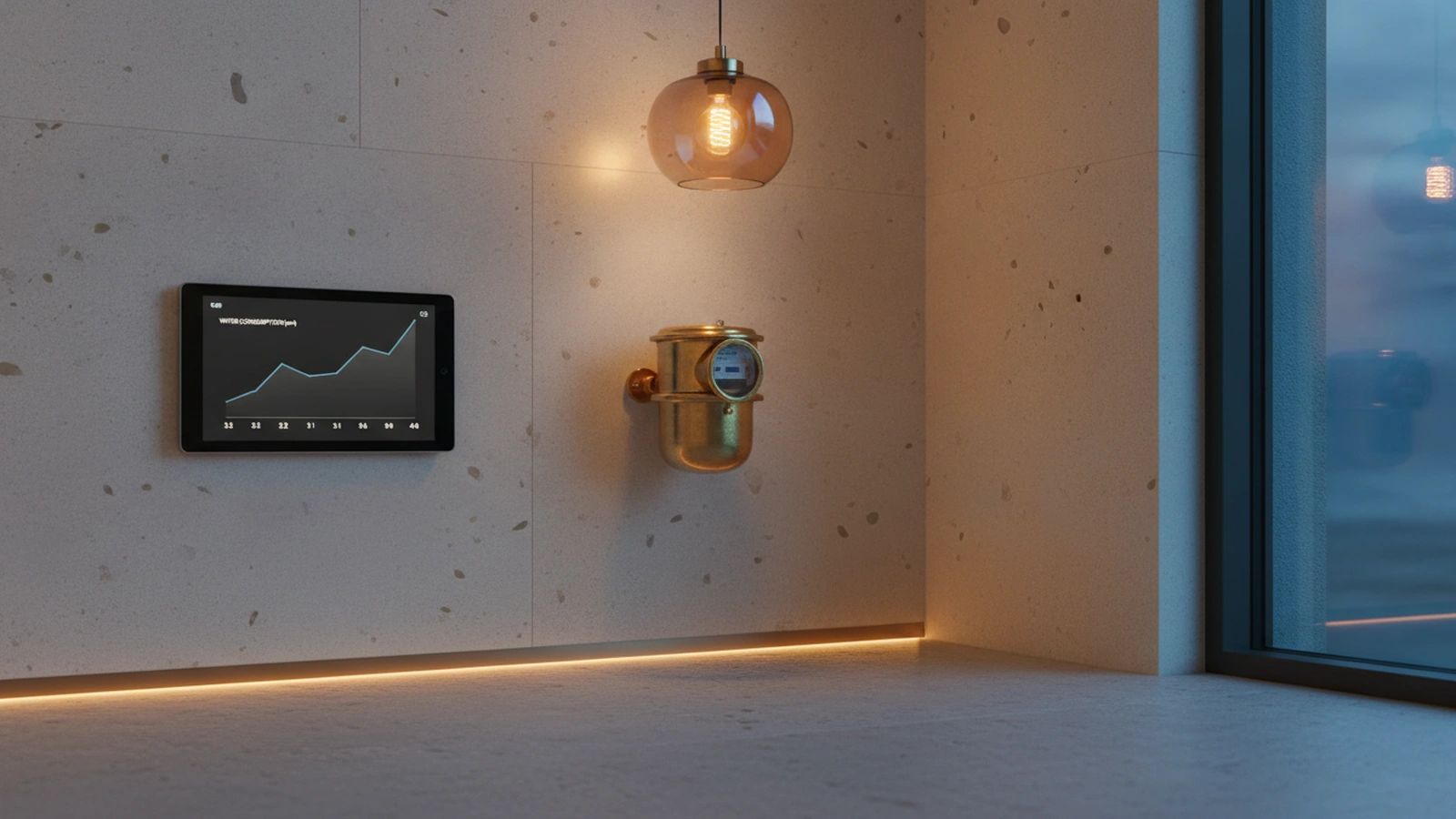
A KNX villa we commissioned in Al Barsha South runs flow meters on the three main cold water branches: domestic, irrigation, and pool top up. Each branch is metered separately, totalled hourly, and graphed on the home owner's dashboard. Two months in, the irrigation number flagged a leaking 25 mm drip line in the rear garden that was running through the night for four weeks. The dashboard caught it. Without it, that 4 cubic metres a day would have continued to bill at the sewerage rate, the water rate, and the next slab boundary, for as long as the line stayed buried.
You do not need pool, garden, and domestic split to start. Even a single inline cold water flow meter feeding the dashboard, with a daily and monthly threshold, is enough to flag the unusual. The hardware cost is two figure dirhams; the bill exposure it protects against, on the 2027 sewerage rate, is four figure annually for a leak that runs unnoticed. This is exactly the class of problem our energy and water monitoring dashboards are designed to catch early.
We have written about the AC side of this same logic in AC Zoning and DEWA Savings in a Dubai Villa; cold water meters extend the same approach to the water bill.
The decision sitting on your bill
A 2026 DEWA bill on a typical Dubai villa is paying for the same water it always did, charged at a higher sewerage rate, with another step coming in seven months. The question is not whether the rate is fair; Dubai's wastewater infrastructure needs the upgrade and the city is not going to subsidise it from the central budget. The question is whether your villa has any visibility into what is actually flowing through the meter, or whether you find out about a problem when the bill arrives.
A KNX villa with submetering does not save sewerage charges by lobbying the regulator. It saves them by making the volume legible to the owner, the moment it moves.
Where to start
If your villa was wired with KNX from build, the cold water flow meter is usually a one day retrofit on the main inlet. If your villa was not, the dashboard layer can sit on top of a hybrid setup; we have done this on several existing villas across Emirates Hills and District 9, and the Smart Home Hubs guide walks through the three architectures we recommend for retrofits.
If you are curious about what the right answer looks like for your villa, we are happy to walk through the options.
FAQ
Is the sewerage charge the same as the housing fee?
No. The sewerage charge is consumption based and scales with the volume of water you use. The housing fee is rental value based and scales with the assessed rent of the property; it does not move with how much water or electricity you consume.
Why is sewerage still billed in fils per gallon when water is in cubic metres?
DEWA changed the primary water unit to cubic metres in March 2025, but the sewerage rate is set by Dubai Municipality and is still expressed and increased in fils per imperial gallon. The unit on the DEWA bill itself converts back to dirhams against the metered volume; the gallon notation is the rate, not the meter.
Can I appeal the sewerage line?
The rate is regulated and the same for every residential customer in Dubai. What you can dispute is the volume the meter has recorded, if you have a leak or a faulty meter. Both of those are easier to detect when you have submetering and a dashboard reading the inlet every hour.
Does a Shams Dubai solar PV system reduce sewerage charges?
No. Solar reduces your electricity slab and your fuel surcharge. Sewerage is independent of the electricity side of the bill.