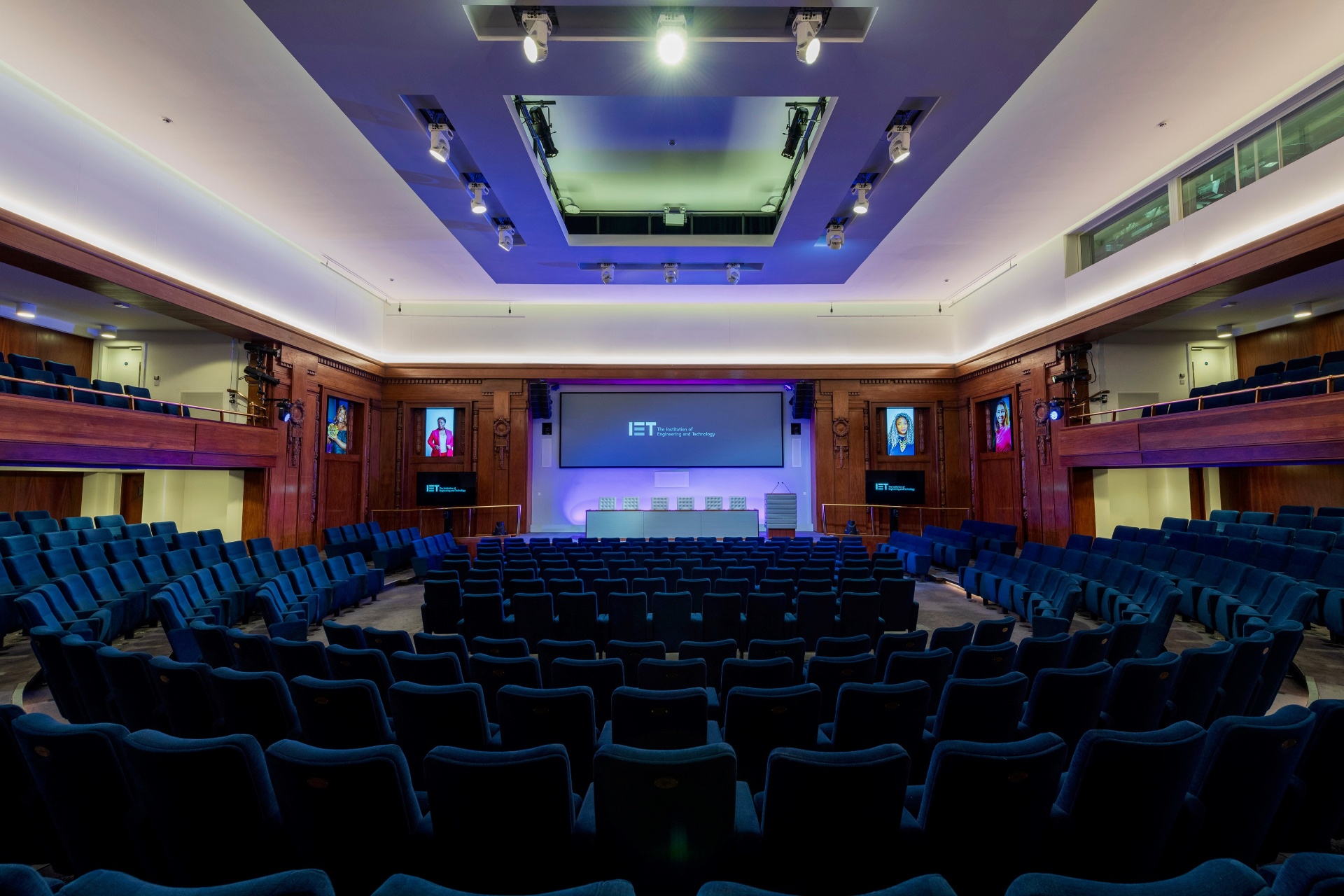
LONDON · 2024 · GRADE II* LISTED
IET Savoy Place, London: full building lighting control retrofit
Nine years of lock‑in, undone.
Six floors of a working London landmark, rebuilt onto an open standard while the lights stayed on. Not one dark night.
The project: Winner, Best Commercial Project, KNX UK Awards 2025Basement to roof, all live
Control modules replaced by KNX panels
£30,000 a year in the published case study, at 4.96 on 11 Aug 2026
Open protocol, serviceable by anyone
The building
A landmark that never closes
Savoy Place has stood on the Thames for over a century, and behind the listed façade it runs like a venue: lecture theatres, conference rooms, kitchens, offices, events most days of the week. There was never a week to close it. The work went floor by floor, basement to roof, stripping the old devices out and bringing the new system up in the same visit. Not one dark night.
The failure
Seven things to fail, in one room
The control system went in with the 2015 refurbishment. Nine years on it was breaking regularly, and every fix ran through one supplier because the protocol was closed. Some rooms carried up to seven separate light control modules: seven things to fail, and one phone number to call when they did.
The replacement
Seven modules become two panels
KNX, built on Zennio hardware, engineered and programmed by our team. Fewer parts, fewer failures, an estimated AED 149,000 a year off the operating budget, about £30,000 in the published source, and ten more years of service life. The result hardest to put a number on: the IET can now have the system serviced by anyone who knows KNX.
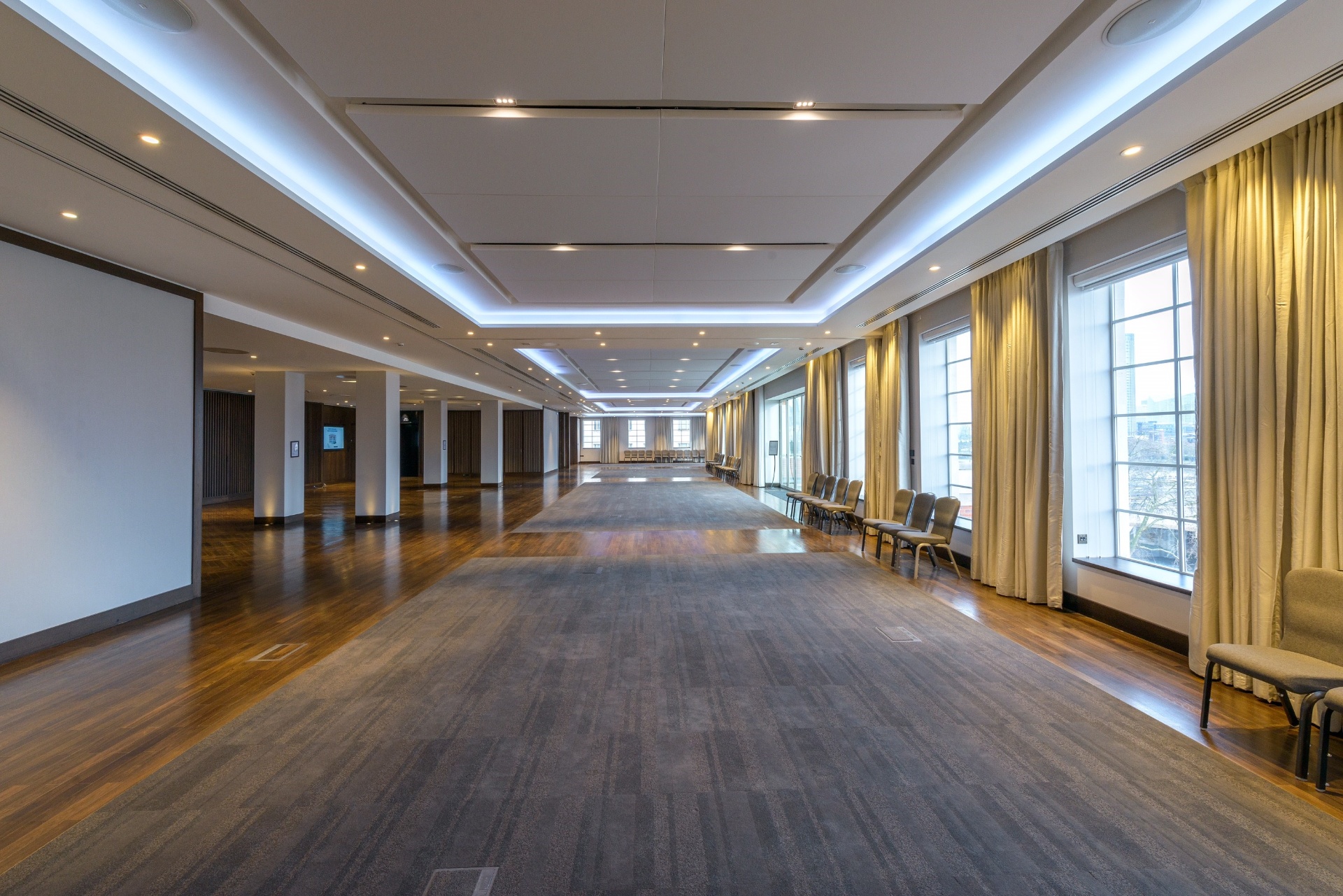
A landmark that never closes
Savoy Place has stood on the Thames for over a century, and behind the listed façade it runs like a venue: lecture theatres, conference rooms, kitchens, offices, events most days of the week. There was never a week to close it. The work went floor by floor, basement to roof, stripping the old devices out and bringing the new system up in the same visit. Not one dark night.
Representative hardware · 06
What went in
Every lighting component came from one manufacturer. Not a preference: a mixed bill of materials means mixed firmware, mixed support paths and a compatibility argument every time something fails.
The published sources name the component categories supplied to Savoy Place, not model numbers. Shown below are current Zennio products of those categories, to illustrate the class of equipment. They are not presented as the units installed in 2024, and some were released after the project completed.
- 01
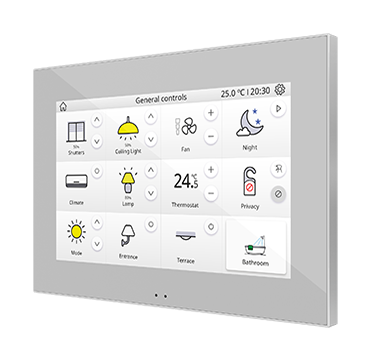 Touch panelZVIZ70V2Representative
Z70 v2
The panel on the wall. Scenes, levels and status in one place, so a room is operated rather than programmed.
In a retrofit the panel is the part the building actually meets. Replacing a closed system means every room's controls change at once, so the interface has to be learnable in seconds by staff who never asked for a new system: scenes named for what the room does, not for circuit numbers. A capacitive panel also has no moving parts, which removes one class of wear from a surface that gets touched constantly.
- Display
- 7" capacitive
- Bus
- KNX TP
- Mounting
- Flush, in-wall
Colour capacitive touch panel with 7" display
- 02
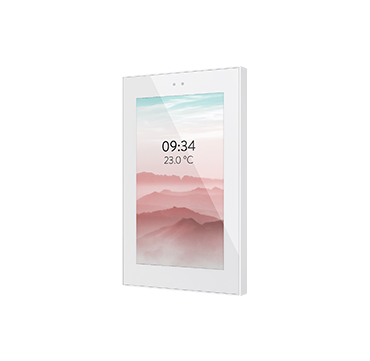 Touch panelZVIZ50Representative
Z50
The same control surface where a smaller plate suits the room, so the interface stays consistent across the building.
The same control surface at a smaller plate size. Consistency matters more than it sounds: a building where the panel in the meeting room behaves differently from the one in the theatre generates support calls forever. Matching the interface across room sizes is how a facilities team ends up able to operate every space without a manual.
- Display
- 5" capacitive
- Bus
- KNX TP
- Mounting
- Flush, in-wall
Colour capacitive touch panel with 5" display
- 03
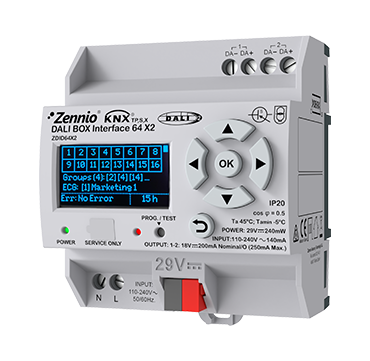 DALI interfaceZDID64X2Representative
DALI BOX Interface 64 x2
Addresses fittings one by one instead of by circuit. This is what lets a single luminaire change without an electrician moving a wire.
This is the device that makes individual luminaires addressable. Without a DALI layer, lighting is controlled by circuit, so changing one fitting's behaviour means an electrician moving a wire in a ceiling void. With it, a fitting is a software address: a room can be re-zoned, a scene re-balanced, or a failed ballast identified by number, from a laptop. In a listed building where opening ceilings is slow, expensive and sometimes not permitted, that distinction is most of the value.
- Channels
- 2
- Ballasts
- Up to 64 per channel
- Mounting
- DIN rail
KNX-DALI interface for up to 64 ballasts per channel, 2 channels
- 04
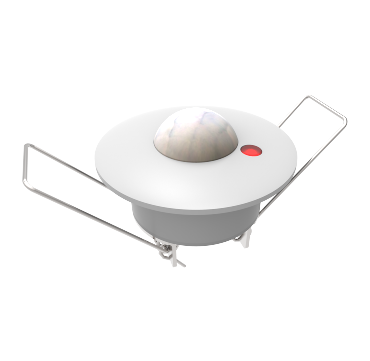 Presence detectorZPDMDXRepresentative
Motion Detector X
Light follows occupancy rather than the clock, which is where most of an operating budget quietly goes.
Occupancy sensing is where the operating figure actually comes from. Timeclocks light empty rooms; presence detection lights occupied ones. In a venue whose booking pattern changes weekly, no schedule written in advance is correct for long, which is why a saving projected from scheduling alone rarely survives contact with a real building.
- Sensing
- Presence and movement
- Bus
- KNX TP
- Mounting
- Ceiling
Motion detector
- 05
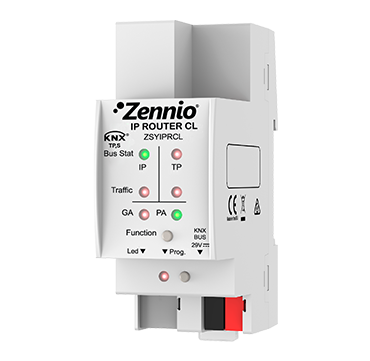 IP routerZIPRTCLRepresentative
IP Router CL
Carries the bus across six floors and puts the system on the network, which is how it reaches a phone at all.
The router is what turns a control bus into something reachable. It couples KNX lines over the building's IP network, so a system spanning six floors is addressed as one rather than as separate islands, and it is what a phone or tablet connects through. It is also the commissioning path: an engineer can work on a line from anywhere on the network instead of walking to the panel.
- Function
- KNX to IP routing
- Bus
- KNX TP
- Mounting
- DIN rail
KNX-IP router
- 06
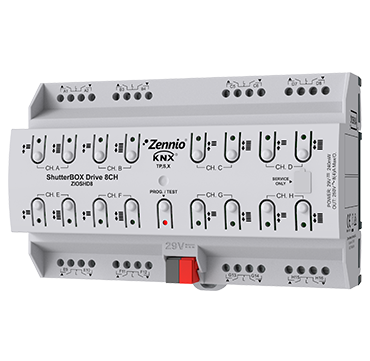 Blind and shutter actuatorZIOSHD8Representative
ShutterBOX Drive 8CH
Daylight handled on the same bus as the lighting, so blinds and fittings stop working against each other.
Blinds belong on the same bus as the lighting, not on a parallel system. When they are separate, the two fight: blinds close while the lights are dimming for daylight, and the room ends up darker and more expensive at the same time. Automatic travel-time measurement matters in a heritage building because shading runs are rarely uniform, and a controller that learns each one avoids commissioning every position by hand.
- Channels
- 8
- Feature
- Automatic travel time
- Security
- KNX Secure
8-channel shutter actuator with automatic travel time measurement and KNX Secure
One manufacturer, one bill of materials, one support path. We specify, supply and commission Zennio hardware on our own projects, so a client is not managing a distributor and an integrator separately, and a designer is not chasing two lead times.

Dealer · Brand ambassador · Integrator
Zennio, specified and supplied.
Zennio is the KNX platform we standardise on, and we are a Zennio dealer, so we can supply the hardware as well as commission it. One account, one lead time, and one number to call when a panel needs looking at. If you are specifying Zennio on a project in the UAE, you do not need a separate supplier and integrator.
Talk to us about a Zennio specificationControl without constraints
Several systems were evaluated. KNX won on one criterion above the rest: as an open standard it lets the building choose who installs, maintains and adapts it. The old system could only be touched by the people who put it in.
- 01Lower ongoing maintenance costs
- 02Long-term flexibility and scalability
- 03An extended system lifespan
- 04Reduced operational expenditure
- 05Servicing by any qualified provider
- 06Internationally recognised reliability
Full command from any room
Control routes through a KNX panel to a central server, reachable from a phone or tablet anywhere in the building. Maintenance simplified, operations smoother, and a system built to evolve with the space rather than freeze it.
“The new lighting control system has provided us with better control, reliability and reduced maintenance costs.”
A London office is not a Dubai villa. The lock-in is.
The building was different; the failure was not. A closed system is a closed system, and it costs the same way in a Jumeirah villa as it does on the Thames: one supplier, one price, one waiting list, and no way out without opening the ceilings again. The programme and the interfaces are not the same; the protocol risk is.
The window to avoid it is the pre-wire. Once the ceilings close and the joinery goes in, the topology is fixed and every change becomes a variation. We work to your electrical contractor's drawings, and we do not approach your client.
What is the one constraint on your current villa project?
One line is enough. It reaches an engineer, not a mailbox.
Send us the drawings before the ceilings close.
Send your GA and MEP single-line drawings. We will mark the KNX drops that are missing, the zones that will not switch the way the design intends, and the points where the lighting and shading topology will fight the joinery. You get the marked-up set back; nothing else follows unless you ask.
The same engineering, in Dubai.
Fifteen years of KNX, and a team that has done this in buildings that could not go dark.
Arrange a private consultation