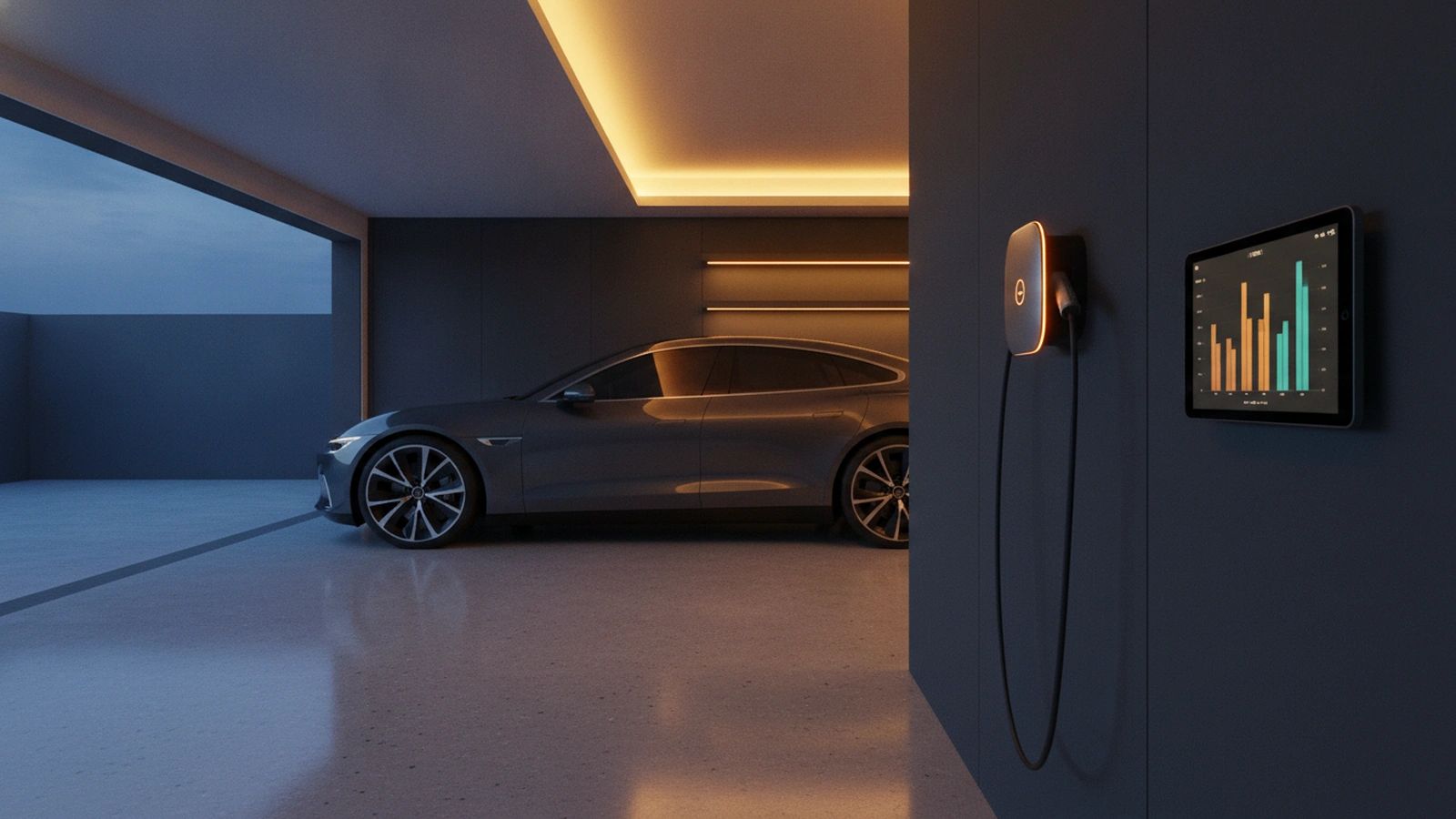
You bought the EV. The charger sits in the garage. The first DEWA bill after install lands and the number is bigger than the dealership made it sound. Not catastrophically bigger; just enough that you start looking at the line items, then at the slab brackets, then at the question nobody at the showroom answered: what does this thing actually do to my bill, every month, for the next ten years.
Most Dubai villa owners are paying more than they need to for EV home charging. Not because the cost per kilowatt-hour is wrong, but because nothing in the villa is coordinating the charger with the rest of the loads. The fix is not a different charger. The fix is a wired backbone that knows when the AC is running, when the pool pump is on, and which side of a tariff slab the household is sitting on right now. That backbone is the same home automation system that runs the villa's lighting, cooling and metering; the charger just becomes one more load it schedules.
The 40-second answer
In Dubai, residential EV home charging is billed at the standard DEWA slab tariff, which steps from 23 fils per kWh up to 38 fils per kWh as monthly consumption rises. A KNX backbone with EV-charger integration lets the villa cap total household load, schedule charging to off-peak hours, and pause the charger when the AC or pool pump is pulling peak. The savings are not from a different rate; they are from not crossing the next slab and not running the charger when it pushes you into one.
The DEWA tariff structure, in plain numbers
The residential electricity slab tariff in Dubai is progressive. The first 2,000 kWh of monthly consumption are billed at 23 fils per kWh. The next 2,000 (2,001 to 4,000) at 28 fils. The next 2,000 (4,001 to 6,000) at 32 fils. Everything above 6,000 kWh at 38 fils. A fuel surcharge sits on top of the slab rate and DEWA reviews it each quarter.
A typical Dubai villa sits in the third slab during the summer months and in the second slab in the cooler months, depending on size and AC usage. An EV adds anywhere from 200 to 600 kWh per month of charging load, depending on driving pattern. The cost question is not "what is the per-kWh price"; the cost question is "which slab is that extra 400 kWh going to live in".
If your villa runs at 5,500 kWh in July and you add 400 kWh of EV charging, most of the EV kWh is billed at the top-slab rate of 38 fils, because the household crosses from the 32-fil slab into the 38-fil slab partway through the EV load. The same 400 kWh in February, when the household sits at 1,800 kWh, would be billed mostly at 23 fils with the tail spilling into 28 fils. The difference per month, on the same charger and the same car, is roughly AED 50 to AED 60 of pure slab drift.
Why a standalone charger does not solve this
A standalone home charger is a dumb device. It draws as much current as the car asks for, when the car asks for it. If you plug in at 7 PM, the charger pulls 7 to 11 kW for two to four hours, on top of whatever the AC, pool pump, lighting, and kitchen are doing. The chargers themselves are fine; they meet the DEWA-approved spec and the AED 10,000 villa-owner subsidy under the EV Green Charger initiative is real. The problem is the orchestration above the charger, not the charger itself.
DEWA's residential tariff is flat across the day; there is no time-of-use rate that rewards midnight charging on its own. The savings from shifting load come from a different mechanism: keeping the total monthly consumption in a lower slab, and avoiding moments where the EV pulls peak at the same time as the AC.
What KNX integration actually does
A KNX backbone treats the EV charger as one more controllable load on a network that already knows what the AC zones, the pool pump, the irrigation, and the heat-pump water heater are doing. With a KNX energy gateway like the ise SMART CONNECT KNX e-charge II, the charger publishes its current draw to the bus and accepts setpoint commands back from the bus. The villa's energy logic then runs three things in the background that a standalone charger cannot.
First, total-load capping. The villa sets a hard ceiling, for example 18 kW of total household draw. When the AC compressors fire and the pool pump kicks in, the EV charger automatically throttles from 11 kW down to 4 kW. When the AC cycles off, the charger ramps back up. The car still charges; the household never exceeds its capacity ceiling.
Second, slab-aware scheduling. The KNX dashboard reads the running monthly kWh total via the DEWA-approved IMD pulse output. When the household is approaching a slab boundary, the energy logic shifts non-urgent loads, including the EV, to a window that minimises spillover into the next slab. The car is full by the morning; the bill stays in the lower slab.
Third, conditional pause. If the villa runs a solar PV system under DEWA's Shams Dubai program, the EV charger can be configured to charge only when there is surplus generation, or to throttle to match the net export. This turns the EV from a load that competes with the air conditioning into a sink that absorbs PV that would otherwise be exported at the lower feed-in rate.
What EV home charging does to a DEWA bill in practice
A villa that adds an EV without any orchestration typically sees the DEWA bill rise by the cost of the added kWh plus a slab-drift premium of 15 to 25 percent above the per-kWh notional. A villa with KNX-orchestrated charging compresses the rise to the cost of the added kWh at the lower of the two adjacent slabs, with the slab-drift premium effectively eliminated. On a typical 400 kWh per month EV pattern, the monthly delta sits in the AED 40 to AED 80 range. Over ten years, that is a real number; not enough on its own to recover a KNX retrofit, but more than enough to tip the math when KNX is being installed for other reasons and the EV charger comes along for the ride.
The same coordination logic is what makes pre-cooling a Dubai villa pay back on the DEWA bill; a wired backbone earns its keep by being a single brain for every variable load in the house.
What to look for if you are evaluating this
Three things distinguish a real KNX-aware charging setup from a marketing setup.
First, the charger talks to the bus on something more than a dry contact. A relay-only pause input is the floor, not the ceiling. The ise SMART CONNECT family and equivalents publish active power, energy total, and charging session state to KNX, and accept setpoint commands for current limit and charging mode. That bidirectional channel is what makes total-load capping and slab-aware scheduling work.
Second, the energy logic lives on the bus, not in a cloud account. If energy management runs on a third-party cloud service, the day the service changes its API is the day your EV charger goes dumb. KNX logic runs locally; it survives the internet going down, the integrator changing, and the next decade of cloud-product churn.
Third, the IMD is properly placed and properly calibrated. The slab-aware logic is only as good as the running kWh total it reads. We covered IMD placement in How AC Zoning Cuts Your DEWA Bill in a Dubai Villa; the same placement rules apply when the goal is EV-charger coordination.
FAQ
Does DEWA offer a separate EV tariff for home charging?
No. Residential home charging is billed at the standard residential slab tariff. DEWA's EV Green Charger network at public stations is a separate program with its own tariff for public charging.
What is the AED 10,000 subsidy and who qualifies?
The EV Green Charger initiative subsidises home charger installation for villa owners up to AED 10,000 and for apartment buildings with five or more registered EVs up to AED 5,000. The subsidy covers a DEWA-approved charger installed by a DEWA-approved contractor on the customer's side of the meter.
Will KNX integration void the manufacturer warranty on the charger?
Not when done correctly. KNX integration uses the charger's published control interface (Modbus, KNX-IP, or the dedicated KNX gateway product line). It does not require any modification to the charger hardware. The integrator should be a certified KNX Partner and the charger should be on the manufacturer's compatibility list.
Can I add KNX orchestration to an existing standalone charger?
Sometimes. If the charger has a dry-contact pause input, you can implement basic pause-and-resume from KNX without replacing the charger. Full bidirectional integration usually requires a charger from a vendor that publishes a documented control interface, or an in-line KNX energy gateway between the meter and the charger.
If you are pricing a new villa or planning an EV addition to an existing one and you want to see what KNX-aware charging would actually do to your DEWA bill, we are happy to walk through the math on your specific consumption pattern. Start with our overview of KNX-aware energy management for Dubai villas to see what that monitoring layer involves.