You leave for work at 7am with the AC switched off to save electricity. By the time you walk back through the front door at 6:30pm, the villa has been baking for eleven hours. The slab is warm. The walls are warm. The furniture is warm. Every soft surface has soaked up heat. The thermostat now reads 32 to 35 degrees. You drop it to 22; the chillers roar; the system runs flat out until well after midnight. The bedroom is still warm at 11pm. You sleep in front of a fan.
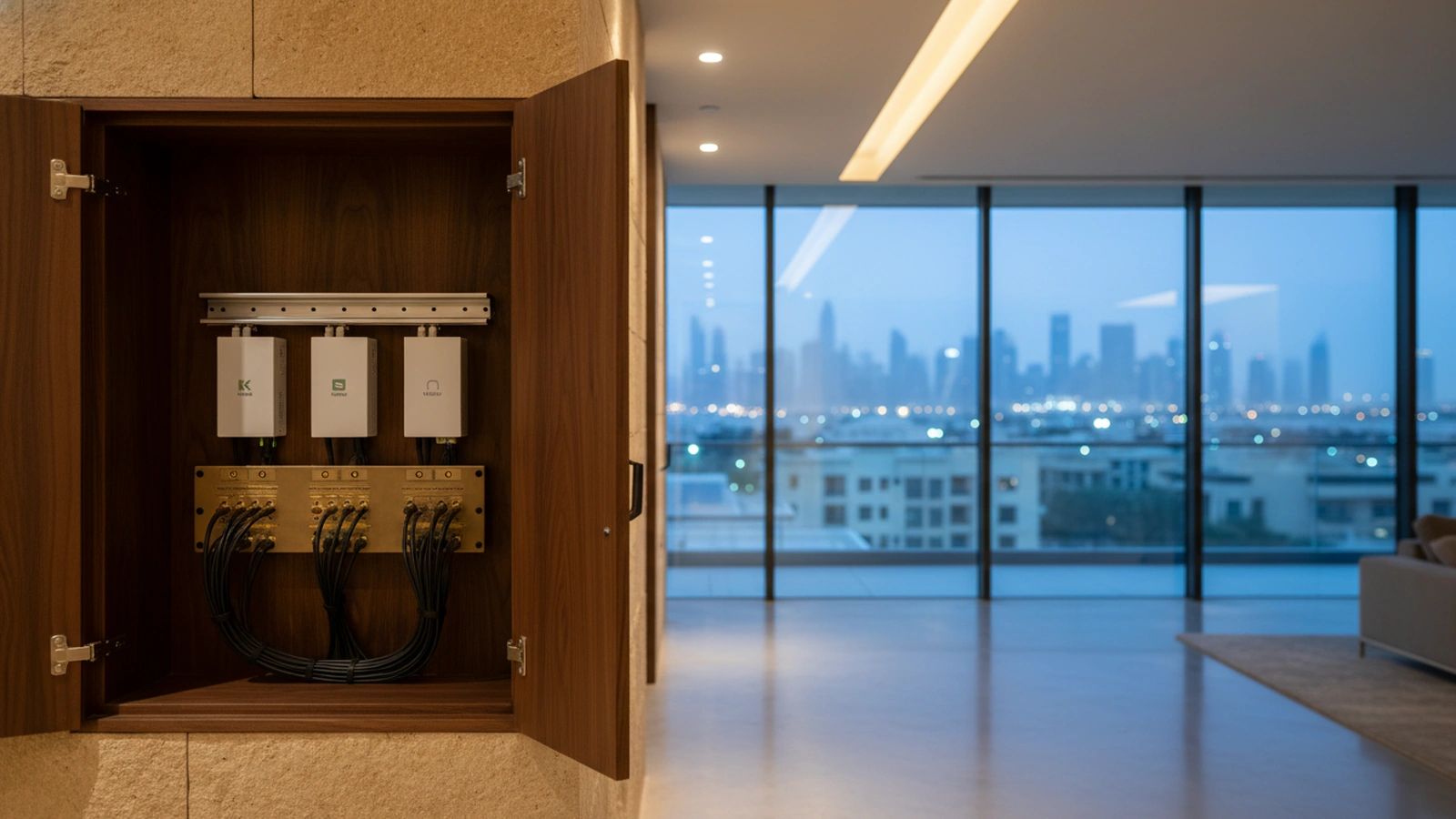
In UAE villas with concrete structure and stone or tile finishes, this is the most common cooling pattern we see, and it is often the most expensive way to run a house. Not because the system is wrong. Because the strategy is. Pre-cooling is a strategy you program once, on the same wired backbone that runs the rest of the villa's automation.
The right answer is usually the opposite of what intuition suggests. In a high-mass villa, you do not save energy by switching off all day. You save it by cooling smartly during the hours that suit the building, and then coasting. That is pre-cooling, and it is one of the biggest levers a modern climate control system in a Dubai villa has to pull.
A caveat up front: this story is about typical UAE villas, with concrete structure, marble or tile finishes, and high solar exposure. A lightweight apartment with good insulation behaves differently, and "off while you are out" can genuinely save energy there. The advice below is calibrated to the high-thermal-mass case.
Why "off all day" usually loses in a villa
Cooling load in the UAE villa stock is dominated by thermal mass and solar gain. Concrete, marble, and tile absorb heat all day. When the AC is off, the slab keeps storing it. When the AC comes back on, every degree the room drops is being fought by every degree the slab is still giving up. The compressor runs longer. The duct work pulls warm air past warm surfaces. The system never gets ahead.
Air conditioning often accounts for 50 to 70 percent of a UAE residential electricity bill during summer. (DEWA, Set Your AC to 24°C; regional cooling-load studies for hot climates) Inside that share, the cost is not flat across the day. The longer the building has been heating up before you start cooling, the more kilowatt-hours you spend reaching the same setpoint. The expensive degrees are the last ones, not the first.
Pre-cooling flips the math. You cool the building when the load is lighter and the cost per useful degree is lower, then you let the slab and the envelope carry you through the peak.
What the research actually shows
Pre-cooling is not a folk theory. It is a well-studied strategy.
Studies on residential and commercial buildings in hot climates show that, in optimised scenarios, pre-cooling can deliver up to roughly 20 to 25 percent cost savings on high-temperature days compared with a "no pre-cooling, ramp up at occupancy" pattern. (Optimum Energy Management for Air Conditioners in IoT-Enabled Smart Home, peer-reviewed research, NCBI PMC) The actual saving you see depends on three things: tariff structure, building type, and control strategy. Treat the high end of that range as what is possible in a well-tuned villa, not what every villa will see automatically.
The savings come from three building-physics effects. The slab and walls absorb cooling capacity while the system is running, which lowers the radiant heat load felt in the room later. On modern inverter systems, the compressor runs at a more efficient load because it is not being asked to drop the air ten degrees in twenty minutes; older fixed-speed units benefit less from that effect, but they still avoid the long flat-out runtime that follows an "off all day" pattern. The evening setpoint is reached without ever running the system flat out.
A note on tariffs worth flagging early: UAE residential electricity tariffs are mostly flat across the day, so pre-cooling here is not the time-of-use arbitrage it can be in other markets. The saving comes from the building physics: smoother cycles, lower delta-T per run, and avoiding the punishing peak strain of a full late-evening recovery from a baked building. Comfort and equipment longevity sit alongside the kilowatt-hours.
Pre-cooling does not mean leaving the AC on all day. It means cooling in a specific window, often a few hours before the building would otherwise need it, and then letting the setpoint drift gently for the rest of the cycle.
DEWA's own published guidance on the cooling side is consistent with this. The official residential recommendation is 24°C; each degree higher on the thermostat saves, as a rule of thumb, around 3 to 8 percent on cooling energy, with roughly 5 percent the figure DEWA leans on publicly. (DEWA, Set Your AC to 24°C) The mistake is not the 24°C setpoint. It is the eleven-hour gap before you re-engage with the building.
A four-stage way to actually do it
We use a four-stage progression when we plan climate control for a villa. The labels matter because they map directly to how the wiring, the thermostats, and the dashboard need to be configured. Each stage delivers more than the last, with diminishing complexity per unit of saving.
Stage 1: manual discipline
Stage 1 is what you do with no automation at all. You leave the AC on a higher setpoint during the day, say 26 or 27, rather than off. You do not let the building bake. You drop the setpoint to your preferred evening temperature about an hour before you arrive home.
It works. It saves money against the "off all day" strategy in a high-mass villa. It also depends entirely on you remembering, every day, for the next ten years. We do not recommend Stage 1 as a long-term plan; we mention it because it is what most UAE villas are still doing.
Stage 2: scheduled control
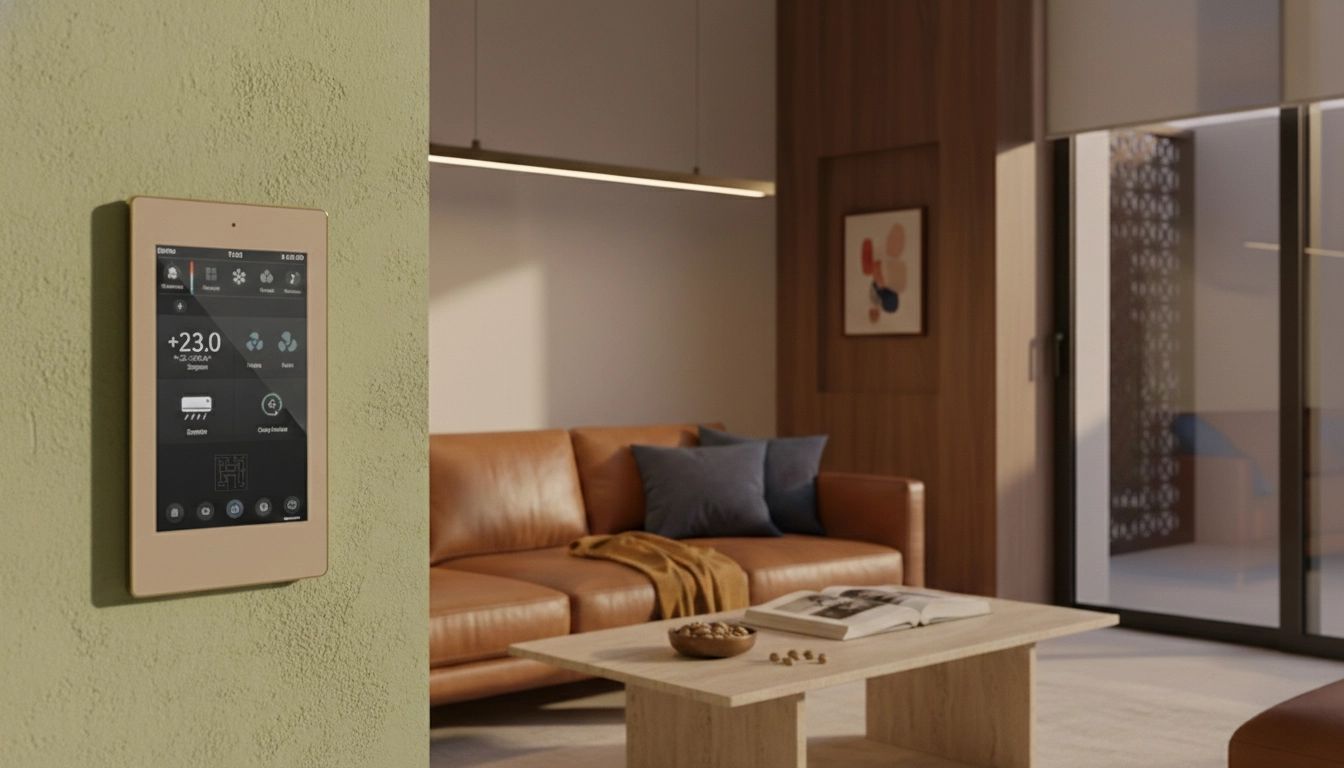
Stage 2 introduces a schedule. The thermostat, or the KNX room controller, holds a higher background setpoint during the day, drops to a pre-cool setpoint for a defined window in the late afternoon, and then settles to the evening setpoint at occupancy.
Stage 2 is the floor we deliver on any KNX climate project. The cost over Stage 1 is essentially nothing once the controllers and actuators are already in. The savings against the "off all day" baseline are real and immediate. We see this consistently in our own monitored projects in Emirates Hills and Dubai Hills.
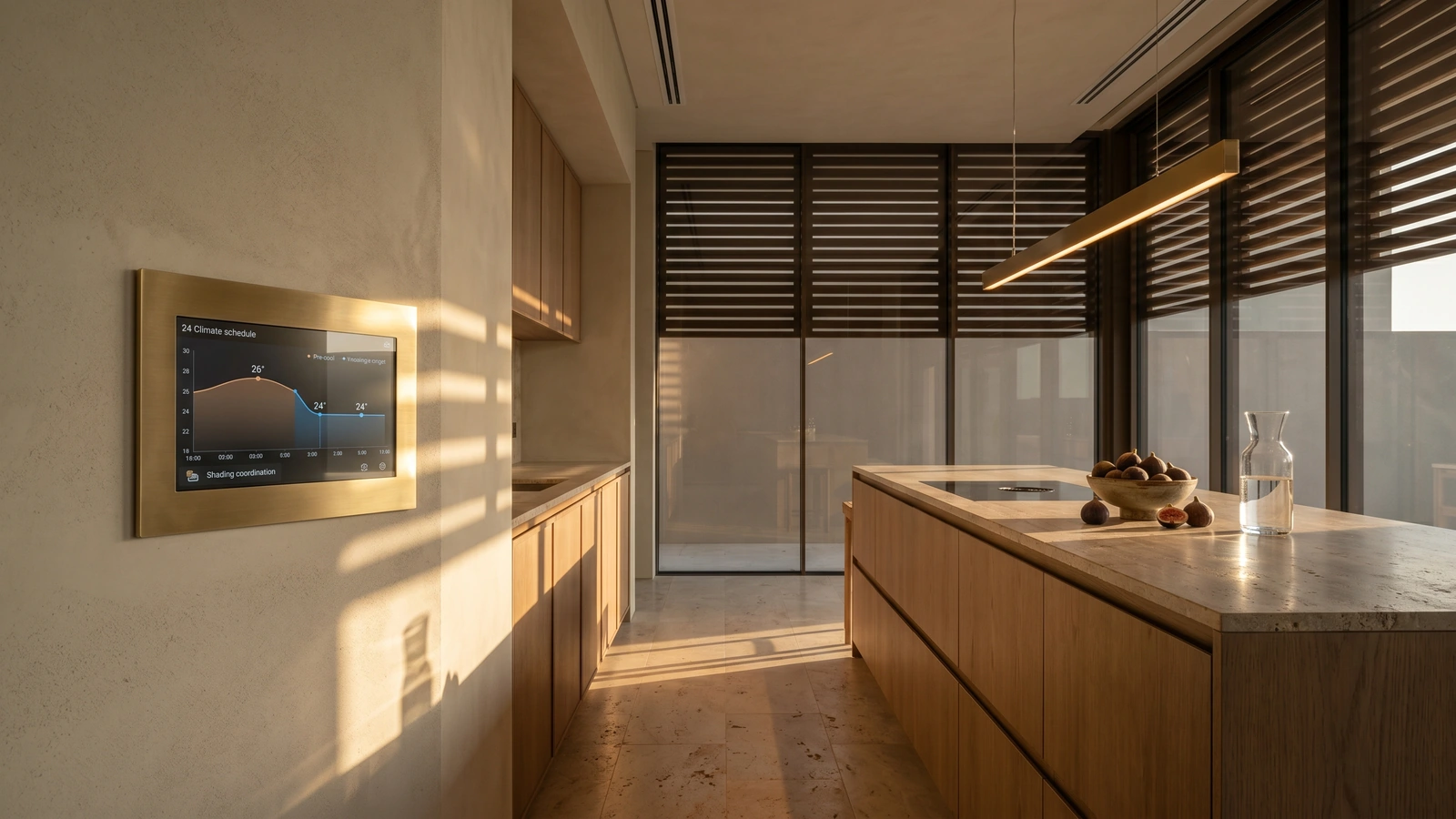
*A wall-mounted climate panel running a Stage 2 pre-cool schedule in a Dubai villa kitchen.*
Stage 3: smart, adaptive control
Stage 3 is where the dashboard layer above KNX, in our case a custom Haus Logic dashboard, starts to earn its place. The schedule stops being fixed.
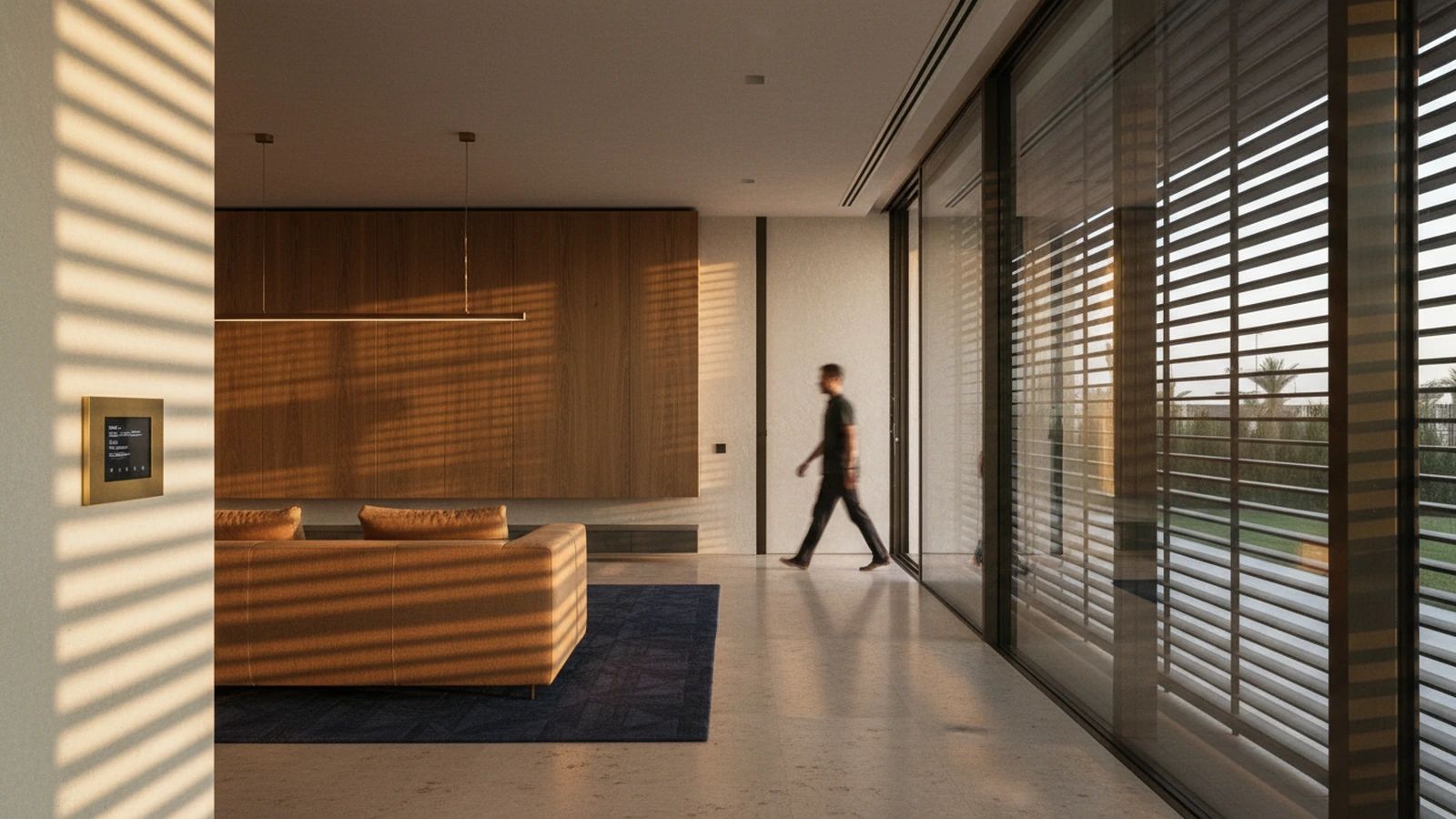
The system reads outdoor temperature, indoor temperature, and humidity. It pre-cools longer on hotter days and skips pre-cool entirely on mild days. It coordinates with the shading, lowering blinds on the western exposure before the late-afternoon solar gain arrives. It pauses cooling in rooms that have not been occupied for a defined window. It logs every cycle so we and the owner can review what worked.
Stage 3 is what we recommend for most villas. It is conservative, well understood, and demonstrably effective. The hardware is the same KNX wired backbone. The intelligence sits in the dashboard above it.
Stage 4: predictive, model-driven control
Stage 4 is the destination, and it is what people have started calling the AI-powered home. The system is not just reacting to today's outdoor temperature. It is using the weather forecast, the building's own thermal response, and learned occupancy patterns to plan tomorrow's cooling profile tonight.
Practically, that means a model that knows your villa's slab heats up at a particular rate, that the upstairs west bedroom is always two degrees warmer than the downstairs east one, that the kitchen draws more cooling on Friday lunches than on Tuesday lunches, and pre-cools accordingly. It also means the system spots a chiller working harder than it should, three weeks before the bill goes up.
The local inference tooling for this is becoming viable. A modern local inference stack, running on hardware that fits in a panel, is now within reach for a residential project; it remains an emerging pattern rather than a market-standard one. We do not always recommend going to Stage 4 immediately. We do design Stage 3 so that the wiring, the metering, and the data model are ready for it.
What this looks like in a real villa
A typical KNX climate setup in a four-bedroom villa, programmed for Stage 3 pre-cooling, will run the cooling at a higher background setpoint during low-occupancy hours, push the building down to a pre-cool target in the late afternoon, lower the blinds on the western and southern exposures before the building feels the gain, and ease to the owner's preferred evening setpoint by the time anyone walks through the door.
The chiller and the indoor units are no different from a standard installation. The thermostats are no more elaborate. The difference is the discipline of the schedule and the data that feeds it. None of this is theoretical. It is what we programme by default.
Which stage is right for you
If you are renting an apartment for a year, none of this is worth a major retrofit. Stage 1 discipline, plus a willingness to leave the thermostat at 24 or 25 during the day, gets you most of the available saving with no hardware change.
If you are an owner-occupier in a villa, Stage 2 is the honest floor. The hardware is already on most KNX projects; the schedule just needs to be programmed. If you have been told your KNX system is "smart" and you cannot point to where the pre-cool window is in the schedule, it is almost certainly not running one.
Stage 3 is the right answer for most villas we look after long term. Stage 4 is for the owner who wants the system to genuinely outperform a careful human.
What to ask if your villa is already built
If your villa already has KNX, the first question is whether the climate logic is genuinely running a pre-cool schedule, or whether the thermostats are simply set to a fixed temperature and left alone. The second question is whether your shading and your cooling talk to each other. The third question is whether anyone is reviewing what the system actually consumes, month over month.
We do these reviews on existing installations, including systems we did not originally install. It usually takes us less than a day on site to read the panel, read the dashboard, and tell you which stage you are operating at and what it would take to move up one.
Where Haus Logic fits
We design and programme climate control as part of an integrated KNX system, with a custom Haus Logic dashboard as the orchestration and monitoring layer above it. Pre-cooling, smart shading, and energy monitoring are part of the standard scope on any villa-scale project we deliver, not optional add-ons. The system works. When something needs attention, we handle it. The owner does not.
If you would like us to look at how your villa is being cooled today, and what a Stage 2 or Stage 3 retrofit would look like, we are happy to walk through it.
Email: projects@hauslogic.io
Phone and WhatsApp: +971 54 764 6619
Pre-cooling is one layer of a broader stack; see how it fits with zoning, sensors, and DEWA-aware scheduling under KNX climate control.