Two villa owners are sitting in a Jumeirah Islands kitchen on a Friday afternoon. One has just bought an Apple HomePod and wants the door lock, blinds, and a few scenes on the Home app for the kids to use. The other is part way through a KNX install for the whole house. The question on the table is the one that gets asked at every smart-home meeting in Dubai right now: do we throw the KNX out and start over on Matter, or do we keep both, and if we keep both, how?
The short version is that this is not a real choice. The longer version is that Matter and KNX are designed to live in the same villa, and the question is only ever about which device is on which side of a bridge.
What Matter actually is in 2026
Matter is an interoperability standard from the Connectivity Standards Alliance, the body that runs Zigbee. The goal is consumer simplicity: any Matter-certified device should work with any Matter-certified hub, regardless of brand. Apple Home, Google Home, Amazon Alexa, and Samsung SmartThings are the four largest ecosystems on the controller side, and Matter is the protocol that lets a single device speak to all of them. (Connectivity Standards Alliance, 2026)
In late 2025 the standard reached version 1.5, released on 2025-11-20. That update did two important things. It introduced camera streaming (a side-channel approach over wifi or ethernet), and it introduced a Device Energy Management cluster that lets smart plugs, appliances, and now solar inverters report and accept dispatch instructions in a standardised way. The 1.4 release before it added solar, battery, heat pump, and water heater device types. (matter-smarthome.de, 2026)
The first 2026 release is incremental: cameras, doorbells, intercoms, plus minor refinements. There is no "Matter 2.0" yet, and headlines that say otherwise are usually compressing one of the 1.x feature drops into a marketing number. (matter-smarthome.de, 2026)
Why this is not a question of "KNX or Matter"
KNX is a wired building-automation standard with a 30+ year installed base. It commissions through ETS. It is what we use for lighting, climate, blinds, scenes, and access in a Dubai villa because it is reliable, vendor-independent, and built to last the life of the building.
Matter is a consumer-facing IP protocol focused on cross-ecosystem interoperability of individual devices. It does not commission in ETS, and it is not designed to run a whole-villa lighting and climate scheme. The two protocols answer different questions. The right pattern in a Dubai villa, in 2026, is KNX on the wired backbone and Matter at the edges, with a bridge between them.
There are now several KNX-to-Matter bridges shipping commercially. The KNX Association supports the pattern, and the bridges work in both directions: a Matter controller (Apple Home, Google Home, Alexa, SmartThings) sees KNX devices as standard Matter accessories. (KNX Association documentation, 2026)
What Matter adds to a villa already running on KNX
Three concrete additions, in order of how much they matter for a Dubai owner.
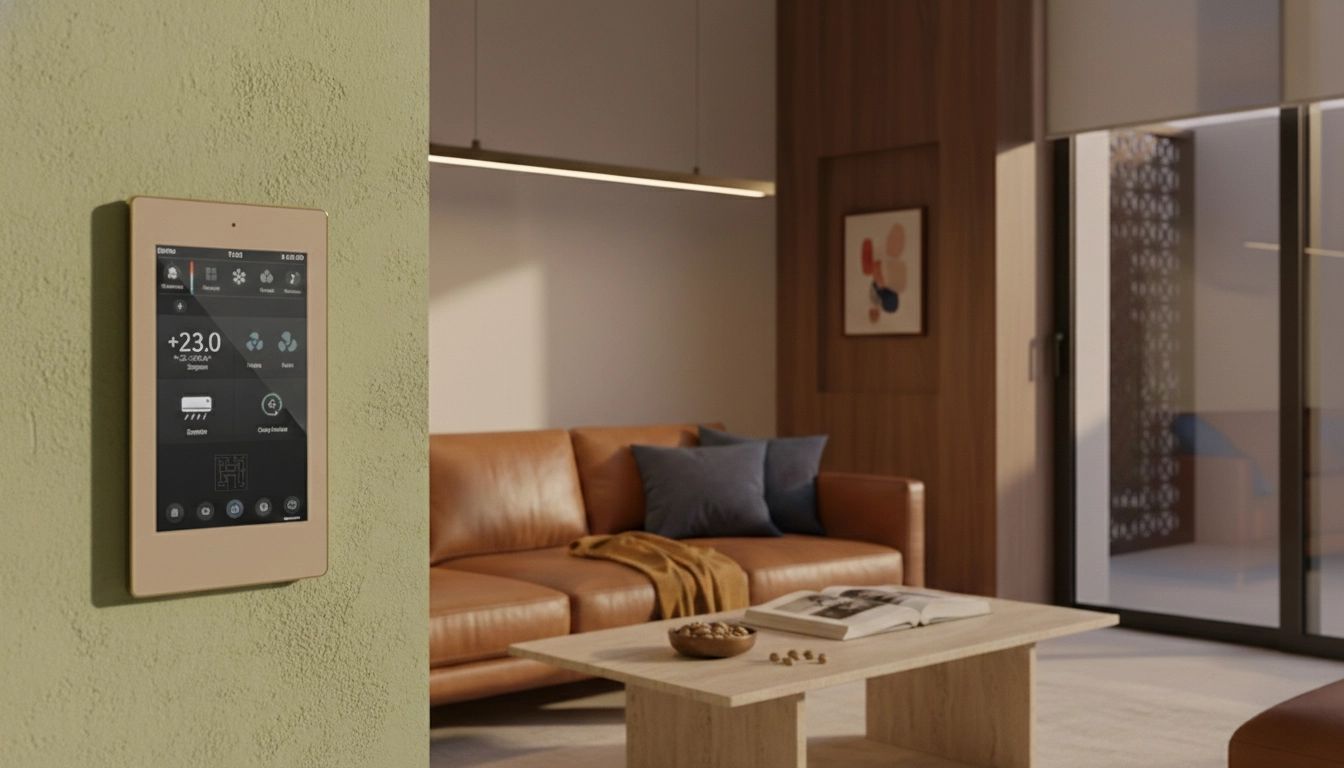
First, the family-facing app surface. Once a KNX-to-Matter bridge is on the rail, the KNX lighting, blinds, climate, and access show up in Apple Home (and Google Home, and SmartThings) the same way a consumer smart bulb would. The owner who lives in Apple Home does not need to learn the KNX dashboard for routine use; the family-facing layer is the one they already know. The dashboard layer stays available for power users.
Second, the consumer-grade gadgets you may want to add later. Smart-home toys do not stand still. New cameras, doorbells, voice-controlled appliances, energy meters, and EV chargers will keep arriving with Matter labels. A villa with a KNX-to-Matter bridge can absorb those additions through the same hub, without re-cabling and without forcing the integrator back through ETS for every new gadget.
Third, the energy stack. This is the most underrated reason. Matter 1.5's Device Energy Management cluster, combined with the 1.4 solar/battery/heat-pump device types, means consumer-grade energy hardware can now report and accept dispatch in a standard way. KNX is already strong on energy at the wired layer (PV, batteries, heat pumps, EVs are explicit focus areas for the KNX Association in 2026). Matter on the consumer side now speaks a compatible language. For villas with PV plus batteries plus an EV charger, the bridge is the layer that lets the wired KNX scheme and the consumer-grade energy assets coordinate without bespoke glue code. (KNX Association, 2026-05-18)
What Matter does not change
Three things stay exactly as they were.
The KNX backbone, the cabling, and the commissioning. ETS is still the source of truth for lighting, climate, scenes, and access. A KNX-to-Matter bridge does not change that; it sits next to ETS, not over it.
The reliability profile. KNX devices keep working if the bridge, the wifi, the cloud, and the internet all fail at the same time. Matter is an IP protocol that prefers a working hub. The wired backbone is still what you want behind the lights and the chiller. The same logic that applied to pre-cooling a Dubai villa applies here: the routines that have to work in heat have to live on the wired side.
The local control. Matter is increasingly local in 2026 (more controllers do Thread or wifi without cloud round-trips), but the KNX side has always been local first. Both layers preserve that property. If your reason for going wired in the first place was that the lights do not stop working when DEWA is fine but the internet is not, Matter does not weaken that.
A four-stage ladder for Matter in a KNX Dubai villa
Stage 1, KNX only. Wired backbone, ETS commissioned, Haus Logic dashboard on top. Family uses the dashboard or the wall keypads. No Matter. This is where every well-built Dubai villa starts.
Stage 2, Matter at the edges. Consumer devices (a Matter-capable doorbell, a Matter-capable kitchen scale, a few Apple Home-driven scenes for the kids) live in their own ecosystem. They do not see the KNX devices. They do not need to. This is a clean separation; very low integration cost.
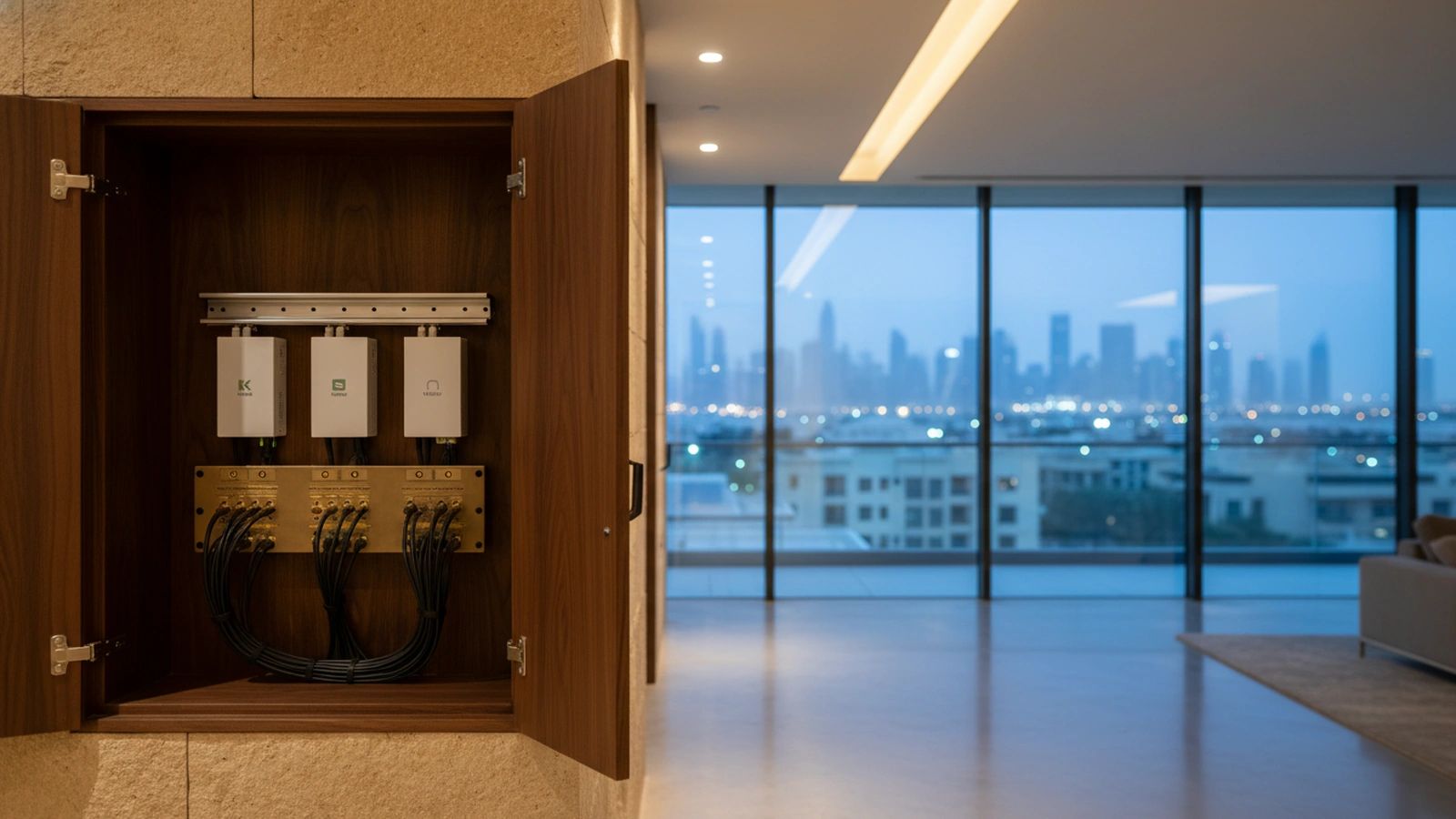
Stage 3, KNX-to-Matter bridge. A single bridge module (Atios, 1Home, Hager Domovea, or one of the newer Wago units arriving in 2026) exposes selected KNX devices into the Matter ecosystem. The family can now control KNX lighting, blinds, and climate from Apple Home or Google Home. ETS is unchanged; the bridge is configured separately. Typical exposure cap is 100 to 200 devices per bridge, which covers a full villa with room to spare.
Stage 4, Bridge plus energy. The same bridge carries the Device Energy Management traffic between KNX-side energy hardware (PV, battery, heat pump, EV charger on KNX-IP or KNX IoT) and Matter-side consumer energy devices and dashboards. This is the stage that matters for any villa designed against the Al Sa'fat 2.0 envelope and energy targets; it is also the stage that compounds with the KNX IoT direction the standard is now headed in.
Most owners we talk to land at Stage 3 within a year of finishing the KNX install. Stage 4 is for villas with a real energy stack to coordinate.
Where this matters less
Two cases.
A small apartment or a one-bedroom retrofit with no PV, no batteries, no EV charging, and no appetite for cross-ecosystem device sprawl can live happily at Stage 1 or Stage 2. The bridge is overhead it does not pay back.
A villa whose owners have committed entirely to a single ecosystem (only Apple Home, only Google Home) may not need Matter at all for cross-ecosystem reasons; the value then collapses to "consumer devices the integrator did not pre-select", which is real but smaller.
Buyer-side traps to avoid
Three things to watch for.
A bridge that locks you into one Matter ecosystem (Apple only, or Google only) is a tax you are not obliged to pay. Matter's whole point is cross-ecosystem; insist on a bridge that exposes the KNX side to all four major hubs.
A "Matter-only" smart home pitched as a replacement for KNX in a 6,000 to 12,000 square foot villa is almost always a sales angle, not a system design. The 200-device caps on consumer bridges are sized for residential ranges, but the reliability profile of a Matter-only install is not where you want lighting, climate, and access to live.
A bridge that requires cloud connectivity for routine KNX-to-Matter calls is a regression on the local-control property. Check the data sheet; the better bridges (Atios, current Hager Domovea generation) keep KNX-to-Matter traffic local.
What to do now
Three steps, in order.
If the KNX install is fresh or in progress, leave room on the DIN rail for a Matter bridge. It is one slot; you do not commit to a product yet.
Decide which Matter ecosystem the family lives in (Apple Home, Google Home, Alexa, SmartThings). The bridge selection follows the ecosystem more than the brand, since the better bridges support all four anyway.
If the villa has PV, batteries, heat pump, or EV charging, pick the bridge with the strongest Device Energy Management story. This is where Matter 1.5 actually pays for itself, and where the KNX side and the Matter side stop being two separate conversations. That convergence is what our home energy management service is designed around.
If you want help choosing the bridge, or planning the KNX side so it stays clean when Matter arrives at the edges, we are happy to walk through the options for your villa.