# KNX Thermostat Dubai: What Sits Between the Wall Panel and Your AC Unit
You are standing in a finished villa, and the electrician asks where you want the thermostats. You point at the usual spots. Three weeks later the panels are on the wall, they look right, and the bedroom is still ten minutes behind the living room every evening. The panel was never the problem. What was missing was a decision, made before the walls closed, about how each panel would talk to the AC behind it.
If you are planning a KNX thermostat Dubai villa installation, that decision is the whole job.
A KNX Thermostat Dubai Villa Owners Can Rely On Starts With the Interface
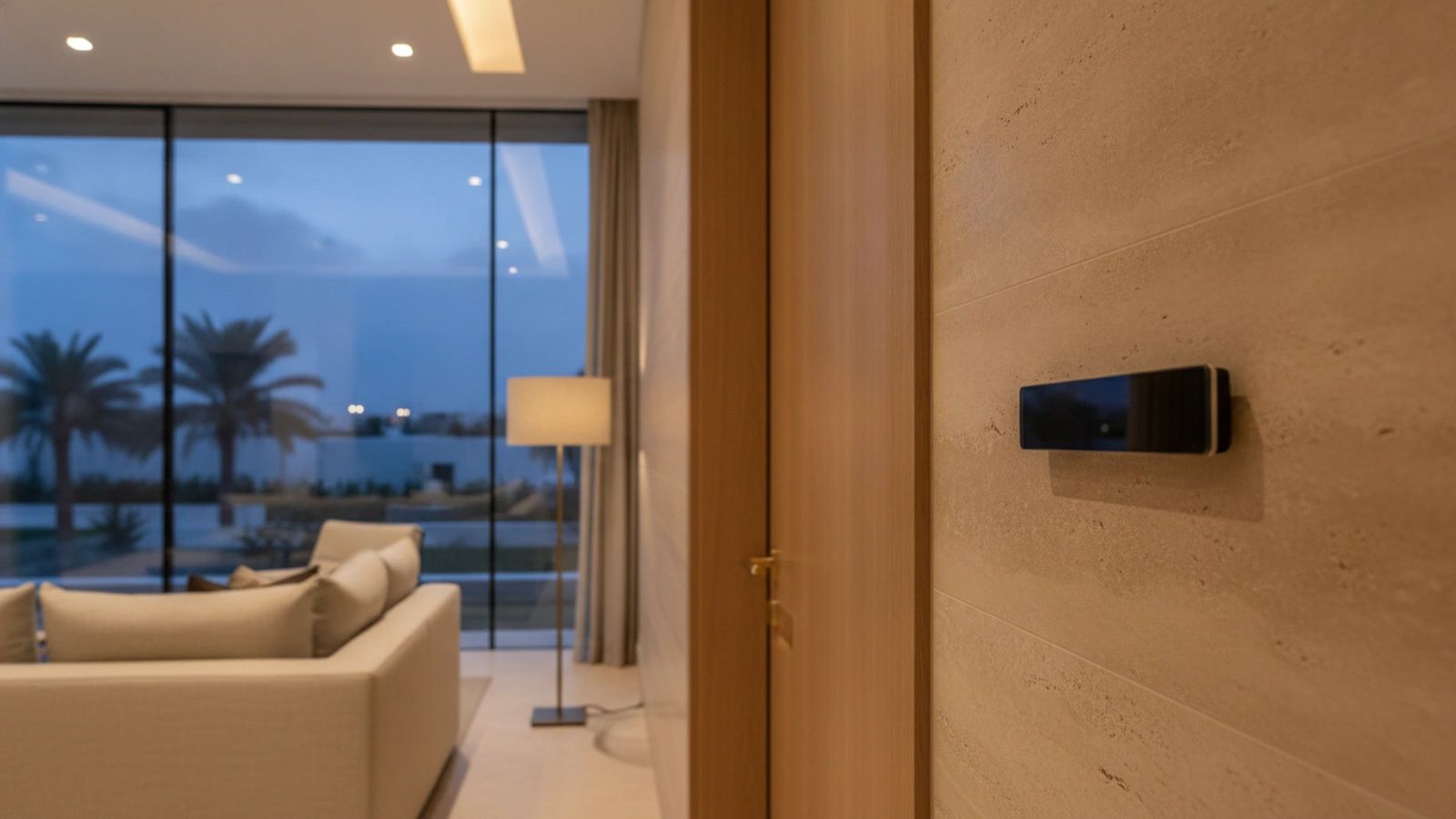
A KNX thermostat is a sensor and a control surface. It does not cool, heat or move air. It measures the room, compares it with a setpoint and sends a message across the KNX bus. Something else has to receive that message and act on it. That something is the interface, and it varies with the type of AC in the villa.
For fan-coil units, a fan-coil actuator or controller on the bus drives the valve and fan speeds directly. The KNX Association's own device catalogue lists fan-coil actuator and controller products for this purpose. For VRF and other branded AC systems, the usual route is a gateway that connects the unit's own electronics to the KNX bus. The catalogue includes VRF air conditioner gateways, and one entry describes its device as used for monitoring and controlling the functioning parameters of a manufacturer's air conditioners via the KNX bus. An article published by the KNX Association adds that for AC, control is straightforward once you establish the make and model and choose from the pre-configured interfaces available.
The practical consequence is simple. Before anyone buys a panel, you need the make and model of every indoor unit in the villa. That list decides which interface is possible, and the interface decides what you can control.
Three Questions That Decide the Result
What is being controlled? A gateway for a given AC model is designed to monitor and control that unit's functioning parameters over the bus. A basic contact input can generally only switch the unit on and off. Those are very different houses to live in, and the quote for each will not look the same. Ask which of the two you are getting, per room.
Where does the sensor sit? In our experience the most common reason a room feels wrong is a sensor reading the wrong thing: mounted beside a glass door in direct sun, on an external wall, or next to the airflow from the unit it controls. The panel can be beautiful and still report a temperature the room never has. Sensor position is a design decision, not an installation detail.
Who owns the schedule? A thermostat on its own reacts. A system with a schedule acts first. DEWA states that air conditioning consumes a large portion of the electricity generated during peak hours, which is why when the cooling runs matters as much as how much it runs. In a KNX villa, pre-cooling and zoning are programmed into the system rather than left to each panel, and we have written about how that works in practice in pre-cooling a Dubai villa with a KNX schedule and AC zoning in a Dubai villa.
Why the Wired Approach Holds Up
KNX describes ETS as the tool used to configure the communication between components and program functions such as lighting, HVAC, shading and energy management. Everything above, the setpoints, the schedules, the interface settings, lives in one project that a technician can open, read and change. In our view, that is the advantage over a patchwork of standalone smart thermostats, each with its own app and its own account. We compare the two approaches in KNX versus WiFi smart home in a Dubai villa.
It also means the unit's own remote can stay as a fallback. Where the unit allows it, our practice is to keep the manufacturer's remote working, so a failed panel or a bus fault never leaves a room without cooling.
What to Ask Your Installer
Ask for the indoor unit schedule in writing, room by room, with the make and model of each unit and the interface proposed for it. Ask where each sensor will be mounted and why. Ask whether the schedule and pre-cooling logic live in the KNX project or in a separate app, and who can change them after handover. Three honest answers to those questions tell you more about an installer than any brochure.
How We Specify It at Haus Logic
We begin with the unit schedule, not the panel finish. Our practice is to list every indoor unit by make and model, choose the interface for each, place the sensors against the room's sun and airflow, and only then choose the panel that matches the finishes. The schedule, the zones and the pre-cooling logic sit in Haus Logic's custom dashboard on top of the KNX backbone, so the household sees one set of controls rather than one per room. This is the approach behind the VRF and KNX integration work we do on villas in communities such as Emirates Hills.
For the broader picture, our climate automation service covers how zones, sensors and schedules fit together, and energy management covers the metering side. If you are curious what a properly specified KNX thermostat setup would look like in your villa, we are happy to walk through the options.
Sources
1. KNX Association, What is ETS. https://www.knx.org/what-ets
2. KNX Association, HVAC: using KNX to control units that form part of a block-wide building management system. https://www.knx.org/news/hvac-using-knx-control-units-form-part-block-wide-building-management-system
3. KNX Association, device catalogue: VRF AC KNX gateway. https://knx.org/devices/midea-vrf-ac-knx-gateway
4. Dubai Electricity and Water Authority, Peak Load. https://www.dewa.gov.ae/en/about-us/sustainability/lets-make-this-summer-green/peak-load