You bought the villa five years ago, before the smart home conversation in Dubai had reached its current pitch. The walls are finished, the joinery is set, the family is moved in. Now you want lighting scenes, AC zoning that survives August, motorised shading on the south-facing glazing, and a single panel that lets your spouse turn off the whole house without hunting for switches. You do not want to live in a construction site for three months. You also do not want to be the homeowner who pays for a "wireless-only" retrofit twice: once now, and again in three years when the mesh starts behaving like a temperamental teenager.
This is the retrofit smart home question for an occupied Dubai villa. The honest answer has three parts: the premium is real, the hybrid is the right architecture, and the protocol decision matters more on a retrofit than on a new build.
Retrofit smart home Dubai villa, in 50 seconds
A smart home retrofit in an occupied Dubai villa typically costs 25 to 40 percent more than the same scope on a new build, with full-villa moderate integration landing in the AED 20,000 to 45,000 band and premium integration with HVAC, security, solar, and wellness sensors reaching AED 60,000 to 150,000 or more. The premium pays for access, making-good, and project management around a lived-in property. The right architecture is a hybrid: KNX at the electrical panel for core loads, wireless for sensors and switches where wiring is impossible.
Why a Dubai villa retrofit costs 25 to 40 percent more than new-build
Three things drive the premium and they are all predictable. Access difficulty: chasing cables through finished walls, drilled ceiling voids, and concrete elements that were never meant to be opened. Making-good costs: skim, paint, marble re-polishing, joinery touch-ups that follow every chase. Project management around an occupied property: phased rooms, dust containment, working hours that fit the family's schedule, and the integrator's time spent waiting for the housekeeper to finish a corner before pulling cable. Ziotech and HomeControl both call the band 25 to 40 percent above new-build; that matches what we see on KEZAD-adjacent Dubai villa projects and broader regional sources put the same range on the same scope.
The premium is real, but it is not arbitrary. It is the price of not gutting your house.
The three retrofit architectures, and which one survives ten years
There are three serious approaches to a smart home retrofit in an occupied Dubai villa.
The first is pure wireless: WiFi switches, Zigbee or Thread sensors, Matter-over-Thread for cross-platform devices. It is the cheapest path on day one. It is also the path that ages worst on a long-stay villa. Wireless mesh networks degrade with channel congestion, age with battery cycles (one to three years for most Thread devices, longer for mature Zigbee), and fail in ways that are difficult to diagnose because the symptom is "the bedroom switch was slow today" rather than a clear hardware fault. We are not against wireless on principle; we are against wireless as the entire system in a villa you intend to live in for ten years.
The second is full re-cabling to a wired KNX backbone. This is the new-build approach forced into a retrofit, and it is sometimes the right call: when the renovation is structural anyway, when ceilings are coming down for AC upgrades, or when the owner has decided that the next decade of reliability is worth the disruption. It is the most expensive option and the most disruptive. It is also the most durable, with KNX bus topologies running reliably for fifteen-plus years on a low-voltage line that is fundamentally indifferent to WiFi outages and cloud platform deprecation.
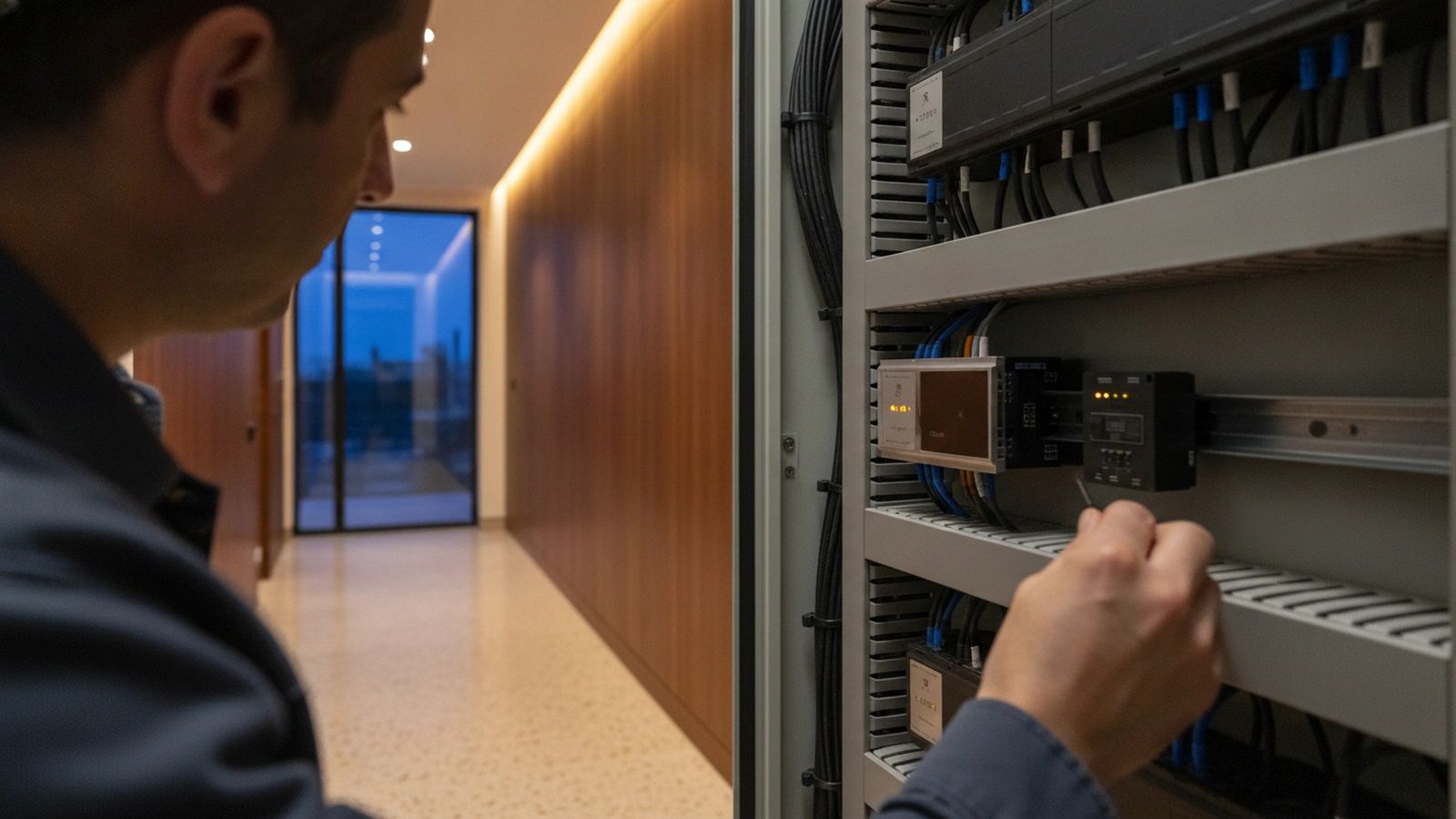
The third is a hybrid: KNX at the electrical panel for core loads (lighting circuits, motorised blinds, AC interface), wireless for the rooms or devices where wall opening is impossible (curtains in a finished marble alcove, occupancy sensors on a vaulted ceiling, lifestyle remotes). Industry sources describe this as delivering roughly 80 percent of the value at 50 to 60 percent of the cost of a full re-cable, and that matches our experience on occupied Dubai villa projects. It is the architecture we recommend by default for retrofit briefs.
The reason the hybrid works is that the wired backbone carries the loads that have to be reliable for ten years (your AC, your downlights, your blinds) on a protocol that does not depend on a router uptime SLA. The wireless veneer carries the loads that are allowed to fail occasionally (a single battery-powered remote, a corner sensor) without taking the house with them. The architectural separation is the design decision; the brand is a downstream consequence.
Where wireless-only retrofits actually fail
We have seen four failure modes on pure-wireless retrofits in Dubai villas, all of them within 18 to 36 months of installation.
The first is battery cycle compounding. A villa with 40 battery-powered devices on Thread and Zigbee will see its first big maintenance day around month 14, when the cheap devices hit end-of-life together. The owner did not plan for that; the system did not warn them ahead of time; the integrator who installed it is no longer reachable on the same number.
The second is mesh re-configuration. Wireless meshes self-heal, which is wonderful in a demo and a nuisance in a finished villa, because the path a signal takes today is not the path it took yesterday, and the latency between pressing a switch and watching the light turn on slowly drifts upward.
The third is platform deprecation. Cloud-dependent wireless devices fail when the platform behind them gets sunset, and the homeowner discovers it the day they cannot turn on the porch light from the airport.
The fourth is integrator handoff failure. Wireless-only retrofits are often installed by generalists who treat the system as a collection of apps. When the original installer leaves the market, finding someone who can pick up a poorly documented mesh is harder than picking up a documented KNX bus on an open standard.
What the retrofit conversation should sound like
Walk an integrator through your villa and the first question should be about your AC system. Is it VRF or chiller, what is the BMS protocol, can it be addressed at the panel. The second question is the lighting topology: how many circuits, are they DALI-ready, what is the current control wiring. The third is the shading: motorised already, or curtain rods that need motorisation, and where is the closest cable run. None of those questions begin with brand names. All of them begin with the building.
For an occupied villa, the integrator should also be asking about your tolerance for disruption: which rooms cannot be touched until the kids are at school, what the working hours look like, and how many trips into the house you are willing to host. The answer changes the phasing, the sequence, and sometimes the architecture.
We covered the open-standard question in KNX vs Proprietary Smart Home Systems, What Actually Holds Up Over Ten Years. The architecture question we cover here pairs directly with the integrator-vetting question in How to Verify Your KNX Integrator in Dubai Before You Sign.
FAQ
Is a wireless-only retrofit ever the right call?
Yes, on short-stay apartments and short-term rental units where the owner expects to refresh the system in three years. For a villa you intend to live in for a decade, the wired backbone earns its premium.
Can I phase a retrofit one room at a time?
Usually yes. A hybrid architecture is naturally phaseable: backbone first, then rooms in sequence. We typically phase by zone (ground floor, first floor, outdoors) over six to ten weeks for a moderate scope. If that cadence would suit your household, plan a phased retrofit with us.
Does Matter change the retrofit calculation?
Matter improves cross-vendor interoperability on the wireless side, which is useful. It does not replace a wired backbone for loads that have to be reliable in August. We treat Matter as a complement to KNX on a hybrid retrofit, not as a substitute.