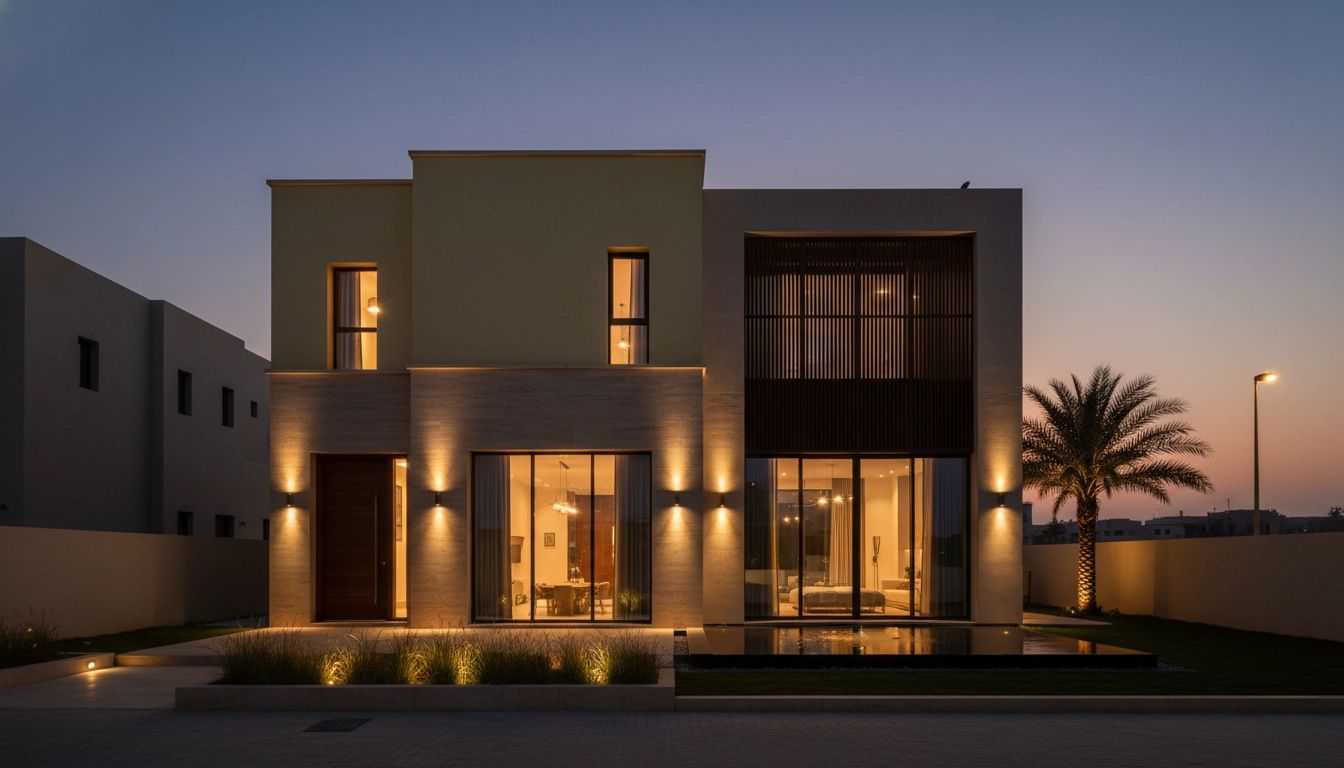
You are sitting in your new villa on Saadiyat, or Yas, or one of the AlReeman releases. The keys arrived last month. The handover snag list is mostly closed. Someone in the family WhatsApp group has just forwarded you a "Best Smart Home Companies in Abu Dhabi 2026" listicle, and ten browser tabs are now open on your laptop.
Close them.
The listicle is a marketing artefact, not a procurement document. You are about to commit to the automation layer of a villa that will run for thirty years, and you are choosing it from a top-ten ranking with no specification behind it. The right document is a written specification you hand to every company on the shortlist, and you measure them against it before you compare brochures.
This is the specification baseline an Abu Dhabi villa owner can use in 2026. Four levels, each one builds on the last. By the end, you have a one-page brief any installer can quote against, and you can read their answers like a contract instead of a sales call.
Why the specification matters more than the shortlist
The Pearl Rating System for Estidama has been mandatory for new villas in Abu Dhabi since September 2010. Private new villas must achieve at least 1 Pearl; Emirati (government-funded) villas must reach at least 2 Pearls. Energy monitoring capability is built into the rating system's energy-efficiency credits, so your villa is already required to produce data the automation layer can read. (Pearl Rating System overview)
The implication: an Abu Dhabi villa in 2026 is not a blank canvas for smart-home gadgets. It is a Pearl-rated envelope with measured energy performance, and the automation choice is about what reads, controls, and exposes that performance. A listicle does not tell you which of the ten companies actually treats Pearl compliance, ADDC tariff banding, and the solar self-supply policy as line items in their scope. The specification does.
Level 1: The wired backbone
Wireless-only systems can be installed in a day and removed in an afternoon. Your villa is not an afternoon project. The first line of the specification is a wired bus your installer commits to in writing.
KNX is the wired open standard. It is governed by the KNX Association in Brussels and supported by hundreds of manufacturers, which means a panel-board built today can be extended by any KNX-certified installer in fifteen years. The Middle East regional body is KNX MEA. (Find KNX Partners)
Specification lines you should write:
- Wired KNX TP1 backbone reaching every lighting circuit, every blind motor, every fan-coil or VRF zone, every door and gate contact.
- Every actuator and binary input addressable from a single project ETS file the integrator hands you on completion.
- Bus power supply, line couplers, and surge protection sized for your circuit count, not for the cheapest catalogue option.
What this buys you: thirty years of replaceable parts, an open standard nobody can lock you out of, and an audit trail your insurer and your re-sale buyer can both read. The KNX backbone is the villa.
Level 2: Climate, zoning, and the ADDC tariff band
Abu Dhabi's residential tariff for expat villa accounts in 2026 sits in a daily-allowance band: 26.8 fils per kWh up to 200 kWh per day (green band), then 30.5 fils per kWh on the entire month's consumption if you cross 200 kWh on any single day. UAE National villa accounts sit on a different schedule, with a 400 kWh per day green band at 6.7 fils per kWh and a red band of 7.5 fils per kWh above that. (ADDC residential tariffs overview; ADDC 2026 tariff guide via Utility Bill UAE)
The mechanics matter for the spec sheet. A villa that spikes once on a 45 degree summer Saturday with the pool pump, the family gathering, and four split-system AC units at full tilt can flip the entire month onto red band. Climate zoning is therefore not a comfort feature. It is the line that protects the bill.
Specification lines you should write:
- Independent KNX zoning per AC zone (typically per floor for a small villa, per wing for a larger one), with occupancy or schedule-based set-points.
- Fan-coil or VRF integration via KNX gateway, not a separate proprietary thermostat network.
- A daily kWh budget configured in the dashboard with a soft alert at 80 percent of the green-band threshold and a hard alert at the threshold itself.
- Estidama-compliant SEER 14 minimum on residential split systems, recorded as part of the commissioning handover.
What this buys you: a villa that defends its own tariff band, with the automation reacting before the bill does.
Level 3: Security, access, and the camera layer
Abu Dhabi's residential security expectations are higher than the brochure usually reflects. The villa shortlist focuses on lighting and climate; the security layer is where most retrofits start, six months after the family moves in and realises the developer's basic intercom and the gate fob are doing the entire job.
Specification lines you should write:
- IP CCTV with on-camera AI analytics (vehicle, pedestrian, package, line crossing) connected to the KNX bus through a video management system, not a standalone phone app.
- ANPR on the main gate camera, with KNX-triggered gate-open events logged to the dashboard.
- A consolidated alarm view that combines KNX intrusion, video analytics events, and the smoke and CO detector network.
What this buys you: one screen the villa owner actually checks. Not three apps the family ignores.
Level 4: Solar self-supply readiness and the data layer
In February 2026 the Abu Dhabi Department of Energy launched the second phase of the Solar Energy Self-Supply Policy at the World Governments Summit, expanding eligibility to the residential sector for the first time. Villa owners can now generate and store electricity from rooftop solar, integrated with the grid, under a defined regulatory framework. (Abu Dhabi Media Office: DOE solar self-supply phase 2)
Even if you defer the install, the automation should be specified as if you will fit PV within three years. The cost of leaving the wiring, the meter loop, and the dashboard hooks in place during the base build is a small fraction of the cost of opening up the panel-board and the ceiling void again later.
Specification lines you should write:
- Spare DIN-rail capacity in the main and sub-panels for a future PV inverter contactor and energy meter.
- A KNX-readable energy meter on the main incomer at handover, even if PV is not on the spec.
- An open data layer (MQTT, REST, or equivalent) the owner can route to the dashboard layer that orchestrates the villa.
- A documented schema for the meter, the inverter, and the battery so a future installer can plug in without reverse-engineering the panel.
What this buys you: optionality. The villa that is solar-ready today will be solar-quoted tomorrow at a meaningfully lower number.
Reading the answers like a contract
When the shortlist companies come back, read each Level against the specification. The company that has KNX certifications, ETS project files from comparable Abu Dhabi villas (Saadiyat Lagoons, Yas Acres, AlReeman, or earlier Aldar releases), and a written commitment to the four-level baseline is in a different category from the company that responds with a phone-app screenshot and a five-zone wireless thermostat brochure.
We covered the Dubai parallel in our piece on Al Sa'fat 2 and mandatory villa automation in Dubai. The structural lesson is identical across emirates: the regulator has already specified the envelope and the energy data. Your installer either reads that as a starting line, or treats it as overhead. The first installer is a partner; the second is a brochure.
FAQ
Do I need KNX in an Abu Dhabi villa, or can I use a wireless platform?
Wireless platforms can run a small villa for two or three years. They do not survive a tenant change, a renovation, or a manufacturer retiring a product line. KNX, as an open wired standard with multi-vendor support, gives you a thirty-year envelope and a clean handover document. For a Pearl-rated villa, the wired backbone is the correct floor on the specification.
How does the ADDC daily-allowance band affect my automation choice?
The expat villa tariff in 2026 charges 26.8 fils per kWh inside the daily allowance and 30.5 fils per kWh for the whole month if you exceed it on any single day. Climate zoning, schedule-based set-points, and a dashboard with a daily kWh alert are not comfort features. They are the line items that defend the band.
How do I tell which of the ten companies on the listicle is the right one?
You will not tell from the listicle. You will tell from how each company responds to the four-level specification above. The right installer answers in writing, by level, with named products and named standards. The wrong installer answers with a brochure.
If you are picking an installer for an Abu Dhabi villa in 2026 and you want a partner who reads Pearl, ADDC, and the solar policy as line items, we are happy to walk through the specification on a call. The four-level baseline above is also a useful internal document; please feel free to take it into any conversation with our competitors, with or without us in the room. We covered how to read installer credentials in our piece on how to choose a KNX installer in Dubai when the top of Google looks crowded. The same logic applies in Abu Dhabi. If you would rather start from your own project, book a specification call and we will build the baseline with you.