# CCTV Installation in Dubai: The Standard Behind a Proper Specification
Someone has quoted you for eight cameras around the villa. The quotation lists a brand, a channel count, a recorder, and a price. It does not say what resolution the recordings will be, how many days of footage you will actually have when you need it, or what happens to the picture when a camera is pointed at a white wall in the middle of a July afternoon.
Most conversations about CCTV installation in Dubai happen at the level of camera count. That is the wrong level. There is a published technical standard sitting underneath this market, and once you have read it, a quotation stops being a list of hardware and becomes something you can actually judge.
The document behind CCTV installation in Dubai
Dubai's Security Industry Regulatory Agency publishes the Standard and Technical Specifications of the Security Systems, issued under Law No. 12 of 2016 and the procedures manual of its implementing regulation. The version in circulation is 4.0, released in February 2022.
An important piece of context first. That document governs security systems at regulated establishments, and the obligations in it fall on the establishment, not on a private homeowner. You are not applying for a permit when you put cameras on your own villa.
What matters is that every approved security contractor in Dubai builds to this sheet, because it is what they are assessed against on commercial work. The specification is therefore the local professional baseline, and there is no good reason for the system on your house to sit below it. Reading it is the fastest way to find out whether the quotation in front of you was written by someone who works to a standard or someone who works to a price.
What the standard asks of the cameras
The requirements are specific enough to be useful as a checklist.
- Resolution. Camera resolution shall not be less than Full HD 1080p. Note what this is and is not: it is a floor, not a target. If a proposal is vague about resolution, it is proposing something below the floor.
- Colour and signal quality. Cameras shall be colour, with a signal-to-noise ratio of not less than 48 dB. That number is why cheap cameras look acceptable in daylight and turn to mush at dusk.
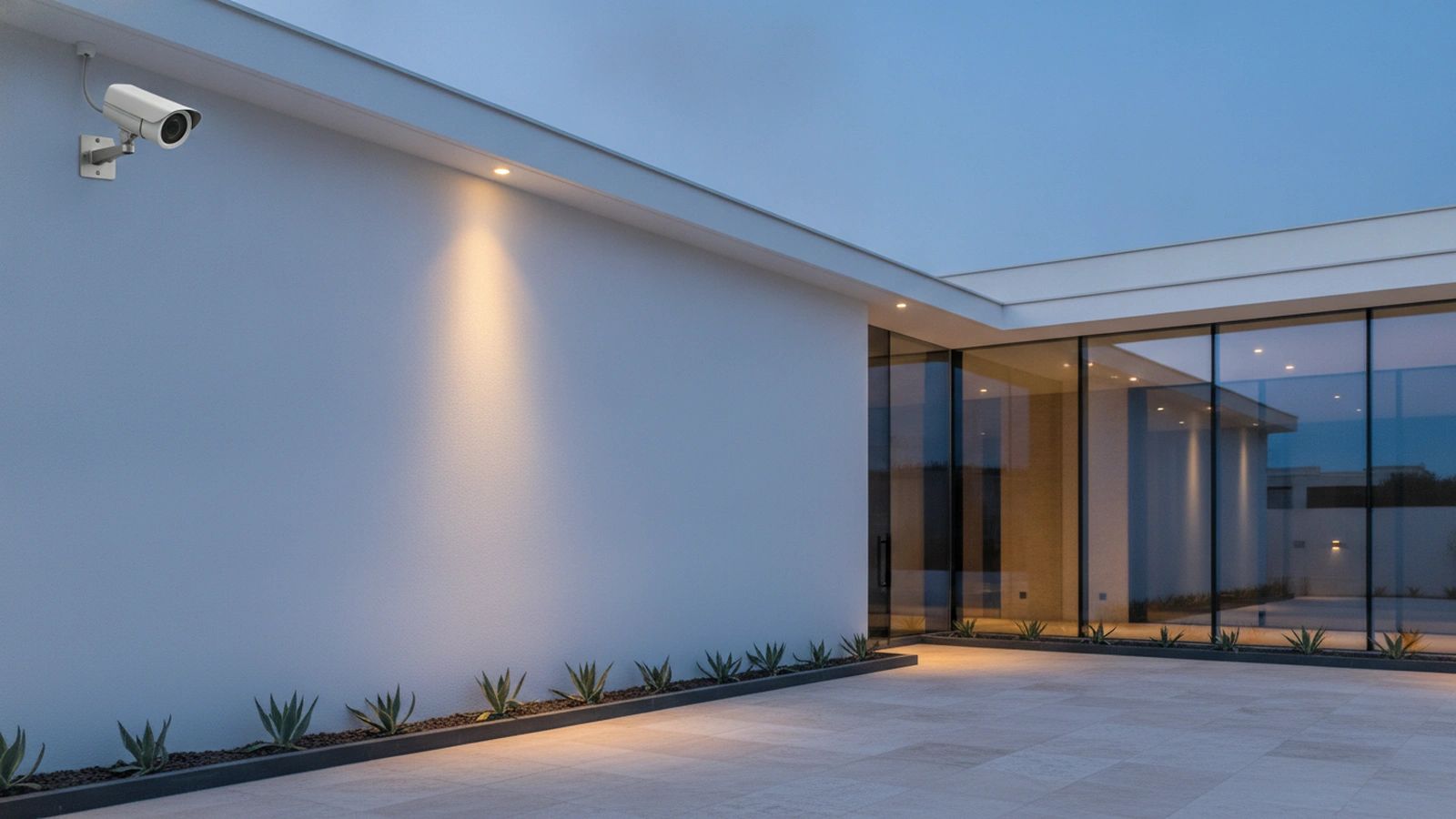
- Visible, not hidden. Cameras shall be visible and not concealed. Covert cameras require the regulator's approval. Deterrence is part of the design, not an accident of it.
- Outdoor rating. Outdoor cameras shall be at least IP66, or housed in an enclosure of at least IP66, and shall suit the Gulf environment: high temperatures, humidity, and dust. This single line explains most of the failed cameras we are asked to replace.
- Wide dynamic range. Any camera facing a natural or artificial light source, directly or reflected off polished surfaces, shall be a wide dynamic range camera with at least 110 dB, or equivalent. In a villa that means every camera covering a glazed entrance, a pool deck, or a marble driveway.
- Night behaviour. An infrared cut filter is required, with the ability to switch itself to monochrome night imaging when visible light disappears. Auto iris is required where light conditions change.
- Height. Cameras mounted at four metres and above shall have remote zoom and focus. Anyone who has watched a technician re-climb a ladder three times to adjust a gate camera understands why.
- Audio. Cameras fitted with microphones are prohibited without the regulator's permission. If your proposal includes audio, ask the question before the cable goes in.
What the standard asks of the recording
This is the half of the system nobody photographs, and it is the half that decides whether the footage is there when it matters.
The standard requires digital recording at not less than Full HD 1080p, and live viewing at not less than 25 frames per second per camera. The recorder must handle live view, recording, and playback at the same time without any of the three degrading.
The retention requirement is the number worth writing down. For motion-triggered recording, the setting shall be not less than 70 percent of the day per camera, not less than 10 frames per second per camera, and not less than 31 days. A month of retrievable footage is the baseline, not a premium feature. Ask any prospective installer what retention their proposed storage actually delivers with the cameras and frame rates they have specified, and watch how quickly the conversation gets specific.
Two more clauses that quietly separate a competent design from a guess. Recording devices shall be computed with 20 percent extra capacity, which means the storage calculation must carry headroom rather than land exactly on the requirement. And the system shall be compatible with ONVIF 2.0, which is the practical guarantee that you are not locked to one manufacturer's cameras for the life of the recorder.
Where this meets the rest of the house
A villa camera system is not a standalone product; it is a load on your network and a source of events for everything else.
Eight cameras recording continuously at 1080p is sustained traffic that has to be carried on cabling and switching designed for it, on a segment that does not compete with the family's streaming. That is a residential networking decision made at first fix, not a Wi-Fi decision made afterwards.
Once the cameras sit on a properly designed network, they stop being a separate app. A gate camera can trigger a lighting scene. An analytics event can wake a dashboard tile rather than push a notification nobody reads. We have written before about the difference between consumer cameras and an integrated villa CCTV system, and the specification above is where that difference starts.
Four questions to put on the quotation
Take these to whoever is bidding, and ask for written answers.
1. What resolution and frame rate is each camera recording at, and what retention in days does that produce on the proposed storage?
2. Which cameras are wide dynamic range, and does that list include every camera facing glass, water, or light stone?
3. What is the ingress rating of the outdoor cameras and housings?
4. Is the recorder ONVIF 2.0 compatible, and can it take additional storage later?
A supplier working to a standard will answer all four in a paragraph. A supplier working to a price will answer with a brand name.
How we specify it
We write the camera schedule before we price the job, because the position, the lens, and the light condition at each point determine the camera, and the camera determines the storage. We design the network that carries it as part of the same job rather than as an afterthought, and we integrate the result into the same dashboard that runs lighting, climate, and access, so the household has one place to look.
We have been a KNX Partner since 2014, and we are ISO 9001 certified and DED licensed. You can see how camera coverage sits inside a full villa scope on our private villa in Dubai project page, and the service scope itself on our CCTV installation in Dubai and home automation pages.
Better cameras are not the point. A specification you can hold someone to is the point.
If you have a quotation in front of you and you want a second opinion on what it actually delivers, send it over; we are happy to read it with you.
Sources
1. Security Industry Regulatory Agency, Standard and Technical Specifications of the Security Systems, Version 4.0, released 14 February 2022, issued under Law No. 12 of 2016. https://www.sira.gov.ae/assets/1554846d/Standard%20and%20Technical%20Specifications%20of%20the%20Security%20Systems.pdf.aspx
2. Security Industry Regulatory Agency, Legal Library and regulatory amendments. https://www.sira.gov.ae/en/legal-library/amendments.aspx
3. Haus Logic, company credentials and project record. https://hauslogic.ae/about