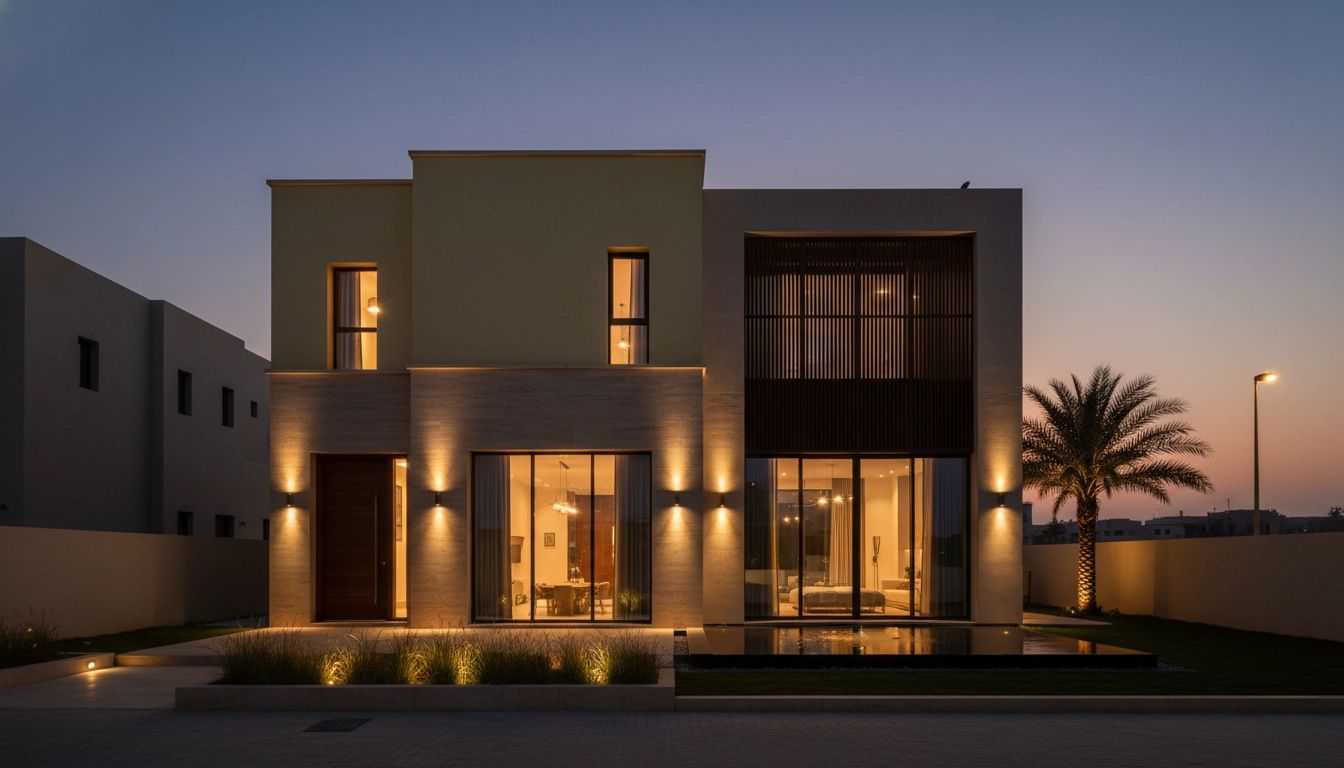
Picture a four-bedroom villa on Saadiyat Island in August. The air conditioning runs almost every hour of the day, the pool pump cycles on a timer somebody set two years ago, and the bill that lands at the end of the month is the largest line item in the house after the mortgage. You did not buy a smart home; you bought a house that quietly spends money while you are at work. This is the gap a KNX system is built to close, and in Abu Dhabi there are two specific reasons it matters more than the marketing usually admits: the way the emirate regulates new buildings, and the way ADDC charges you for power.
If you are weighing KNX for an Abu Dhabi villa in 2026, here is the part most guides skip. KNX is not a brand or an app. It is the wired automation standard, formally published as the international standard ISO/IEC 14543-3, which means the lighting, climate, blinds, and energy logic in your home are not locked to one manufacturer or one company's cloud. That is the whole point, and it is what separates a system you can still service in ten years from a box of gadgets you replace when the vendor moves on.
Why Abu Dhabi is different from Dubai
Most smart home content in this market is written for Dubai. Abu Dhabi villa owners inherit two rules that change the calculation.
The first is Estidama. Since autumn 2010, every new development in the emirate has had to meet a minimum of one Pearl under the Pearl Rating System, with government buildings held to two Pearls. Villas are assessed under their own track, the Pearl Villa Rating System, on a scale that runs from one to five Pearls. Estidama is not a smart home rule on paper. In practice, though, it rewards exactly the things a KNX system is good at: measurable energy efficiency, lighting control, and the ability to reduce demand rather than just monitor it. If you are building or substantially renovating, automation is one of the cleaner ways to support the energy targets the rating already pushes you toward.
The second is your utility. Abu Dhabi villas are billed by ADDC on a banded structure, not a flat rate. Stay within the daily allowance, currently set around thirty kilowatt-hours a day for villas, and you pay the lower green band. Cross it, and the higher red band applies. The behaviour that tips a villa from green into red is almost always the same culprit: cooling. In a UAE summer, air conditioning is the single largest load in the house, and a villa with no automation cools empty rooms at full output because nothing is telling it not to.
What KNX controls in an Abu Dhabi villa
A serious KNX installation in an Abu Dhabi villa is layered, and it is worth understanding the layers before anyone quotes you.
Lighting and scenes come first, because they are the most visible and the easiest to get wrong with cheap kit. Climate control is where the money is; KNX ties your thermostats, VRF or chilled-water system, and occupancy sensors together so the house cools the rooms people are in and lets the rest drift. Blinds and shading cut solar gain before it becomes a cooling problem, which in this climate is not a luxury feature; it is load reduction. Security and access, including CCTV with ANPR at the gate, sit on the same backbone. Energy management is the layer that ties it together, giving you a real picture of where the kilowatt-hours go instead of a guess.
The mechanism that protects your ADDC band is pre-cooling and occupancy logic, and we have written about how that works in detail in our piece on pre-cooling a Dubai villa with a KNX dashboard. The same logic applies in Abu Dhabi; only the tariff bands change.
The dashboard layer
KNX is the reliable wired standard underneath. On top of it, Haus Logic's custom dashboard is the intelligence layer: one screen, one place to set schedules, see consumption, and adjust scenes without learning five separate apps. The dashboard is where a wired backbone stops feeling like infrastructure and starts feeling like a home that runs itself. If you want to see where this is heading, our article on KNX and IoT in a Dubai villa walks through how the standard keeps evolving without forcing you to rip anything out.
What to ask before you sign
Abu Dhabi has plenty of companies that will sell you a smart home. Fewer of them are genuinely KNX certified, and the difference shows up three years in. Ask whether the company is a KNX Partner and how long it has held the certification. Ask to see the system after handover, not just the brochure. Ask who picks up the phone when something needs attention, because the honest measure of a good installation is that the owner rarely has to think about it.
Mandatory building rules are not unique to Abu Dhabi; Dubai runs its own green building code, and we covered how that reshapes new villas in our piece on Al Sa'fat and mandatory villa automation. The pattern across the UAE is the same: regulation is moving toward efficiency, and a wired automation backbone is the most durable way to meet it.
A villa is a fifteen to twenty-five year decision. The cooling system, the wiring, and the automation logic you put in now will outlast three generations of consumer smart home apps. KNX is the choice that assumes you are still living there when those apps are gone. That longevity is the core of our KNX automation service.
If you are planning a new villa in Abu Dhabi, or retrofitting one you already own, we are happy to walk through what a KNX backbone would look like for your specific layout and how it maps to your ADDC bill. Reach us at projects@hauslogic.io or +971 54 764 6619.