# KNX vs Lutron: Open Standard, Single Brand, and the Dubai Villa Question
You are sitting across from two proposals for the same villa. One says KNX on the cover. The other says Lutron. Both integrators were confident, both showed you a keypad that felt expensive in the hand, and both quoted a number you are not going to discuss with anyone. What neither proposal explained is that you are not really choosing between two brands. You are choosing between two ways of building a house.
The KNX vs Lutron question comes up in almost every villa briefing we run in Dubai, and the honest answer is that both are serious systems built by serious people. The difference is scope, ownership, and what happens to the house in year twelve. This article walks through those differences without the sales gloss, so you can read the two proposals in front of you for what they actually are.
What KNX is, and what it is not
KNX is not a company. It is an open standard for building automation, published as ISO/IEC 14543-3 internationally and EN 50090 in Europe, and administered by the KNX Association in Brussels. More than 500 member companies manufacture to that standard, and the association's product database lists over 8,000 certified devices. A KNX villa can have switches from one manufacturer, dimmers from a second, blind actuators from a third, and a climate controller from a fourth, all talking on the same two-wire bus.
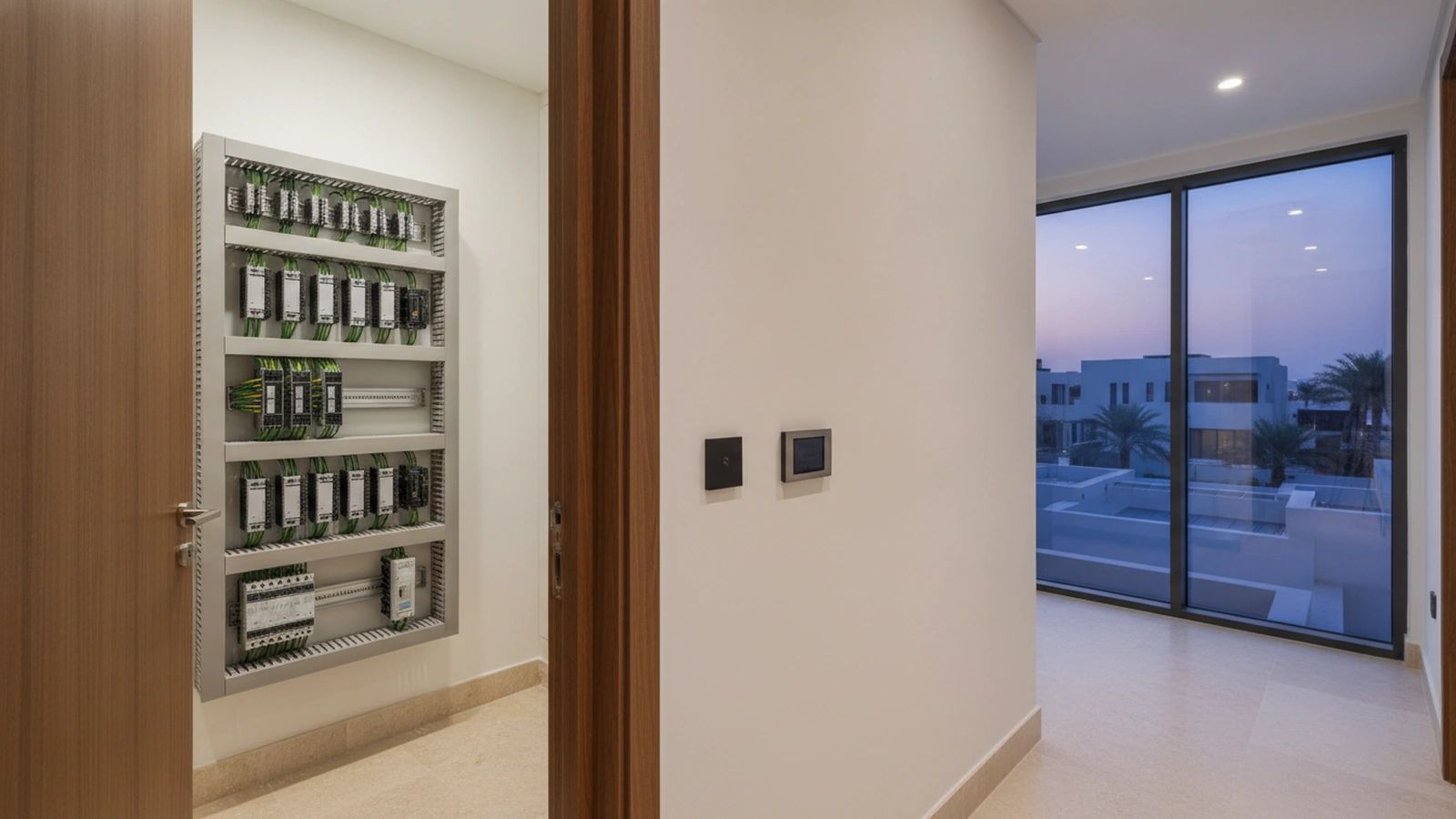
That bus is the part most owners never see. KNX twisted pair carries data and a 29 V DC SELV supply on the same pair of wires, so devices are powered and addressed over one green cable that runs through the walls during first fix. Every device is configured with a single tool, ETS, which any KNX Partner can use. A KNX Partner is an installer who has completed the Basic course at a KNX certified training centre; that is the credential to ask for, and it is the one we have held since 2014.
The practical consequence for a villa owner is simple. If your integrator disappears, retires, or falls out with you, another KNX Partner can open the project file and carry on. The house is not tied to the person who built it. We wrote about this at length in KNX vs proprietary smart home systems, and it remains the single strongest argument for an open standard in a market where integrators come and go.
What Lutron is, and where it is exceptional
Lutron is a manufacturer, founded in 1961 by Joel and Ruth Spira, and Joel Spira is credited with inventing the first solid-state electronic dimmer. That heritage still shows. By the manufacturer's own published documentation, its residential platform for large homes is HomeWorks, which runs on a wired link alongside the company's own radio protocol for wireless devices, with the current processor generation bringing the wired, wireless, and tunable light-source lines into one system.
Where Lutron is exceptional is exactly where it has spent six decades: dimming curves, keypad engraving, shading fabrics, and tunable light. If the brief is "the lighting and the blinds must be perfect and the house is architecturally led," a Lutron proposal deserves a fair hearing. Anyone who tells you otherwise is selling, not advising.
The scope question appears when you look beyond lighting and shading. The manufacturer's own thermostat line, by its published specifications, integrates with VRF and split systems, and in many configurations it does so through third-party interfaces from other manufacturers. That is not a flaw; it is a design choice. Lutron builds the control layer for light and shade and partners for the rest. KNX, by contrast, treats climate, energy metering, access, and irrigation as native citizens of the same bus.
Why climate decides more than lighting in Dubai
In a European townhouse, the lighting system is the smart home. In a Dubai villa, the air conditioning is the smart home, and everything else is decoration. DEWA's own conservation guidance puts air conditioning at the dominant share of a villa's summer electricity use, commonly cited in the 60 to 70 percent range, and the residential slab tariff climbs from 23 fils per kWh below 2,000 kWh a month to 38 fils per kWh above 6,000 kWh. A large villa with a family in residence lives in the upper slabs for most of the year.
This is the point where the KNX vs Lutron comparison stops being about keypads. Cooling control that is native to the automation bus can zone rooms, pre-cool before the afternoon peak, and shut down unoccupied wings on the same logic that runs the lights. We covered the bill mechanics in the DEWA Tier 4 cliff and the schedule logic in our piece on pre-cooling a Dubai villa. Both articles assume the climate system and the lighting system share one brain. That is straightforward on KNX. On a lighting-led platform it is achievable, but it depends on how well the third-party climate interface has been engineered and who supports it when the VRF manufacturer updates its firmware.
Our climate automation work is built on this principle: the thermostat is not a peripheral, it is the primary load, and the automation standard has to own it.
KNX vs Lutron at four levels of automation
Rather than asking "which brand is better," ask which level of automation you are actually buying.
Level 1 is lighting and shading control with scenes and keypads. Both platforms are excellent here. Lutron has a design edge in dimming quality and finish options; KNX has a wider range of price points and manufacturers.
Level 2 adds climate. Zoned AC control, occupancy-based setbacks, and window-contact interlocks. KNX handles this natively; Lutron handles it through its thermostat line and partner interfaces. Ask each integrator to show you a working villa where the AC has been running on their system through a full August.
Level 3 adds energy and infrastructure. Sub-metering by circuit, EV charger management, pump and irrigation control, and dashboards you can actually read. This is where an open standard with 500 manufacturers pulls ahead on breadth. Our energy management page shows the kind of metering a KNX villa exposes without extra gateways.
Level 4 is the long-term ownership question. Who else can service this system? Is the configuration file yours? Can a different company take it over? Our dealer-locked smart home checklist lists the contract questions to ask, and they apply equally to both platforms. The answers differ, and the difference matters more in year twelve than on handover day.
Where each system belongs
A Lutron proposal belongs in a villa where the interior designer leads, lighting and shading are the brief, and the owner is comfortable with one manufacturer owning the control layer for the life of the house. In that context, it is a fine choice.
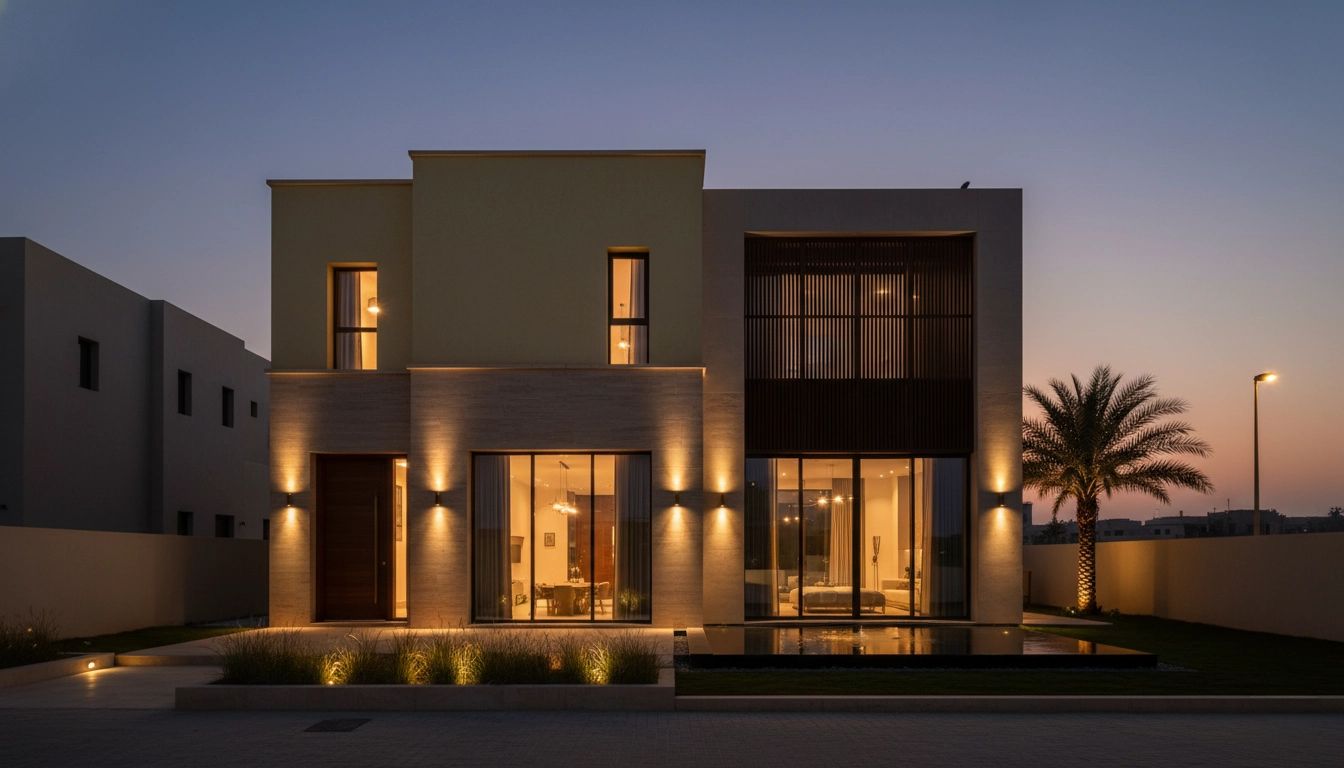
A KNX proposal belongs in a villa where climate, energy, security, and lighting need to run as one system, where the owner wants the option to change integrators without ripping out walls, and where the house is expected to keep working, and keep being serviceable, for twenty years. That is the majority of large villas we see in Dubai, which is why we build on KNX with Haus Logic's custom dashboard as the orchestration layer on top, the same architecture running at a private villa we automated in JVT.
Neither answer is universal. What is universal is the mistake of choosing on keypad finish alone. Read the two proposals for scope, for ownership, and for what happens when the air conditioning is the thing that needs to work. If you would like a second pair of eyes on a proposal you already have, we are happy to walk through it with you. Contact us at projects@hauslogic.ae or on +971 54 764 6619.
Sources
1. KNX Association, members list (500+ member companies). https://www.knx.org/knx-en/for-manufacturers/members/
2. KNX Association, certified products database (8,000+ certified devices). https://www.knx.org/knx-en/for-professionals/get-started/certified-knx-products/
3. KNX Association, Standardisation (ISO/IEC 14543-3, EN 50090). https://www2.knx.org/in/knx/technology/standardisation/index.php
4. KNX Association, Trade Talk: KNX Twisted Pair (29 V DC SELV, power and data on one pair). https://www.knx.org/news/trade-talk-knx-twisted-pair-its-not-just-little-piece-wire
5. KNX Association, What is ETS. https://www.knx.org/what-ets
6. KNX Association, What is a KNX certified training centre (KNX Partner credential). https://support.knx.org/hc/en-us/articles/360021035300-What-is-a-KNX-certified-training-centre
7. DEWA, residential slab tariff. https://www.dewa.gov.ae/en/consumer/billing/slab-tariff