# How Long Does Smart Home Installation Take in Dubai?
Your villa handover is in eleven weeks. The main contractor wants the first fix closed by the end of next month, the joinery drawings are still in review, and someone has just asked whether the automation can be "added later without much fuss". You need a date, not a brochure.
So: how long does a smart home installation take? On a Dubai villa the honest answer is that the wiring happens fast and the thinking happens slowly. The cable pull is rarely what holds a project up. What holds a project up is an unfinished specification, a light schedule that keeps changing, and a programming phase that nobody put in the programme.
Here is how the time actually breaks down, stage by stage, based on how we run villa projects across Dubai and Abu Dhabi.
Stage 1: Design and specification
This is the stage that decides everything after it, and it is the one most often skipped.
Before a single cable is pulled, someone has to decide how many circuits each room needs, which lights dim and which switch, where the keypads go and what each button does, how the air conditioning is zoned, whether the blinds are motorised, and how all of it is going to be reached from a phone at two in the morning. That is a real document, not a conversation.
Expect two to four weeks for a standard villa, longer when the interior design is still moving. The gate is not our drawing speed; it is how quickly the light schedule and the joinery layouts settle. If you want to compress the programme anywhere, compress it here by making decisions early, not by cutting the design short.
Stage 2: First fix, while the walls are still open
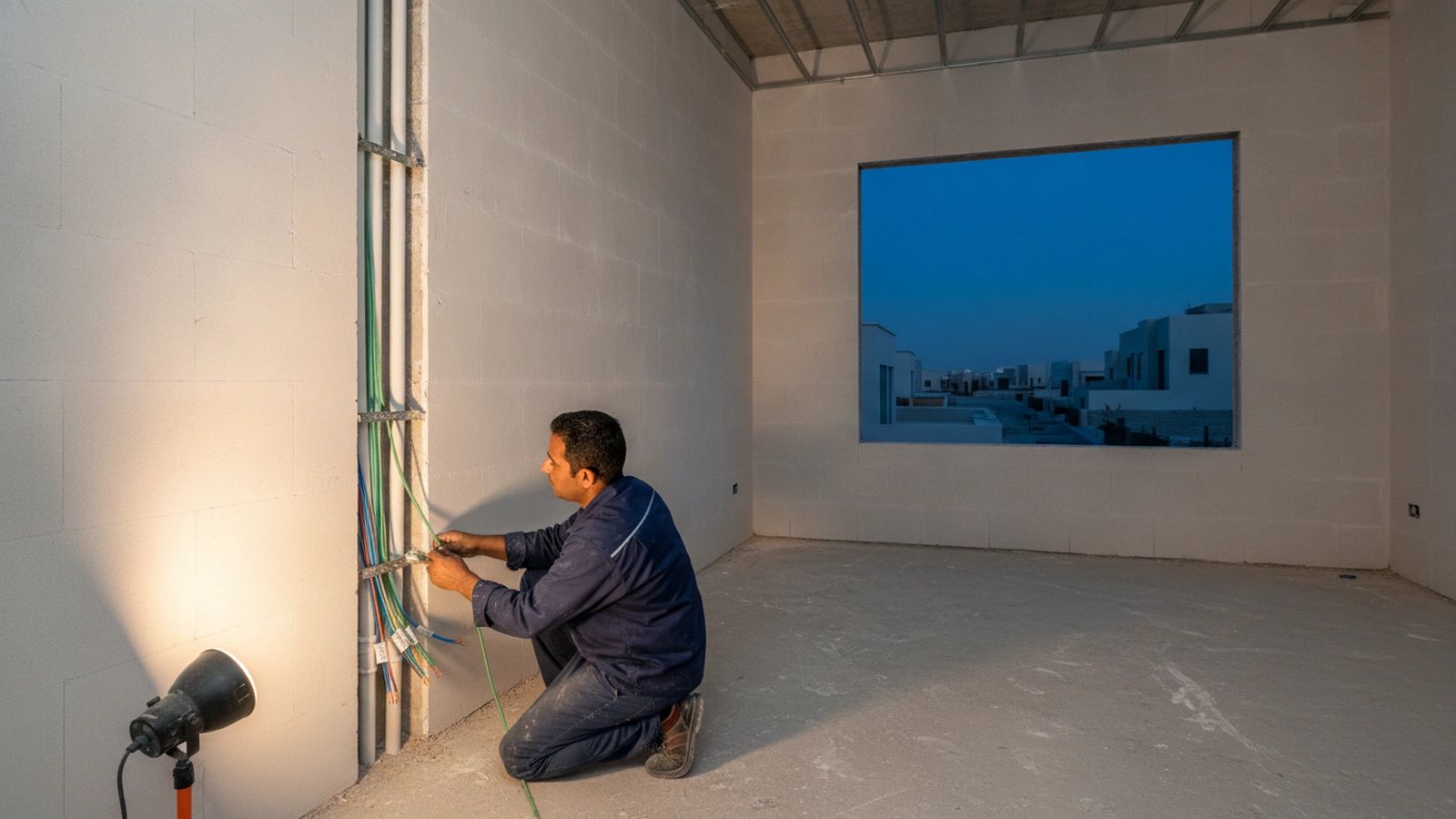
First fix is cable, conduit, back boxes, and the panel space. It runs inside the main contractor's electrical programme rather than alongside it, which is why it feels invisible.
For a typical villa this is one to three weeks of our time on site, spread across whatever window the builder gives us. The work itself is not complicated. The risk is sequencing: once the walls are plastered, adding a circuit stops being a cable pull and starts being a demolition job. Every cable you did not run in this window is a cable you will pay for twice.
This is also where a wired system earns its keep. KNX is an open international standard for home and building control, with devices from hundreds of manufacturers working on the same bus, so the cable you pull now does not commit you to one brand for the next twenty years.
Stage 3: Second fix and device installation
Once the walls and ceilings are closed and the finishes are in, the visible parts go on: keypads, sensors, thermostats, actuators in the distribution boards, and the network hardware.
Allow one to two weeks. This stage is usually the calmest of the five, because by now the decisions have been made and the cable is where it should be. It moves at the speed of the finishing trades around it.
Stage 4: Commissioning and programming
This is the stage clients underestimate, and it is the one that turns a box of components into a system.
KNX projects are configured in ETS, the single manufacturer-independent tool used to design and commission every KNX installation. The published workflow runs in a clear sequence: design the topology, import the product data, define the functions and group addresses, configure each device's parameters, link the group objects, download to the devices, then document the project and hand it over. Nothing in that list is optional, and each step has to be right before the next one means anything.
Plan for one to three weeks depending on how many rooms and how much logic you have asked for. A villa where lighting, climate, shading, and energy monitoring all talk to each other takes longer to commission than a villa where they simply coexist, and the extra time is precisely where the value sits.
Stage 5: Handover and the settling period
On the day you move in, the system works. Over the following weeks, it starts to fit you.
Scenes get adjusted because the evening light is different from what anyone imagined on a drawing. Schedules shift because the family's routine is not the one described in a meeting six months earlier. We budget a settling period of a few weeks after handover for exactly this, and we treat it as part of the job rather than as a warranty claim.
So how long does a smart home installation take in total?
For a new-build villa where the programme is respected, the automation runs from roughly two to four months end to end, and most of that time is spent waiting for the building, not waiting for us. The hours we actually spend on site are a small fraction of the calendar.
Retrofit is a different shape. In an occupied villa the constraint is not the building programme but your family's tolerance for disruption, so the same scope is often split into phases over a longer period, with each phase finished and usable before the next one starts. We have written separately about retrofitting an occupied villa if that is your situation.
What actually causes the delays
In our experience, four things account for almost all lost time, and none of them is the automation itself.
- A light schedule that is still moving. Every change to the lighting layout after first fix is a change to circuits, to the panel, and to the programming.
- Late appointment of the integrator. Being brought in after the walls are closed converts a design problem into a construction problem.
- Decisions spread across too many people. One decision maker and a signed specification will save more weeks than any product choice.
- No time allowed for commissioning. A programme that ends at "devices installed" is a programme that ends before the system works.
The pattern behind all four is the same: the automation was treated as a product to be bought rather than a system to be engineered. If you are still choosing who does the work, our guide on how to choose a KNX installer in Dubai covers what to ask before you sign.
How we handle the timeline
We write the specification before we quote, so the programme is built on a scope that exists on paper rather than on an assumption. We attend the contractor's coordination meetings, because first fix lives or dies on sequencing with the electrical and ceiling trades. We commission in ETS and hand over the project file, the as-built topology, and the documentation, so the system belongs to you rather than to us.
We have been a KNX Partner since 2014 and have delivered projects across the UAE and the UK, including villas in Emirates Hills and a private villa in JVT where the same five stages ran to plan. You can see the full scope of what we design and install on our home automation and villa automation in Dubai pages, and if you want the technology explained before the programme, start with what KNX actually is.
Professionalism is a scheduling question as much as a technical one. We show up when we say we will, we are not late, and we do not cancel. On a construction programme, that is worth more than any feature list.
If you have a handover date and you are trying to work backwards from it, we are happy to look at your programme and tell you honestly what fits.
Sources
1. KNX Association, ETS project workflow from planning to handover. https://www.knx.org/what-ets
2. KNX Association, What is KNX: open standard and multi-manufacturer interoperability. https://www.knx.org/explore-knx/what-is-knx
3. Haus Logic, company credentials and project record. https://hauslogic.ae/about