# Smart Home Palm Jumeirah: What the Sea Air Changes in the Specification
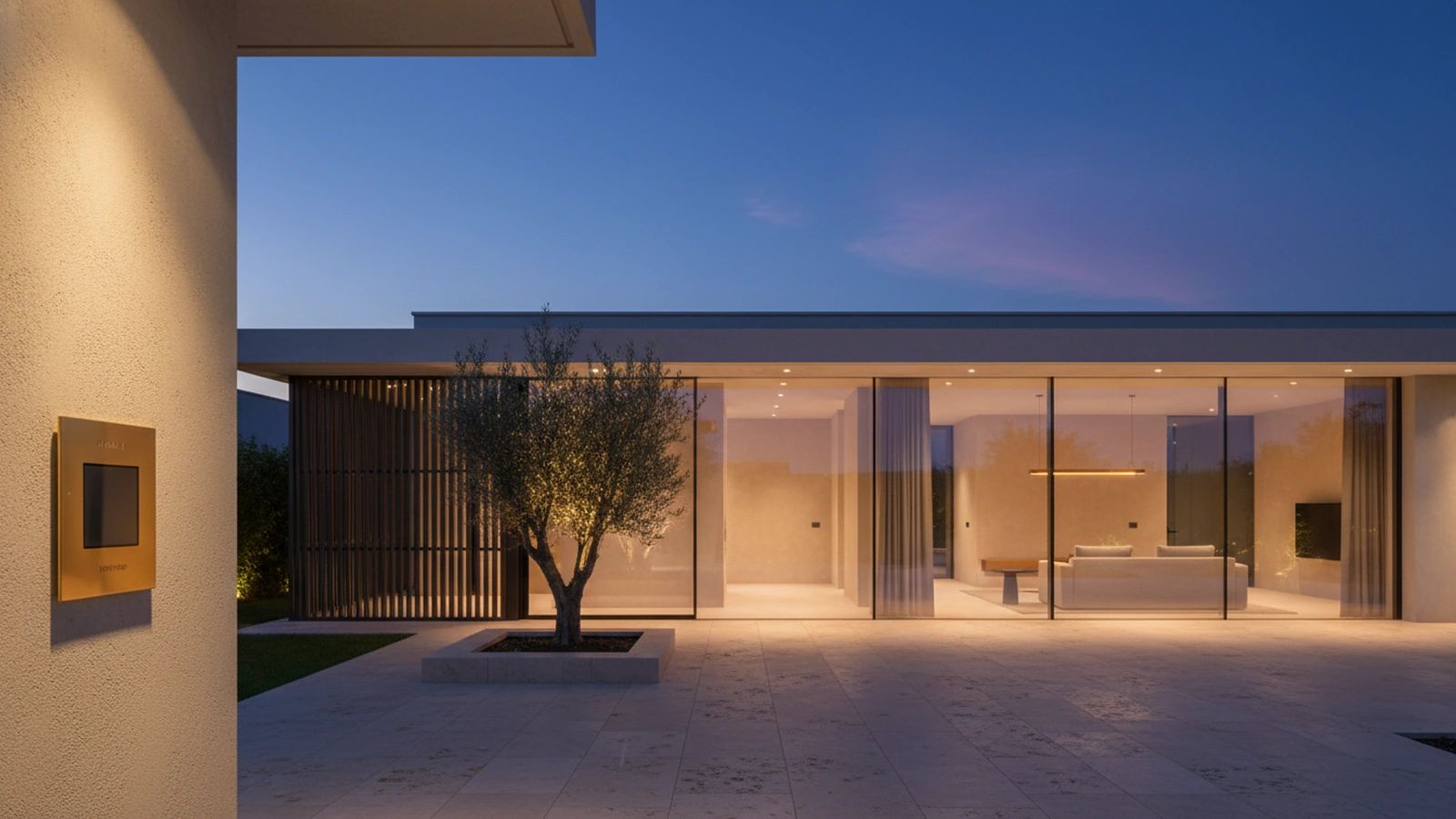
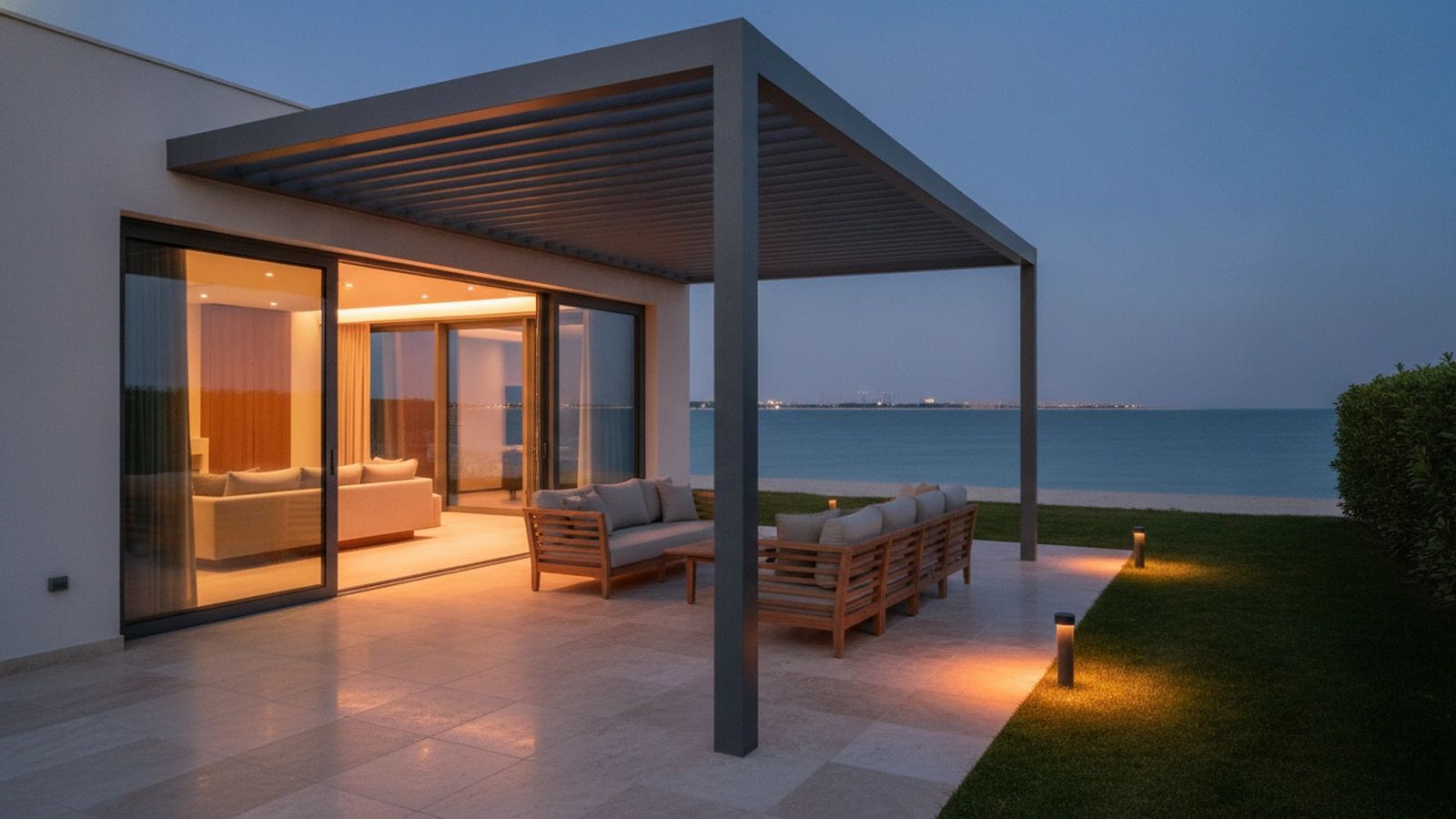
You open the pergola on a mild March evening and one side stops halfway. The gate intercom screen has turned milky. The garden lighting trips whenever the humidity climbs. Nothing was installed badly. It was specified for a house well inland, then fitted a short walk from the water.
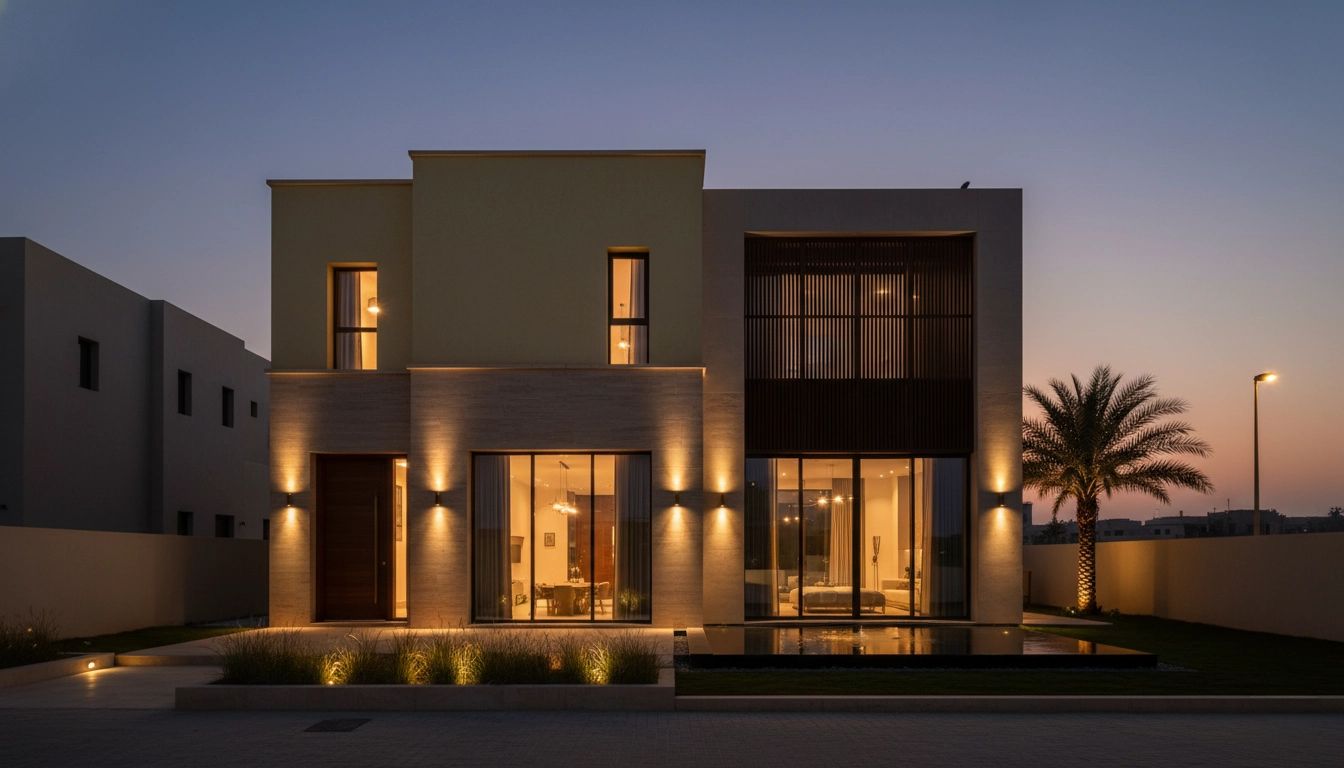
Smart home Palm Jumeirah projects run on the same wired KNX backbone as a villa anywhere else in Dubai. KNX is the open wired standard that carries lighting, climate, shading and security on one bus cable. What changes on the Palm is everything that sits outside the building envelope, and one thing inside it: humidity.
Why a smart home Palm Jumeirah specification starts with the air
The international standard that classifies how corrosive an atmosphere is, ISO 9223, names three drivers: the combination of temperature and humidity, sulphur dioxide pollution, and airborne salinity. A frond villa has the first and the third all year. The standard was written for metals, not for automation, but the principle carries across: the nearer a device sits to salt spray and long damp periods, the harder its housing, fixings and contacts have to work.
So we do not treat the Palm as a normal villa with a sea view. We specify it in four levels, from the outside in.
Level 1: the enclosure
Outdoor devices are sold with an IP code. That code comes from IEC 60529, which classifies the degree of protection an enclosure provides. It is the right first filter, and on Palm projects we set IP66 as the minimum for anything mounted outdoors.
It is only the first filter. An ingress rating describes what an enclosure keeps out. It does not tell you how the housing metal, the screws or the gasket behave after several summers of salt. That is a separate question about materials, and it is the one worth asking a supplier in writing.
Level 2: terminations and boards
Most outdoor failures we are called to look at start at a connection, not inside a device. Our Palm specification calls for sealed terminations and conformally coated circuit boards, meaning boards with a thin protective layer over the electronics.
The second half of this level is about where the intelligence lives. We keep actuators, the devices that actually switch and dim, inside the distribution board indoors. Only the field device goes outside: the light fitting, the valve, the sensor. The part exposed to the weather is then the simplest and cheapest part to replace. We cover the same reasoning for gardens in general in our note on outdoor automation in Dubai.
Level 3: moving parts
Pergola louvres, external blinds and gates are where sea air shows first, because they combine motors, tracks and exposed metal. For beachfront elevations we specify marine-grade motors and salt-resistant tracks, and we program a wind rule so louvres and awnings park themselves before a gust does the parking for them.
Control matters as much as hardware here. A blind that moves only when it needs to lasts longer than one cycled all day by a timer. Our piece on motorised blinds and shading control explains how the control layer decides that, and our blinds automation page shows the options.
Level 4: inspection
No specification removes the need to look. Our service plan for Palm villas includes an inspection of external enclosures twice a year: gaskets, glands, fixings and any sign of moisture inside a housing. It is a short visit that catches a slow problem before it becomes a dead gate on a Friday evening. What a service agreement should cover more broadly is set out in our guide to smart home maintenance in Dubai.
Inside the house: humidity is the hidden load
When humid air meets a surface that is colder than the air's dew point, water condenses on it. On the Palm that is a daily risk: a living room held very cool, a terrace door left open, and moisture forms on glass, grilles and stone.
The answer is coordination, not a lower setpoint. In our climate automation designs for coastal homes, cooling, fresh air, dehumidification and shading are controlled together, room by room. We usually add contacts on the large terrace doors, so a room pauses its cooling when the door stays open instead of fighting the sea air.
Apartments on the Palm follow the same logic
Not every Palm home is a frond villa. At a Serenia Living apartment on Palm Jumeirah we put 20 lighting circuits, four climate zones, eight curtain tracks and seven audio zones on one system. It runs locally, so it keeps working when the internet does not, and the client was handed the complete ETS project file, the programming file of the KNX system, at handover. Exposure is lower in an apartment. The balcony still gets the outdoor treatment.
Four questions to ask before you sign
1. Which outdoor devices are on the schedule, and what is the IP code of each one?
2. What are the housings, fixings and tracks made of, and is that stated in writing?
3. Where do the actuators sit: in the board, or outside with the device?
4. Who inspects the external enclosures, and how often?
A contractor who has worked by the water answers all four without a pause.
How we approach it
We design each waterside community on its own terms. Our Palm Jumeirah villa automation page sets out the coastal specification in full. A community such as Jumeirah Islands sits around inland lakes, not open sea, and gets a different outdoor schedule. The backbone is the same in both: wired KNX, with Haus Logic's custom dashboard on top, and nothing in the core that depends on the cloud.
If you are planning a villa or apartment on the Palm and want the outdoor schedule checked before it is ordered, we are happy to walk through it with you: projects@hauslogic.ae or +971 54 764 6619.
Sources
1. ISO, ISO 9223:2012 Corrosion of metals and alloys, Corrosivity of atmospheres. https://www.iso.org/standard/53499.html
2. IEC, IEC 60529 Degrees of protection provided by enclosures (IP Code). https://webstore.iec.ch/publication/2452
3. Haus Logic, Palm Jumeirah villa automation. https://hauslogic.ae/villas/palm-jumeirah
4. Haus Logic, Serenia Living, Palm Jumeirah portfolio entry. https://hauslogic.ae/portfolio/serenia-living-palm-jumeirah