# Outdoor Automation Dubai: Which Controls Survive the Garden, Heat and Dust
It is a quarter to eight on a July evening. The sun is down, the pool is dark, and the path lights are still off because someone set the timer in winter, when the sun went down much earlier. Nobody notices until a guest walks to the car.
Outdoor smart home automation in Dubai is a different job from the same work indoors. The equipment sits in direct sun, the sprinklers overspray the wall, the dust finds every gap, and nobody opens a garden junction box until something stops working. Four decisions keep an outdoor system dependable: where the electronics live, what triggers the lights, how shading reacts to weather, and when the cable goes in.
Outdoor smart home automation in Dubai starts with the enclosure
Every outdoor device should carry a stated protection rating. IEC 60529 is the international standard that classifies the degrees of protection provided by enclosures, which is where the IP code on a datasheet comes from. A rating tells you what the enclosure is built to resist. It does not tell you where it was mounted.
So the rating is half the question. The other half is position: out of the sprinkler's throw, out of standing water, shaded where possible, and reachable without a ladder. A well-rated sensor in the wrong place still fails.
Our rule is to keep the intelligence indoors. The actuators, the power supplies and the logic sit in the distribution board. Outside, we put only what has to be outside: the luminaire, the sensor, the valve. That keeps a service call short and keeps the fragile parts out of the heat.
Light by brightness, not by the clock
A timer knows the date it was set. It does not know whether the evening is clear, dusty or overcast. KNX Association guidance on weather stations describes switching internal lighting from external brightness levels, and it lists sunset and sunrise times as a less accurate alternative to measuring brightness directly.
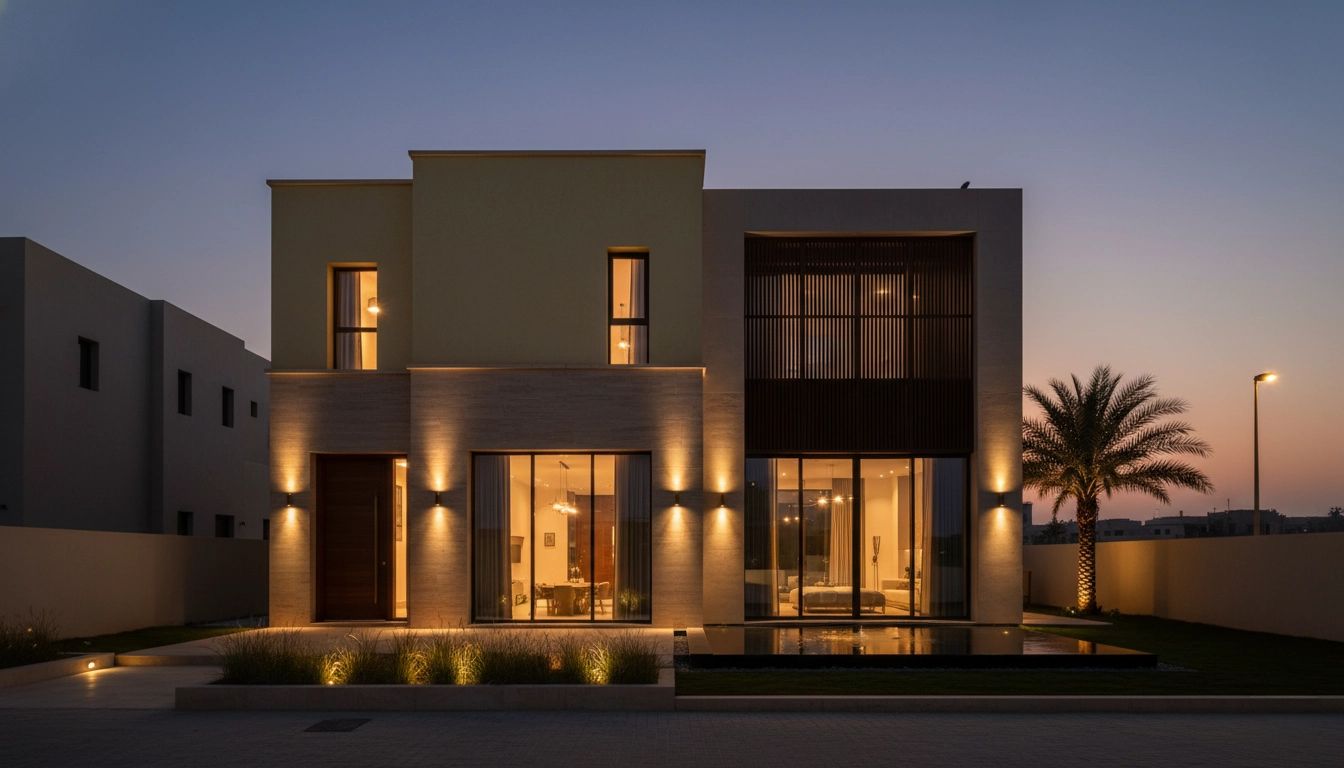
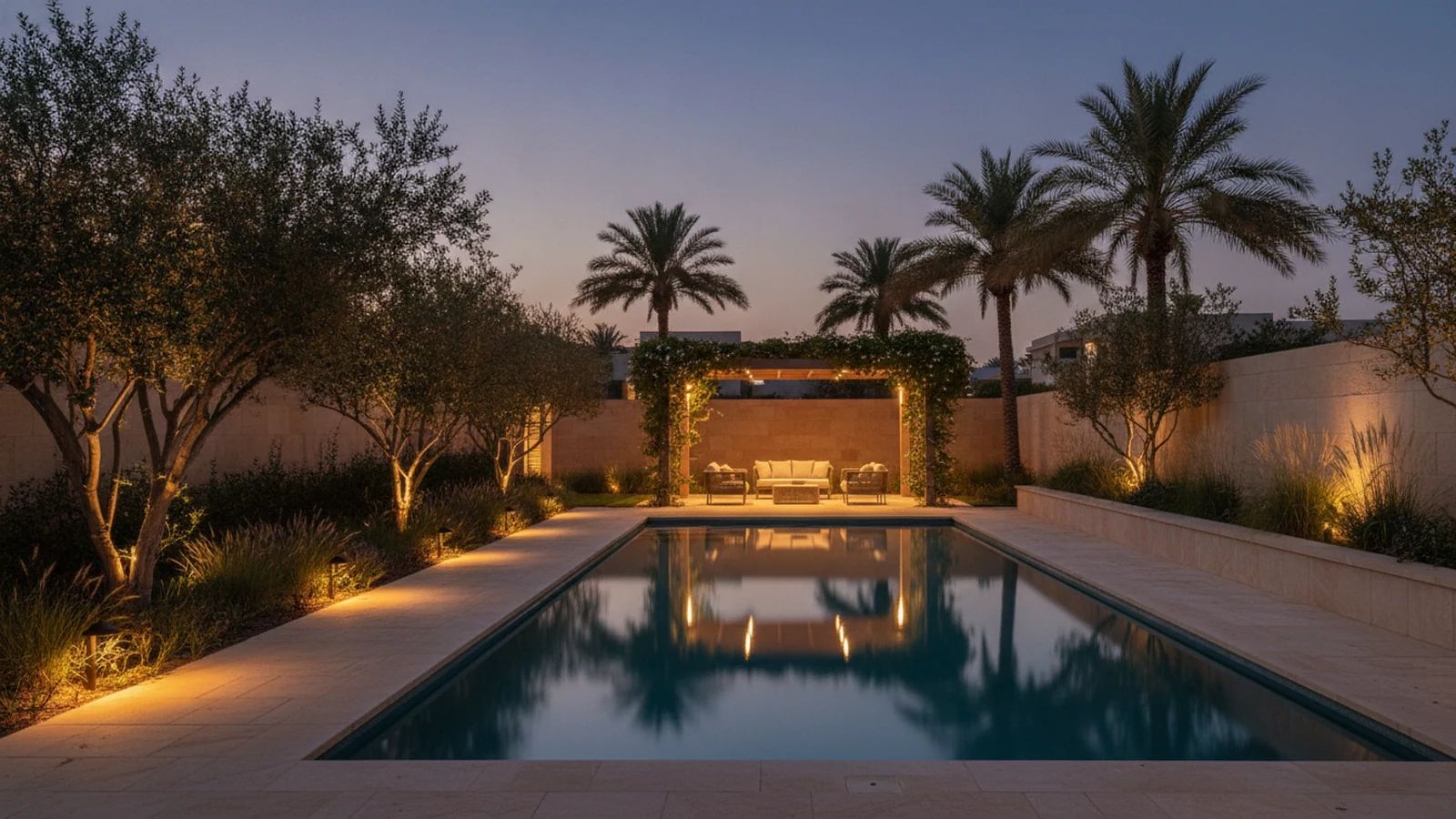
That gives you two honest options. A schedule calculated from sunset is simple, and it tracks the seasons without anyone touching it. A brightness sensor reacts to the actual evening, which matters on a hazy day. At the Jumeirah Village Triangle villa we documented, the perimeter lighting runs from sunset to 10 pm, with a separate floodlight on the dark side of the plot. Where an owner wants lighting to respond to a heavy, hazy dusk, we add the brightness sensor.
For the indoor side of the same logic, see our note on smart lighting decisions before first fix and our lighting automation page.
Shading, wind and rain
Pergola louvres, external blinds and awnings are moving parts exposed to weather. KNX Association guidance on weather stations notes that wind speed readings can protect external shutters, that rain can close skylights, and that brightness can drive blinds closed to limit solar gain.
The principle is that wind always wins. A wind rule retracts or locks the shading before the scene logic gets a vote. We apply the same approach to pergola louvres and awnings, because a gust does not wait for the afternoon schedule. The comfort logic then sits on top: close on brightness, open when the sun moves off the façade. Our guide to motorized blinds and the control layer covers the indoor version, and the blinds automation page explains what we install.
Irrigation, pool and gate: let the controller decide
KNX Association guidance says rain readings can feed irrigation control, though a soil moisture probe is the better input. That matches how we think about it: the sensor closest to the problem makes the best decision. We cover the full logic in what a villa garden controller should decide, and the service itself is on our irrigation automation page.
At the JVT villa the lawn sprinklers fire only when a camera triggers them, with a 15-minute failsafe cutoff so a stuck zone cannot run on. The pool pumps run continuously. Neither is exotic. Both are decisions made once, written into the logic, and left alone.
Pool plant and gate motors usually arrive with their own controllers. The job is not to replace them. It is to connect them to the same scenes and status as the rest of the house, so "goodnight" can confirm the gate is shut and the garden lights are on their night setting.
Decide before the landscaping is poured
The outdoor cable run is the cheapest and the most regretted decision in the project. Once paving, planting and the pool deck are finished, adding a conduit means breaking something that was just paid for. Run the conduit to every position that might ever need a sensor, a valve or a light, even where nothing is installed on day one. Our note on what to specify before the walls are closed applies outdoors as much as in.
An empty conduit costs very little. It keeps the option open, because KNX Association material describes more than 8,000 devices from over 500 manufacturers that are guaranteed to work together. A device you did not need at handover can be added later without rebuilding the system.
How we handle outdoor systems at Haus Logic
We design the outdoor layer with the landscape contractor, not after them. The conduit routes, the valve positions and the light points are agreed on the drawings, and the electronics stay in the distribution board. Haus Logic's custom dashboard then shows gate, lighting, irrigation and pool status alongside the indoor systems, so one screen answers "is the house closed up?" You can see the result in our JVT villa case study, and the wider approach on our automation solutions page.
If you are curious what outdoor automation could look like for your villa, we are happy to walk through the options. You can reach us at projects@hauslogic.ae or +971 54 764 6619.
Sources
1. International Electrotechnical Commission, IEC 60529: Degrees of protection provided by enclosures (IP Code). https://webstore.iec.ch/publication/2452
2. KNX Association, Tips: Making the Most of Weather Stations. https://www.knx.org/news/tips-making-most-weather-stations
3. KNX Association, KNX for Home and Building Owners. https://www.knx.org/explore-knx/knx-home-building-owners
4. Haus Logic, Private villa in Jumeirah Village Triangle case study. https://hauslogic.ae/case-studies/private-villa-jvt