# Smart Lighting Dubai: The Four Decisions Made Before First Fix
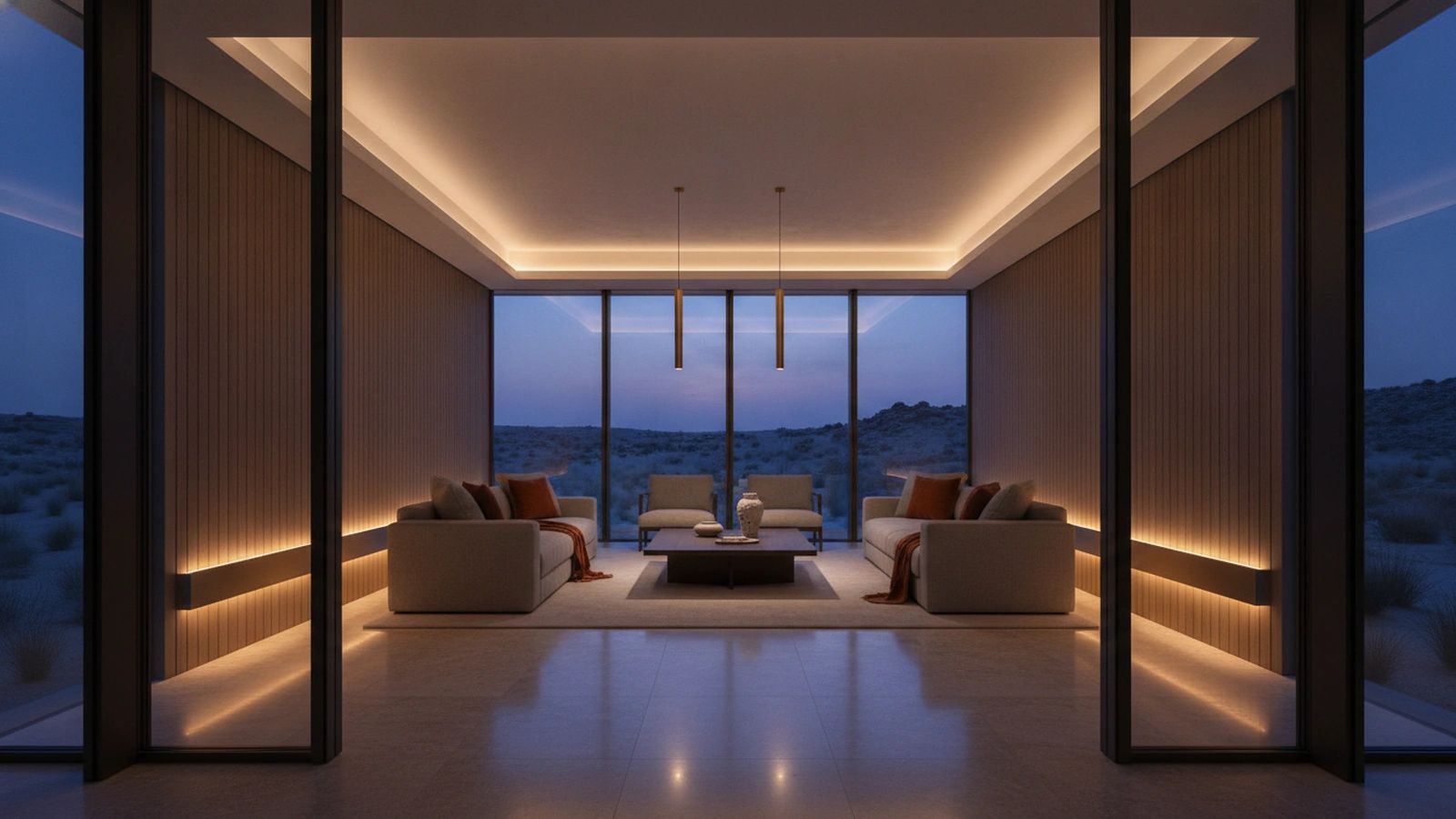
You walk into a newly handed-over villa at seven in the evening. The majlis has fourteen downlights, and they are all on one switch. The cove lighting the architect drew is wired to the same circuit as the pendants. There is no dimmer, because the electrician was never told there would be one. The room has exactly two states: a hospital corridor, or dark.
Search smart lighting Dubai and you will get a wall of product pages: bulbs, hubs, apps, colour-changing strips. Almost none of it addresses the villa above, because the problem in that majlis was not decided by a product. It was decided months earlier, at first fix, when the circuits were pulled and nobody asked what the lighting was supposed to do.
Lighting is the system homeowners notice most and specify last. In a Dubai villa, often handed over as a shell with a basic electrical layout, four decisions determine whether you end up with lighting you control or lighting you merely switch. All four happen before the plaster goes on.
Decision One: Circuits, Not Bulbs
The single most consequential choice in a villa lighting design is how many separately controllable circuits each room gets.
A smart bulb makes one light programmable. A circuit strategy makes a room composable. If the fourteen downlights in that majlis had been split into four circuits, perimeter, centre, cove, and pendants, the room would have had a dozen useful states instead of two. The bulbs themselves could have stayed ordinary.
This is why we ask for a lighting layout before the electrician starts, not after. Splitting a circuit while the walls are open is a routine change. Splitting it after handover means chasing a wall, re-plastering, and repainting a room you have already paid to finish. The cost difference is not marginal, and it is the single most common regret we are called in to fix.
The rule we work to is simple: group lights by the mood they serve, not by the ceiling they share.
Decision Two: The Driver Decides Whether It Dims
In the dimming callouts we attend, the fault is usually not in the control system. It is a compatibility mismatch, and it traces back to the LED driver.
LED fittings do not dim the way incandescent lamps did. A driver sits between the mains and the diode, and how that driver expects to be dimmed determines what you can put in the panel. Phase dimming, leading or trailing edge, is decided by the driver's internal design. Get it wrong and you see the familiar symptoms: flicker at low level, a hard cut-out well above zero, audible buzz, or lamps that refuse to strike at all.
The alternative is a digital dimming protocol, where the fitting is addressed by data rather than by chopping the mains waveform. The best known of these is DALI, published by the International Electrotechnical Commission as the IEC 62386 series, which covers control gear and control devices for control by digital signals of electronic lighting equipment. A digitally addressed fitting reports its state back; a phase-dimmed one does not.
The practical point for a villa owner is this: the dimming decision is made when the fittings are selected, not when the control system is chosen. Choose fittings first, without checking the driver, and you have already narrowed what the control system can do.
Decision Three: The Control Layer
Once the circuits exist and the drivers are known, something has to switch and dim them. This is where the wired-versus-wireless question actually lands, and we have covered that trade-off in full in KNX vs WiFi in a Dubai villa.
Our position is the wired one, for a specific reason. KNX is approved as an International Standard, ISO/IEC 14543-3, as a European Standard under CENELEC EN 50090 and CEN EN 13321, as the Chinese standard GB/T 20965, and its mapping to BACnet is documented under ANSI/ASHRAE 135. That matters less as a specification credential than as a practical guarantee: the keypad, the dimmer module, and the sensor do not have to come from the same manufacturer, and none of them has to be in production in ten years for the room to keep working.
A lighting system on a wired bus also fails in a contained way. If the network goes down, the light still switches at the keypad, because the logic sits in the device rather than in a server somewhere else.
Decision Four: What the Light Responds To
The fourth decision is the one people think of as "smart", and it is the least expensive to change later, provided the first three were done properly.
Lighting control gets useful in stages. Level one is switching. Level two is dimming. Level three is scenes, where one press sets a whole room. Level four is lighting that responds without being asked: presence in a corridor at two in the morning, daylight compensation on a west-facing room, landscape circuits that follow sunset rather than a fixed clock time. We set the whole progression out in the four levels of lighting control.
Dubai adds two things to that progression. The first is daylight: west and south elevations take the heaviest late-day sun, so blinds and lighting need to be coordinated rather than fought separately. The second is the outdoor circuit. Landscape, façade, and pool lighting typically run every night for hours, and they are the circuits most often left on a manual switch nobody touches until the bill arrives.
Smart Lighting Dubai: Where the Energy Argument Actually Sits
We are careful about savings claims here, because lighting is not where the big number is in a Dubai villa. DEWA is explicit that electricity use in Dubai peaks between 12pm and 6pm in summer, and that air conditioning consumes a large portion of the electricity generated during those peak hours. Cooling is the headline; lighting is not.
What lighting control does contribute is the part that never gets measured: circuits that are off because nobody is in the room, outdoor lighting on astronomical rather than arbitrary schedules, and dimmed levels that draw less than full output. DEWA's own peak-load guidance includes turning off unnecessary lights and appliances. Automation is simply the version of that advice that does not depend on someone remembering.
There is a compliance dimension too. Al Sa'fat, the Dubai Green Building System, replaced the earlier Dubai Green Building Regulations from 19 October 2020 and sets mandatory requirements that all new buildings must meet to obtain the Silver Sa'fa rating, with higher tiers available for better performance. Lighting and controls sit inside that framework, which is worth knowing before a design is finalised rather than after.
How We Handle This
On our own projects, lighting is the first conversation, not the last. We produce a circuit schedule against the architect's lighting layout before first fix, confirm the driver type for every fitting family on the schedule, and specify the dimming method per circuit rather than per house. Control is KNX on a wired bus, with scenes and daylight logic layered on afterwards through our custom dashboard.
You can see the result of that sequencing in our private villa in JVT, where the lighting was designed as circuits and scenes from the drawings rather than retrofitted into a finished ceiling. The same approach runs through our lighting automation work generally, and ties into energy management once the circuits are addressable and can actually be measured.
If the villa is already finished, none of this is lost. The options narrow and the method changes, and we have written honestly about what a retrofit in an occupied villa actually costs in disruption in our retrofit guide.
If you are at design stage and want the lighting decided properly before the electrician starts, we are happy to walk through the layout with you. You can reach us at projects@hauslogic.ae or on +971 54 764 6619, and you can see the wider scope of what we do on our automation solutions page.
Sources
1. KNX Association, Standardisation. https://www2.knx.org/in/knx/technology/standardisation/index.php
2. International Electrotechnical Commission, IEC 62386-105:2024, digital interfaces for lighting control gear and control devices. https://webstore.iec.ch/en/publication/77874
3. Dubai Electricity and Water Authority, Peak Load guidance. https://www.dewa.gov.ae/en/about-us/sustainability/lets-make-this-summer-green/peak-load
4. Dubai Municipality, Al Sa'fat Dubai Green Building System. https://www.dm.gov.ae/municipality-business/al-safat-dubai-green-building-system/