# Can You Add Home Automation to an Existing Villa? Yes, and Four Things Decide How
You bought the villa finished. The marble is down, the ceilings are closed, the joinery is in, and the family has been living in it for three years. Now you want the lights, the air conditioning, the blinds and the gate to behave like one house instead of forty separate switches. The question you have typed into a search bar is the one we hear at almost every first meeting: can you add smart home automation to an existing villa without tearing it apart?
Yes. We do it regularly. But "yes" is the least useful part of the answer. What matters is which of four conditions your villa is in, because that decides how much of the system can be wired, how much has to be wireless, and how much of what you actually want is achievable without a renovation. This article walks through those four conditions in order, from easiest to hardest, so you know which conversation to have before an integrator arrives with a brochure.
Condition 1: A renovation is already planned
If you are about to redo the kitchen, strip the bathrooms or re-lay the flooring, you are in the best possible position. Walls and ceilings will be open somewhere, and open walls are where a proper automation backbone belongs.
Our recommendation in this case is always the same: run a wired bus at the same time as the electrical rework. KNX twisted pair is the standard we use; the KNX Association describes it as suited to new builds and major renovations where cabling can be integrated, and it connects more than 8,000 certified products from over 500 manufacturers on one cable. Pull the green cable to every switch position, every blind motor and every fan coil unit or thermostat location while the ceilings are down, and you have converted a retrofit into what is functionally a new install. Nothing else you do in the house will be as cheap per point as this moment, and it does not come round twice.
The practical trap is sequencing. The automation design has to exist before the electrical contractor starts, not after, or the cable goes in where it is convenient rather than where the logic needs it. We covered the cost and disruption side of this in retrofit smart home in an occupied Dubai villa.
Condition 2: No renovation, but accessible ceilings and risers
Many Dubai villas built in the last fifteen years have suspended gypsum ceilings in corridors and service areas, a plant room or roof space where the AC units live, and electrical risers that run from the distribution boards to each floor. If yours does, a surprising amount of wired automation is possible without touching a finished wall.
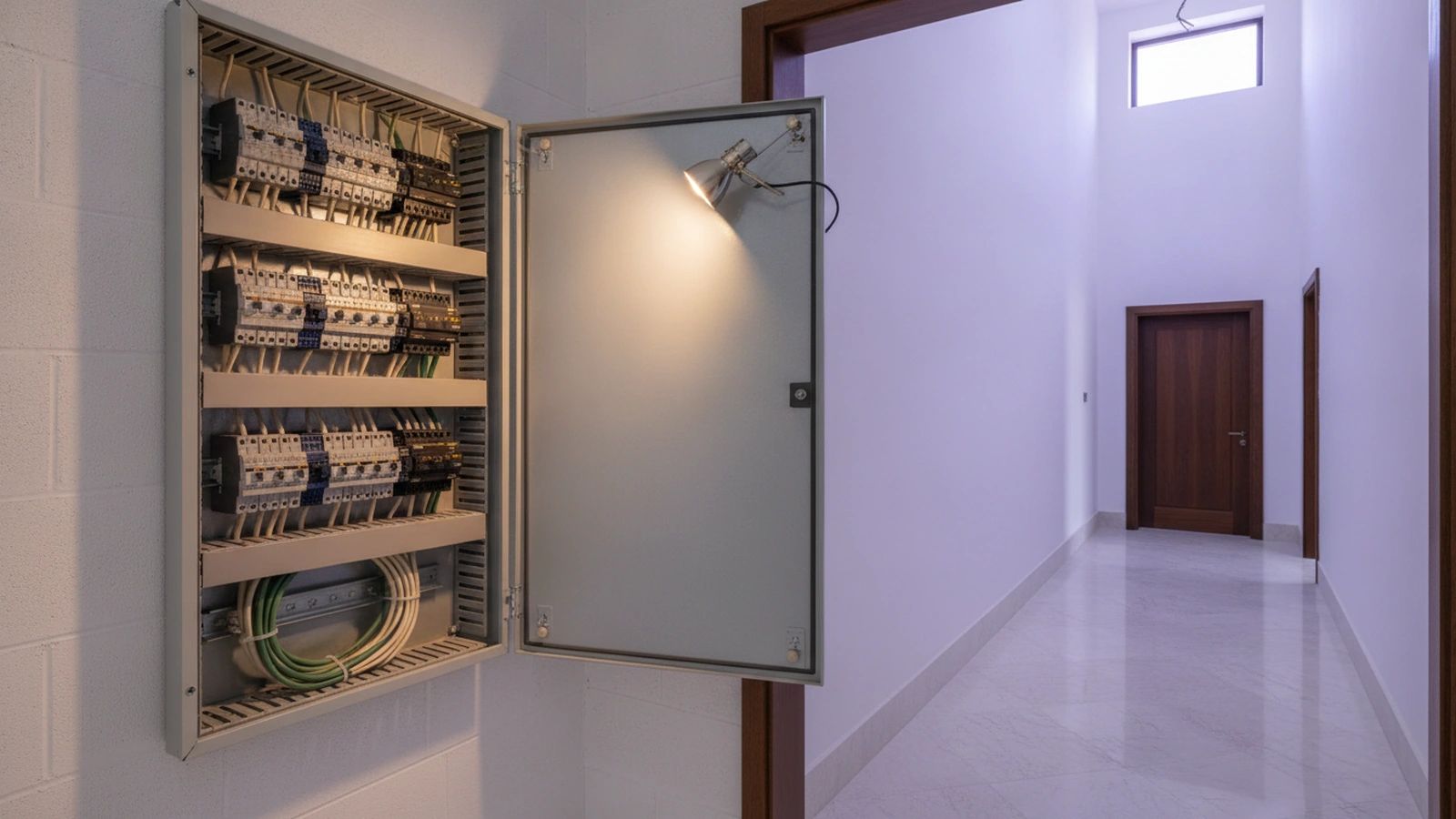
The trick is to work from the distribution board outward. Lighting circuits and blind motors already return to a board; replacing conventional relays with KNX actuators at the board puts those loads on the bus without a single new cable behind the plaster. Air conditioning is often the same story: fan coil units and their thermostat cables run through the ceiling void, and a KNX room controller can usually be fitted at the existing thermostat position. This is where the bill savings live. DEWA has said air conditioning accounts for about 60 percent of peak summer load and recommends a programmable thermostat and a 24 degree set point, noting that each degree added can save up to 5 percent of AC consumption. Zoned, scheduled climate control is the first thing we specify in any retrofit, and the reason is our climate automation work, not the lighting.
What you lose in this condition is the wall switch itself. The existing switch positions are wired for mains, not for a bus, and there is usually no spare core. The answer is Condition 3.
Condition 3: Finished walls, no access, family in residence
This is the case most people mean when they ask the question, and it is where wireless earns its place, provided it is the right kind of wireless.
KNX has a radio medium, KNX RF, that runs on sub-GHz frequencies and joins the wired bus through a media coupler. The KNX Association lists retrofitting existing buildings without opening walls as one of its primary use cases, along with battery-powered or battery-less wall transmitters. In practice that means a KNX RF push button can sit at the existing switch position, powered by a small battery or, in battery-less designs, by the press itself, and talk to actuators that live in the board. The house gets a unified wired backbone for the loads and a wireless edge for the human touch points. The switches stop being the weak link because they carry almost no traffic and do not depend on the household WiFi.
The alternative most retrofit proposals offer is a wireless-only ecosystem: WiFi or Zigbee bulbs, plug-in relays and a hub. It installs in a day and it works, until the router is replaced, the mesh saturates, or the cloud account changes hands. We explained the difference in KNX vs WiFi smart home in a Dubai villa. In a villa with block walls and multiple floors, the wired-backbone-plus-RF-edge model is the one that still works in year ten.
What is not achievable in this condition without opening a wall: motorising blinds that have no power at the window, adding a keypad where no switch exists, and relocating thermostats. Be suspicious of any proposal that promises those things with no making good.
Condition 4: A rental or a villa you will sell within a few years
If the villa is not yours for the long term, the calculation changes. Anything buried in the fabric of the building stays with the building. The sensible scope is board-level actuators for lighting and AC, which improve the property and can be documented for the next owner, plus RF or portable controls that leave with you. We would not recommend running new bus cable through a rented villa; we would recommend a tenant-friendly scope that still zones the air conditioning, because that is where the monthly saving is.
Can you add smart home automation to an existing villa well? Three rules that hold in every condition
Three things hold across all four conditions. First, start with the loads that cost money, which in Dubai means cooling, then lighting, then shading. A retrofit that begins with coloured bulbs and a voice assistant has started at the wrong end. Second, insist on a system another engineer can service. A wired open standard with a portable project file protects you from your own integrator's future. Third, treat the app as the last layer, not the first. If the internet drops, the wall switch must still switch and the AC schedule must still run. Our custom dashboard sits on top of the KNX system for exactly this reason: it orchestrates, it does not gatekeep.
For a full inventory of what can be brought under control in a finished house, see what can actually be automated in your home. For the specific case of a house you are still living in during the works, the occupied villa retrofit article covers dust, phasing and access.
How we approach an existing villa
Our first site visit for a retrofit is not a sales meeting. We open the distribution boards, look above the ceilings in the corridors and plant room, trace the AC thermostat cables and count the switch positions. That survey tells us which of the four conditions each part of the house is in; most villas are in more than one. The design then puts wire wherever wire can go, KNX RF wherever it cannot, and the AC on the bus first in every case. You can see that approach in the executive villa in Sharjah and the family villa in Abu Dhabi in our portfolio, and read more about how we scope automation solutions for finished homes.
If you are living in a villa that was never designed to be smart and want to know which condition it is in, we are happy to come and look before anyone talks about systems.
Sources
1. KNX Association, KNX Technology, KNX TP and KNX RF media and use cases. https://www.knx.org/manufacturers-hub/knx-technology
2. DEWA, Set your AC to 24°C, set point and thermostat guidance. https://www.dewa.gov.ae/en/about-us/sustainability/lets-make-this-summer-green/set-your-ac-to-24
3. DEWA, annual peak load reduction campaign, air conditioning share of peak load. https://www.dewa.gov.ae/en/about-us/media-publications/latest-news/2016/08/dewa-launches-annual-peak-load-reduction-campaign