# Home Cinema Dubai: Why the Room and the Wiring Decide More Than the Projector
It is Friday night in August. The villa is sealed against the heat, the kids are asleep, and you press Play on a film you have waited months for. Ten minutes in, you notice the supply grille above the sofa hissing over every quiet scene, the downlights that will not dim below a glare, and the four remotes it took to get here. The projector cost more than the car it replaced in the garage. The room is still not a cinema.
When people search for home cinema Dubai, most of what comes back is equipment: projectors, screens, speaker packages. Equipment is the easy part. In our experience across villa projects, the rooms that disappoint were almost never let down by the projector. They were let down by the room, the cables inside its walls, and the control layer that was supposed to tie everything together and never did. This article is about those three things, arranged as four levels, so you can decide where your villa should land before anyone quotes you a screen.
Home cinema Dubai, in four levels
Level 1: the living room that plays films
A large television, a soundbar, streaming from the same apps you use on your phone. Nothing wrong with it, and for many families it is the honest answer. The limits are physical: the room has windows on two sides, the sofa is not where the sound needs it to be, and the lighting was designed for dinner, not for a screen.
What automation can do here is modest but real. Blackout blinds on a schedule or a scene, a "Film" scene that drops the lighting to a low level and switches the accent channels off, and a single keypad or dashboard button that replaces the remotes. That last point matters more than it sounds. A cinema that needs four remotes is a cinema that the rest of the family will not use.
Level 2: the media room
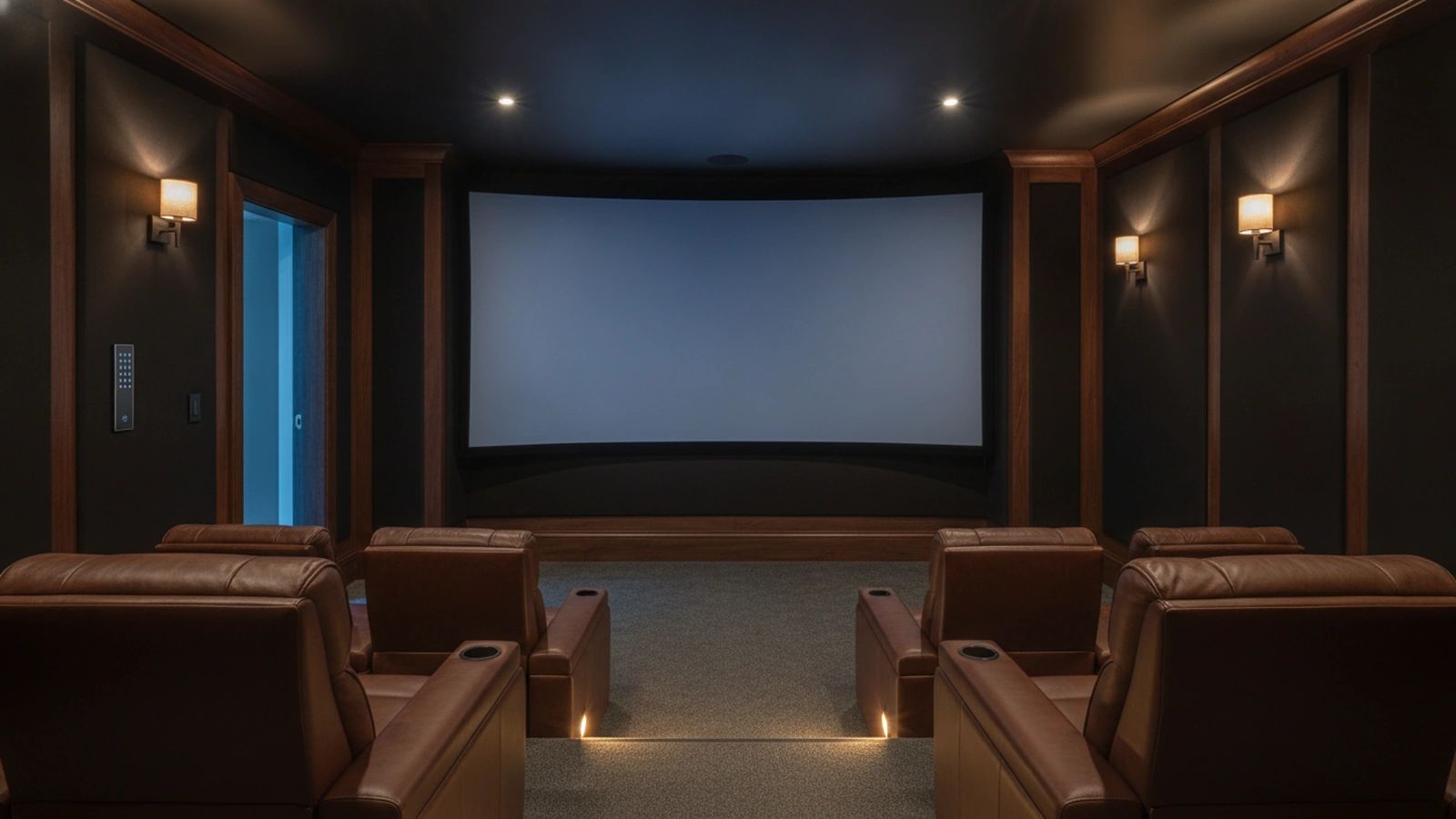
A dedicated room, usually with no external windows, a projector or a very large display, and a surround system. This is where most Dubai villa cinemas sit, and it is where the wiring decisions start to bite.
The speaker layout is not a matter of taste. Dolby's own guidance for Atmos describes the layouts by three numbers: ear-level speakers, subwoofers, and height speakers, so a 5.1.2 room has five speakers around the seating, one subwoofer and two overhead channels, and a 7.1.4 room adds side surrounds and four overhead channels. Dolby also states that the ear-level speakers should sit at seated ear height and be angled at a central seating position. Every one of those speakers needs a cable in the right place before the ceiling closes. Overhead channels in particular are almost impossible to add gracefully after the plasterboard is up, which is why we ask about the cinema at the first design meeting, not the last.
The other wiring question is power. A rack of amplifiers, a projector and a source stack are a real load, and they belong on their own circuits from a distribution board that has been inspected, not on the nearest socket ring. In a KNX villa those circuits are also switched, so the whole rack can power down properly when the room is not in use.
Level 3: the engineered cinema room
This is the level most people picture and few actually get, because it is defined by measurement rather than by brand. The industry now has a published recommended practice for this: CEDIA/CTA-RP22, the Immersive Audio Design Recommended Practice, produced by film-studio, manufacturer and integrator representatives. It defines four performance levels for a room: Level 1 conveys basic artistic intent, Level 2 conveys it more accurately, Level 3 meets or exceeds reference commercial cinema exhibition standards, and Level 4 is the maximum achievable on every parameter. Each level is described by measurable design parameters, from speaker layout and coverage to room proportions, sound isolation and maximum sound pressure, that can be predicted during design and then verified before the system is signed off.
Two things follow for a villa in Dubai. First, the room itself becomes an engineered object: the dimensions, the wall build-up, the door, and the isolation from the rest of the house all matter, and they are decided with the architect, not with the AV supplier. Second, the air-conditioning becomes an acoustic problem. A cinema room needs its own climate zone with low-velocity supply and a quiet return, and it needs that zone to pre-cool before the film and hold temperature quietly during it, because the equipment inside the room is heating it. That is a controls problem as much as a mechanical one, and it is where the automation layer earns its place.
Level 4: the cinema that belongs to the house
At this level the cinema is not a separate island with its own control system. It is one room of the villa, run by the same wired backbone that runs the lighting, blinds, climate and security everywhere else.
On a KNX installation that looks like this. Lighting in the room is on DALI through a KNX gateway. As the KNX Association's own guidance on DALI in homes explains, each DALI fitting is individually addressable, groups can be re-assigned in software rather than by rewiring, and the sensors and keypads that trigger scenes sit on the KNX bus. In practice that means the step lights, the sconces and the ceiling wash each fade at their own rate when "Film" is pressed, and the exit lights come up when "Pause" is pressed, without a single cloud account in the chain. Blinds close on the same command. The AC setpoint and fan profile change on the same command. When the room has been empty for an hour, the rack powers down and the climate zone relaxes. The projector's own control protocol sits behind the dashboard, so the family sees one button, not four remotes.
We built exactly this layering at a Palm Jumeirah apartment in Serenia Living: a Theben KNX backbone dimming twenty lighting circuits, a DALI gateway giving each fitting its own channel, seven audio zones and four climate zones on the same keypads and dashboard, all running locally so the room still works when the internet does not. On the commercial side, No.11 Cavendish Square in London taught us how to integrate a third-party AV system into a KNX house with DALI, tuneable white and room-splitting logic, in a Georgian building where nothing could show. The same disciplines transfer directly to a villa cinema.
What decides the result, in order
If you take one thing from this article, take the order of priority. Room first: position, dimensions, isolation, and whether it has its own AC zone. Wiring second: every speaker cable, every dedicated circuit, every DALI line and network drop in place before the ceiling closes, on the same wired standard as the rest of the house. Control third: one backbone, one dashboard, scenes that run locally. Equipment last, because a well-wired room can take a better projector in five years, but a badly wired room cannot take anything without opening the walls.
This is also why we recommend deciding the cinema alongside lighting and scenes, climate automation and the home network, not after them. The four levels of lighting control map almost one-to-one onto the four cinema levels above, and the arguments in KNX vs WiFi for a Dubai villa apply with more force in a room where a dropped wireless packet means a missed cue. If you are still choosing a platform, our guide to smart home hubs explains why the hub matters less than the bus underneath it.
Where we come in
We design and install the room's electrical, lighting, climate, network and control infrastructure on KNX, coordinate the acoustic and mechanical scope with your architect and consultant, and integrate the AV system your specialist supplies so it lives inside the villa's dashboard rather than beside it. The result is a cinema the whole family uses because it takes one press to start, and one press to leave.
If you are planning a villa and the cinema is on the wish list, the best time to talk to us is before the ceilings are designed. We are happy to walk through the options with you.
Sources
1. CEDIA/CTA-RP22 Immersive Audio Design Recommended Practice, version 1.2 (four performance levels, Level 3 as commercial cinema reference, design parameters). https://cedia.org/site/assets/files/6057/cedia-cta_rp22_v1_2_sept_2023.pdf
2. Dolby, Dolby Atmos Speaker Setup 101 (layout numbering, seated ear height, angling to the central seat). https://www.dolby.com/about/support/guide/dolby-atmos-speaker-setup/
3. Dolby, Dolby Atmos Home Theater Installation Guidelines (5.1.2 and 7.1.4 layouts). https://www.dolby.com/siteassets/technologies/dolby-atmos/atmos-installation-guidelines-121318_r3.1.pdf
4. KNX Association, Lighting: Pros and Cons of using DALI with KNX for Homes (individually addressable DALI fittings, software regrouping, sensors on the KNX bus). https://www.knx.org/news/lighting-pros-and-cons-using-dali-knx-homes
5. Haus Logic, Palm Jumeirah Apartment, Serenia Living (Theben KNX, DALI, 20 lighting circuits, 7 audio zones, 4 climate zones). https://hauslogic.ae/portfolio/serenia-living-palm-jumeirah
6. Haus Logic, No.11 Cavendish Square, London (KNX retrofit with DALI, tuneable white, AV integration, room-splitting logic). https://hauslogic.ae/portfolio/uk-townhouse-events-venue