# How Does KNX Work? What Happens Between the Keypad Press and the Light
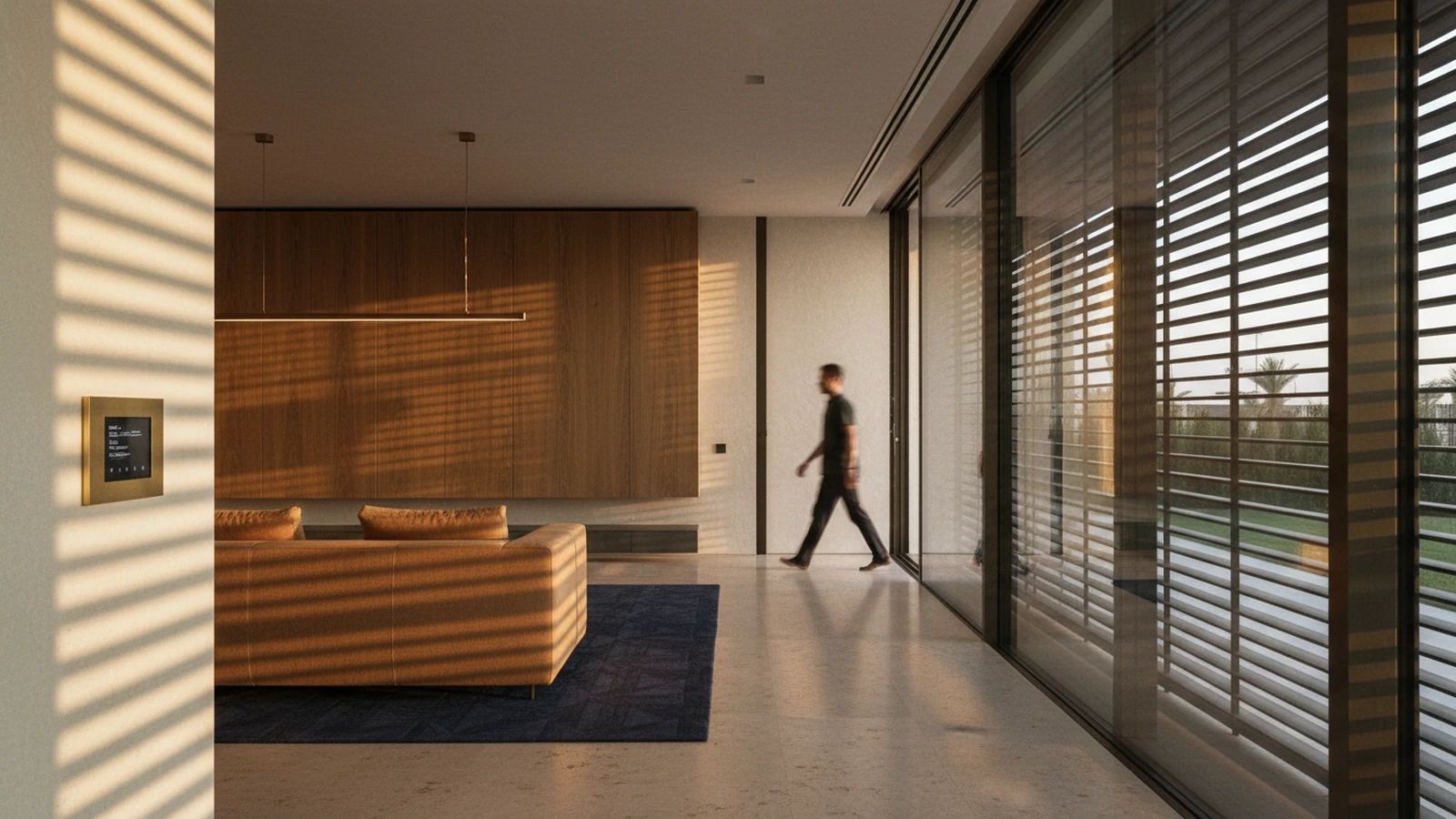
You walk into the majlis at nine in the evening, press the top button on the keypad by the door, and four things happen at once: the ceiling wash comes up, the wall lights settle low, the curtains close, and the air conditioning drops half a degree because the room is now occupied. No app opened. No hub woke up. No server abroad was asked for permission. If you have ever wondered how does KNX work under that single press, this article walks the signal from your finger to the light fitting. We have installed KNX in the UAE since 2014, and once owners see the mechanism, most of the buying decisions become obvious.
How does KNX work at the cable level
Start with the cable, because everything else depends on it. A KNX installation runs a dedicated low-voltage bus alongside the normal mains wiring. The bus cable is a solid-core twisted pair with 0.8 mm conductors; the red and black cores carry both a 29 V DC supply and the data, so a keypad or sensor draws its power and speaks on the same two wires. KNX Association guidance puts the practical limits at 350 metres between a power supply and any device, and 1,000 metres of total cable in one segment, which is generous for even a large villa. Devices are designed to work between 21 V and 30 V, which is why the specification insists on KNX-certified cable: thinner copper drops the voltage, and a run of keypads at the far end of a thin cable is where mysterious faults are born.
The signalling is differential. The receiver reads the difference in voltage between the two cores rather than the level on either one, so interference picked up along the run appears on both wires and cancels out. That is why a KNX bus can run for years in a plant room next to pumps and inverters without a missed command. The bus is built for certainty, not throughput; a lighting command does not need megabits.
The two kinds of device on the bus
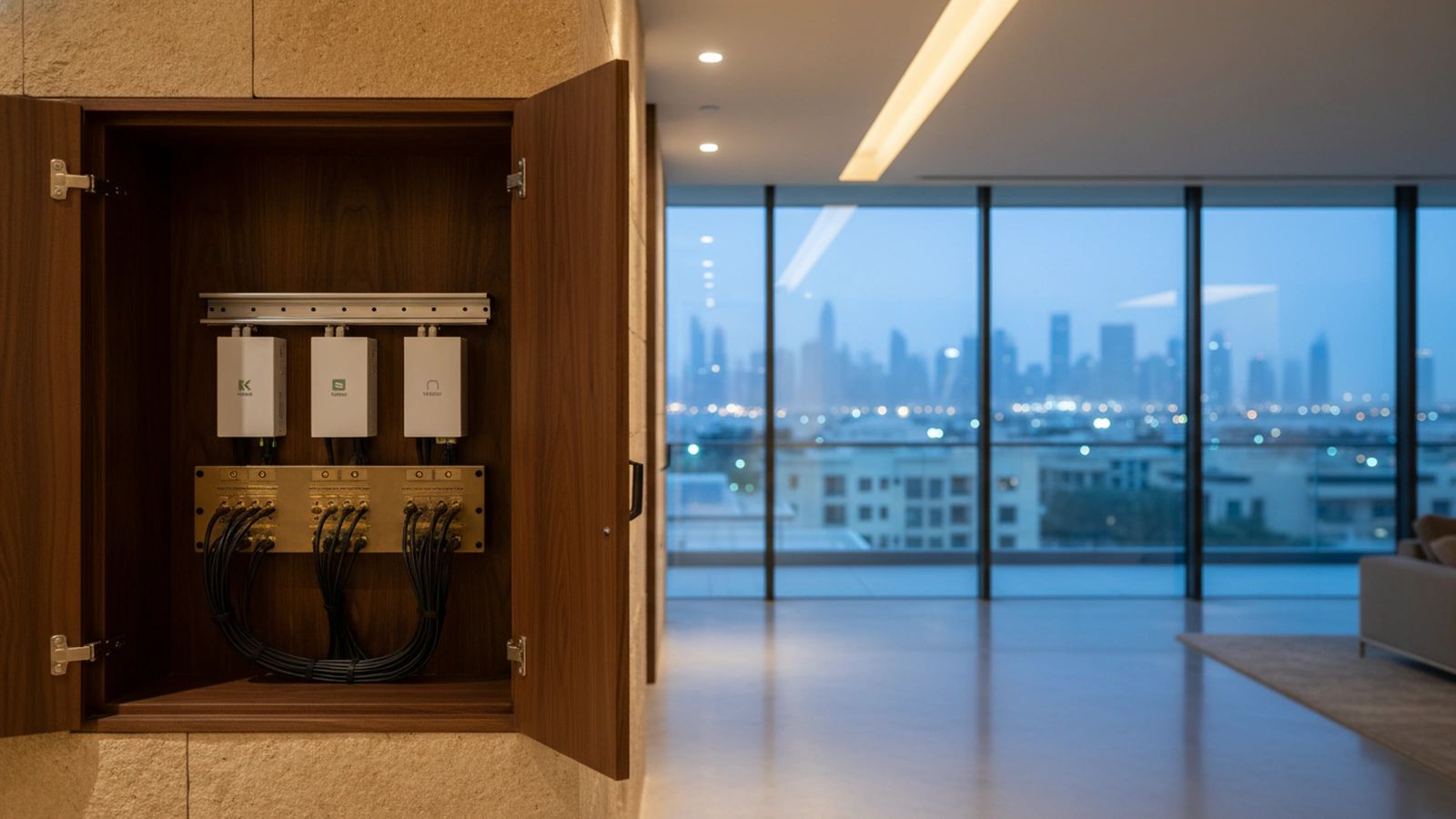
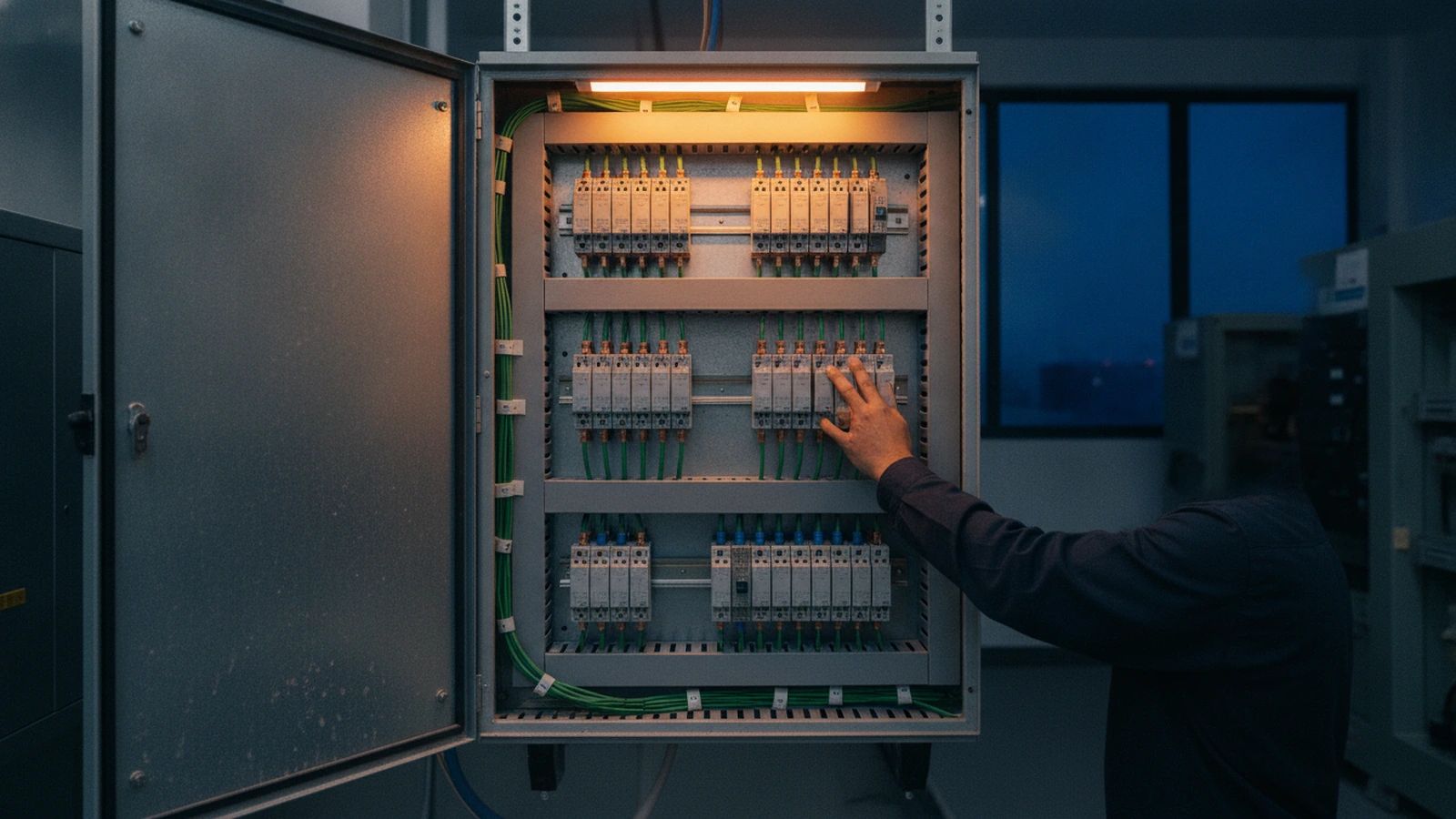
Every device on a KNX bus is, broadly, a sensor or an actuator. Sensors are the things you touch or that watch the room: keypads, presence detectors, temperature and humidity sensors, door contacts, the weather station on the roof. Actuators are the modules in the electrical panel that do the physical work: switching and dimming lighting circuits, driving blind and curtain motors, opening the valves or relaying the fan speeds of the air conditioning.
The important part is where the intelligence lives. There is no central computer that every command must pass through. Each certified device carries its own processor and its own configuration. The keypad knows which message to send when its top button is pressed; the dimming actuator knows which of its channels should respond, how quickly to fade and what level to land on, which is the mechanism behind every lighting scene we commission. Take any one device off the wall and the rest of the house continues as before. That decentralised design separates a wired bus from a cloud platform or a hub-based wireless system, and it is the question to ask of any proposal: what stops working if this box fails?
What is in a telegram
When you press the keypad, it puts a short message onto the bus. KNX calls it a telegram. Every device hears it, because the bus is shared, but only the devices that have been told to care about that message act on it.
That "told to care" is the group address, the single most useful concept for an owner to understand. A group address is a label, such as "Majlis evening scene", that several devices agree to listen for. The keypad sends to the label. The dimming actuator, the curtain actuator and the climate controller have each been configured to react to it in their own way. Nothing is wired point to point; the relationship between a button and a light exists only in configuration. So when you decide two years later that the button by the garden door should also close the pool-side blinds, nobody opens a wall. An integrator changes the links and downloads the change to the two devices involved.
Lines, areas and the villa that grows
A single KNX line serves one cluster of devices. Larger installations join several lines through line couplers; up to fifteen lines form an area, and up to fifteen areas can be coupled again. A villa rarely needs more than two or three lines, but couplers filter traffic, and when a client tells us the pool house may come later we plan a spare line from day one, so the extension arrives as one more coupler rather than a rebuild.
The bus does not have to be copper end to end. The standard supports twisted pair, radio frequency, power line and IP, joined through media couplers. In a villa we use twisted pair behind plaster, IP as the backbone between distribution boards and the visualisation layer, and radio only for the one wall a retrofit cannot open. What we do not do is put the whole house on wireless because it was quicker; our article on KNX versus WiFi in a Dubai villa sets out why.
ETS: the one tool, and why it protects you
All of the configuration above is done in ETS, the Engineering Tool Software published by the KNX Association. It is manufacturer-independent: the same tool programs a keypad from one brand, a dimmer from another and a climate controller from a third, which is what makes a KNX house a multi-vendor house rather than a single-supplier ecosystem. In ETS the integrator lays out the topology, imports the product data for every certified device, links group objects to group addresses, sets parameters such as fade times and setpoint limits, and downloads the result over the bus. Built-in bus monitoring shows telegrams live, so faults are diagnosed by evidence rather than by swapping parts.
For an owner, ETS is a form of insurance, and it is why the KNX ecosystem can hold hundreds of manufacturers without tying you to any one of them. Hold a copy of the project file and any KNX Partner in the world can open it and continue your installation. Our guide to verifying a KNX integrator in Dubai explains what to ask for at handover, and the what is KNX home automation page covers the standard in plainer terms if this is your first meeting with it.
Security, and the internet's proper place
Because the bus is physical and local, the classic attack surface of a cloud smart home does not exist: no account to phish, no remote server holding your schedules. KNX also specifies encryption as part of the standard: KNX Data Secure protects the telegrams between devices and KNX IP Secure encrypts and authenticates traffic on an IP backbone, and segment proxies let easily reached secured devices, a guest-room thermostat for instance, be kept apart from the unsecured devices in the panel. The Association runs a free check at secure.knx.org that tests whether an installation's IP interface is exposed to the internet; we run it at handover and at every visit under a residential maintenance contract. The internet itself is optional in a KNX house. When it drops, the keypads still work, the schedules still run and the house still cools before you arrive.
The dashboard layer, and what we build on top
Everything so far is the standard itself. On top of it we add Haus Logic's custom dashboard: the layer that shows every room's policy and its live reading side by side, holds the schedules, integrates cameras and audio, and speaks to the family through wall iPads and phones. It sits on the KNX backbone rather than replacing it; switch it off and the lights, blinds and climate carry on from the bus alone.
A worked example makes the split clear. At a fully automated villa in JVT we have measured for a year, 389 installed devices run 90 automation routines. Climate rules hold six rooms at 23.5 degrees when occupied and 25 when empty after a fifteen-minute wait; the staircase step lights drop three minutes after the last movement; the perimeter lights come on at sunset and off at ten. The bus carries every one of those commands. The dashboard is where the family sees them, changes them and, when a sensor dies, is told about it at seven the next morning.
That is how KNX works: a robust two-wire bus, intelligence in every device, relationships that live in configuration rather than copper, one open tool, and a dashboard on top for the people who live there. It is the approach behind our automation projects in Dubai and Abu Dhabi, and why we tell clients the system will outlast the phone they control it from. If you would like to see a bus, a panel and a dashboard working together before you commit, we are happy to walk you through a live installation.
Sources
1. KNX Association, Standardisation: ISO/IEC 14543-3, EN 50090, GB/T 20965, ANSI/ASHRAE 135. https://www2.knx.org/in/knx/technology/standardisation/index.php
2. KNX Association, KNX Technology: line couplers, 15 lines per area, 15 areas, power supply, KNXnet/IP, segment proxy and KNX Data Secure. https://www.knx.org/manufacturers-hub/knx-technology
3. KNX Association, Trade Talk: KNX Twisted Pair (0.8 mm solid core, 29 V DC, 350 m and 1,000 m limits, 21 to 30 V device range, differential signalling). https://www.knx.org/news/trade-talk-knx-twisted-pair-its-not-just-little-piece-wire
4. KNX Association, ETS6 Tips and Tricks: KNX topology (TP, RF, power line, IP and KNX IoT media; media couplers; KNX Secure; secure.knx.org check). https://www.knx.org/news/ets6-tip-and-tricks-knx-topology
5. KNX Association, What is ETS (topology design, product import, addressing, group object linking, bus monitoring, device replacement). https://www.knx.org/what-ets
6. KNX Association, Explore KNX (500+ manufacturers, 8,000+ certified devices, standard trusted for over 30 years). https://www.knx.org/explore-knx/what-is-knx
7. KNX Association, Is Your Smart Home Setup Secure Enough? How KNX Prioritizes Privacy (KNX Data Secure and KNX IP Secure). https://www.knx.org/news/your-smart-home-setup-secure-enough-how-knx-prioritizes-privacy
8. Haus Logic, A fully automated villa in JVT, measured for a year (389 devices, 90 routines, climate and lighting rules). https://hauslogic.ae/case-studies/private-villa-jvt