# VRF KNX Integration UAE: What the Gateway Can and Cannot Do
The wall panel is installed, the schedule is programmed, and the owner presses the button for "cool the majlis". Nothing happens. The AC is a VRF system, the KNX bus is working perfectly, and the two never agreed on a language. This is the quiet failure behind a lot of villa automation, and it is decided long before anyone touches a keypad.
If you are planning VRF KNX integration UAE villas can live with for years, the question is not whether it can be done. It can. The question is how much of the AC the KNX system will actually be able to see and command.
How VRF KNX Integration UAE Projects Connect the Two Systems
A VRF system has its own control electronics in every indoor unit. KNX does not replace them; it talks to them through a gateway. The KNX Association's device catalogue lists VRF air conditioner gateways whose job is, in one listing's words, monitoring and controlling the functioning parameters of a manufacturer's air conditioners via the KNX bus.
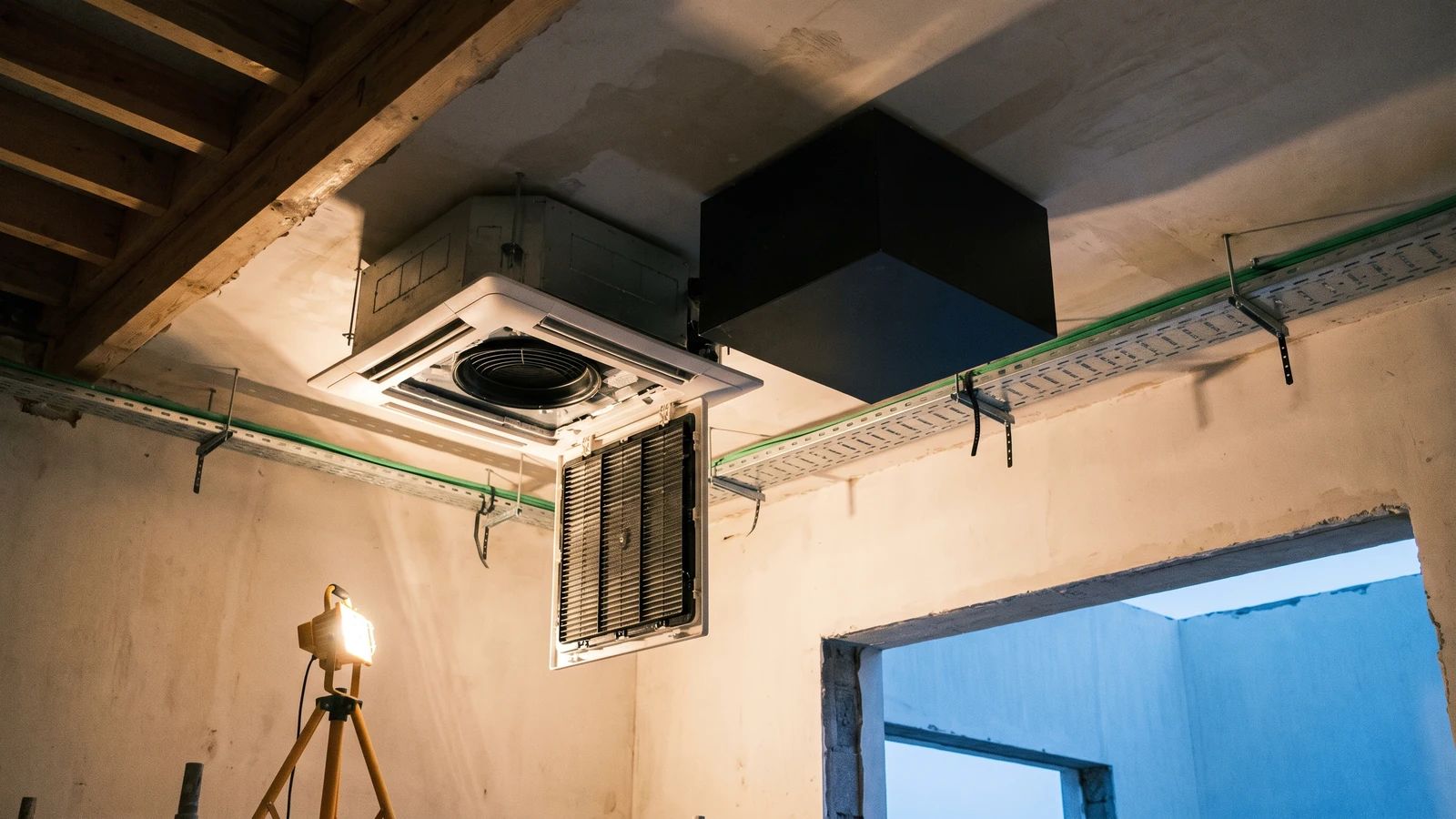
The same listing describes the physical arrangement. One side of the gateway connects directly to the indoor unit's electronic circuit, and the other connects directly to the KNX bus. It can be mounted inside the indoor unit or at a suitable location away from it. In practice that means the gateway is a small translator sitting beside each unit, or serving a defined group of units, and the answer to "where does it go" has to be settled with the ceiling and the unit layout in front of you.
Three Things the Gateway Does Not Promise
It does not promise every command. The listing states that the available commands may vary according to indoor unit model. Two villas with the same outdoor unit can have different indoor units, and the list of things the KNX system can do in each room follows the indoor unit, not the brochure.
It does not promise every model. Gateways are compatible with the VRF models on the manufacturer's published compatibility list. If a unit is not on that list, the integration is a different conversation. The KNX Association makes the same point from the other side: for AC, control is straightforward once you establish the make and model and choose from the pre-configured interfaces available.
It does not remove the unit's own remote. Our practice is to keep the manufacturer's remote working wherever the unit allows it. A bus fault or a failed panel should never leave a bedroom without cooling in August.
What Must Be Confirmed Before First Fix
Four items belong on paper before any cable is pulled to the ceiling.
First, the make and model of every indoor unit, room by room. This is the document the whole integration hangs from, and in our experience it often does not exist until someone asks for it.
Second, the gateway for each model, and what it exposes. Ask for the object list: on and off, mode, setpoint, fan speed, room temperature, and any fault feedback. If fault feedback is not exposed, the system can command the AC but cannot tell you it has stopped working.
Third, the location of each gateway and its bus cable. A gateway inside the indoor unit needs the bus pulled to the ceiling void. A remote gateway needs a service route. Both need access years later, which is why the KNX control cable specification matters here too.
Fourth, who owns the AC warranty and the commissioning. The AC contractor and the automation integrator both touch the same electronics, and the handover is cleaner when one written scope says who connects, who configures, and who tests.
Why Schedules Belong in the KNX Project
Once the gateways are in, the AC becomes part of a single project that a technician can open in ETS, which the KNX Association describes as the tool for configuring communication between components and programming functions such as HVAC, lighting, shading and energy management. The schedules, zones and pre-cooling logic live there, not in a separate app per room.
That matters in the UAE for a plain reason. DEWA states that air conditioning consumes a large portion of the electricity generated during peak hours, so when the cooling runs matters as much as how much it runs. We cover that logic in pre-cooling a Dubai villa with a KNX schedule and in KNX thermostat Dubai: what sits between the wall panel and your AC unit. We make no savings claim here; a gateway only makes the schedule possible.
How We Handle It at Haus Logic
We start from the indoor unit schedule, not the panel finish. We list every unit by make and model, confirm the gateway and its object list for each, and agree the cable and access plan before first fix. The schedules and zones then sit in Haus Logic's custom dashboard on top of the KNX backbone, so the household sees one set of controls. That is the approach behind the VRF and KNX work on villas in communities such as Emirates Hills, and the same discipline appears in our JVT villa case study. Our climate automation service explains how zones, sensors and schedules fit together, and energy management covers the metering side.
If you are curious how your villa's AC units would map onto a KNX project, we are happy to walk through the unit list with you.
Sources
1. KNX Association, certified device listing: VRF AC KNX gateway. https://knx.org/devices/midea-vrf-ac-knx-gateway
2. KNX Association, HVAC: using KNX to control units that form part of a block-wide building management system. https://www.knx.org/news/hvac-using-knx-control-units-form-part-block-wide-building-management-system
3. KNX Association, What is ETS. https://www.knx.org/what-ets
4. Dubai Electricity and Water Authority, Peak Load. https://www.dewa.gov.ae/en/about-us/sustainability/lets-make-this-summer-green/peak-load