# Villa Automation Dubai: What It Covers, and the Order It Has to Be Decided In
Your villa is eight months from handover. The contractor asks, almost in passing, whether you want the house to be "smart". You say yes, because who says no, and the question moves on. Nothing in that exchange tells anyone which cables to pull, and that is the moment most villa automation projects quietly go wrong.
Type villa automation Dubai into a search bar and the results describe outcomes: voice control, scenes, security, savings. What they rarely describe is scope, and they almost never describe sequence. Scope is what the system actually covers. Sequence is the order the decisions have to happen in, which is dictated by the construction programme and not by your preferences.
Sequence is the part that costs money when it is ignored. A decision made before plaster is a line on a drawing. The same decision made after handover is a chased wall.
Villa Automation Dubai: What It Actually Covers
Stripped of marketing, a fully automated Dubai villa covers seven things:
- Lighting: circuits, dimming, and scenes
- Climate: zoning, setpoints, and scheduling for a house that is cooling most of the year
- Shading: blinds and curtains, coordinated with sun position
- Security and access: cameras, intercom, door control, alarm integration
- Networking: the wired and wireless backbone everything else depends on
- Energy: submetering, solar if fitted, EV charging, load awareness
- Water and irrigation: leak detection, landscape scheduling
Nothing on that list is exotic. What separates a good installation from a frustrating one is that all seven talk to each other over a common system, rather than living in seven separate apps that each work perfectly and never cooperate.
Stage One: The Backbone, Before Plaster
The first stage has no visible product in it at all, which is why it is the one that gets skipped.
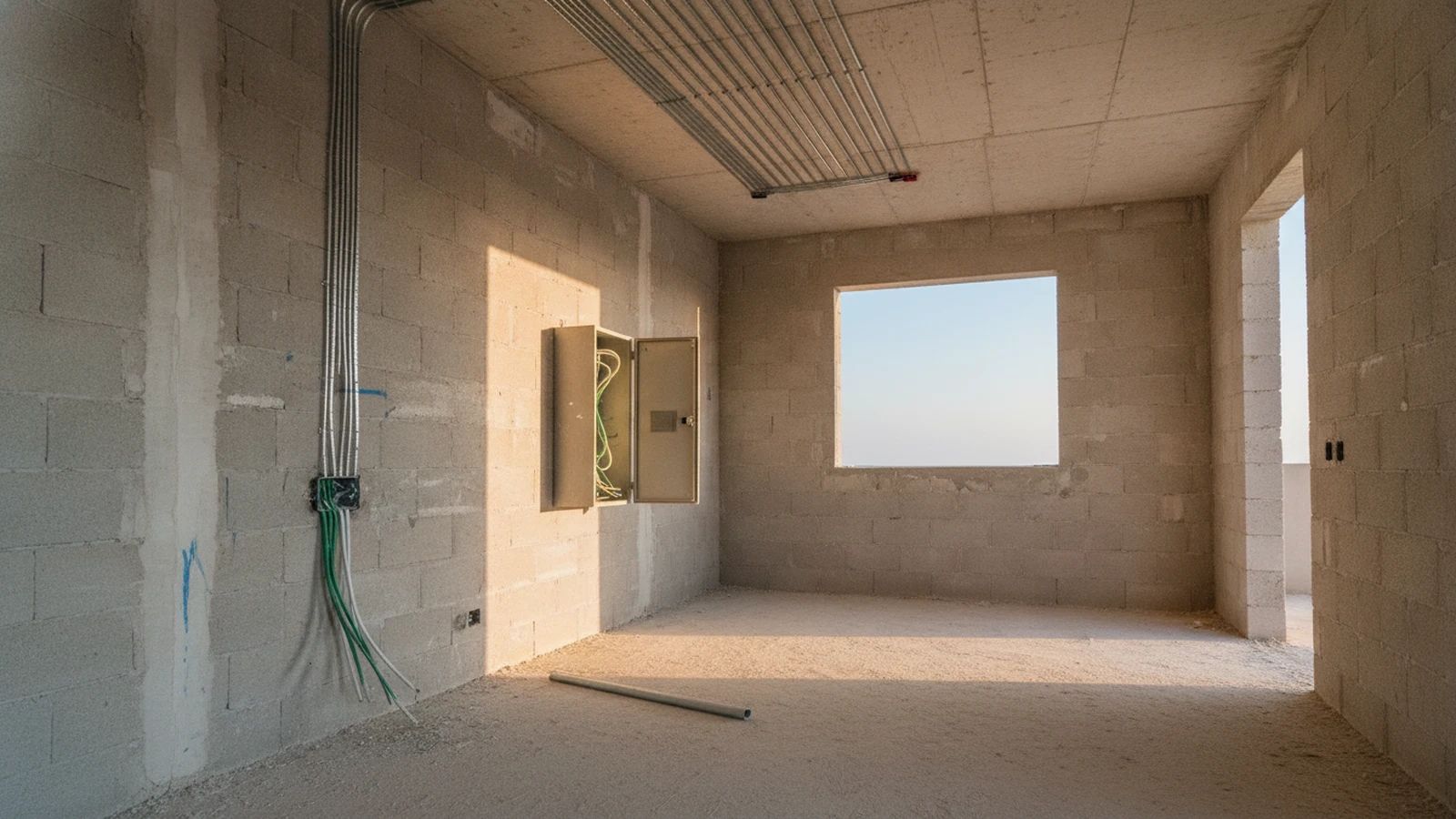
Stage one is containment and cabling: conduit routes, a properly sized panel, home-run wiring to the circuits you will want to control separately, bus cable to every keypad and sensor position, and structured data cabling to every room that will carry a screen, a camera, or an access point. It is drawings, coordination with the MEP contractor, and boxes in walls.
This is also where the control standard is chosen, because the standard determines the cable. We use KNX, which is approved as an International Standard under ISO/IEC 14543-3, as a European Standard under CENELEC EN 50090 and CEN EN 13321, as the Chinese standard GB/T 20965, and whose mapping to BACnet is documented under ANSI/ASHRAE 135. The reason that list matters to a homeowner is not the certificates. It is that devices from different manufacturers are designed against the same published specification, so the system is not tied to one vendor's product roadmap or one dealer's continued goodwill.
Get stage one right and everything after it is a choice. Get it wrong and everything after it is a compromise.
Stage Two: The Loads That Pay
Stage two is deciding which systems get proper control first, and in Dubai that ordering is not a matter of taste.
DEWA states that electricity use in Dubai peaks between 12pm and 6pm during summer, and that air conditioning consumes a large portion of the electricity generated during those peak hours. That single fact sets the priority: climate control is the first system that earns its keep, not the last.
Practically, this means zoning. A villa cooled as one block runs empty rooms at the same setpoint as occupied ones, all afternoon, through the worst of the load. A zoned villa cools the rooms in use and lets the rest drift. DEWA's own guidance recommends setting air conditioning to 24°C and using a programmable thermostat to control it. Zoning is the same idea applied per room rather than per house, and it is why climate automation tends to be the first thing we specify properly.
Lighting comes next, because lighting circuits are decided at the same moment as climate cabling and cannot be revisited later without opening walls. Shading follows, since blinds reduce the solar gain the air conditioning then has to remove. The sequence is not arbitrary; each stage reduces the load on the one after it.
Stage Three: Orchestration
Stage three is where the house stops being a set of controllable systems and starts behaving like one system.
This is scenes, schedules, and conditional logic: an away mode that sets back every zone and arms the cameras, an evening scene that handles lighting and blinds together, a morning sequence that pre-cools before the sun is on the west elevation. It is also the interface question, because a house with seven apps has not been automated, it has been digitised.
Orchestration is cheaper to change later than stages one and two, provided the backbone supports it. That is the argument for spending disproportionate attention early: the reversible decisions can wait, the irreversible ones cannot.
If you want to see what this looks like across an ordinary day rather than in the abstract, we walked through it hour by hour in how villa automation actually works.
Stage Four: Measurement
The last stage is the one that separates a system that feels smart from one that can be proved to work.
Submetering, circuit-level energy data, and runtime logging turn opinions into numbers. Without measurement you cannot tell whether the zoning schedule is helping or whether a plant room is quietly consuming more than it should. With it, a villa becomes something you can tune, which is the whole point of energy management as a discipline rather than a feature.
Where Regulation Sits In All This
Dubai's regulatory framework has been moving in the same direction for years. Al Sa'fat, the Dubai Green Building System, replaced the earlier Dubai Green Building Regulations and Specifications from 19 October 2020, and includes a set of mandatory requirements that all new buildings must meet to obtain the Silver Sa'fa, with Golden and Platinum tiers available to owners targeting higher performance. We covered what that means inside a villa in our Al Sa'fat guide.
The relevance to sequence is direct: compliance is easiest to satisfy when the systems are specified at design stage, and hardest when they are bolted on at the end.
If the Villa Is Already Built
None of the above assumes a bare shell. Retrofit is a real path, with a different method and a different cost profile, and we have set out honestly what does and does not transfer in adding automation to an existing villa.
The one thing that does not change is the sequence. Even in a finished house, the backbone still comes first, the high-load systems still come before the convenience ones, and measurement still comes last.
How We Work
We run this as four stages deliberately, and we say no to out-of-order requests more often than clients expect. Design stage gets a device schedule and a cable schedule before the electrician is on site. Climate and lighting get specified together, because they share containment. Orchestration and dashboards come after commissioning, when the house is real and the schedules can be tested against how it is actually lived in.
You can see the full sequence carried through on a single project in our JVT villa case study, where the backbone was specified before first fix rather than argued about afterwards. Consultants and developers specifying this on behalf of an owner will find our scope and deliverables set out on our for professionals page.
If you have a handover date and no automation scope yet, that is the right moment to talk rather than the wrong one. We are happy to review the drawings and tell you which decisions are still open. Reach us at projects@hauslogic.ae or +971 54 764 6619.
Sources
1. KNX Association, Standardisation. https://www2.knx.org/in/knx/technology/standardisation/index.php
2. Dubai Electricity and Water Authority, Peak Load guidance. https://www.dewa.gov.ae/en/about-us/sustainability/lets-make-this-summer-green/peak-load
3. Dubai Municipality, Al Sa'fat Dubai Green Building System. https://www.dm.gov.ae/municipality-business/al-safat-dubai-green-building-system/