# How Does Villa Automation Actually Work? One Dubai Day, Hour by Hour
It is 5:40 on a Tuesday morning in September and nobody in the house is awake, but the house is. The bedrooms are holding at 23.5 degrees because they are occupied, the majlis has drifted to 25 because it has been empty since midnight, and the pool pumps are running, as they do around the clock. If you have asked yourself how does smart home automation work in a villa, the honest answer is not a list of devices. It is a sequence of small decisions, taken by the house itself, from before dawn to after midnight. This article follows one ordinary Dubai day through a real villa and names which layer of the system makes each decision.
The villa is a two-storey family home in Jumeirah Village Triangle that we automated in 2024 and have measured for a year: 389 installed devices, 90 running automation routines, and a KNX wired backbone under everything. Every rule quoted below exists in that house's configuration, not in a brochure.
05:40 to 07:00: the house wakes before the family
The first decisions of the day are about heat that has not arrived yet. A DEWA campaign put the figure plainly: air conditioning accounts for about 60 percent of Dubai's peak electricity load in summer, and the peak runs from noon to five in the afternoon. A villa that waits until the family is hot to start cooling pays the most for the least comfort, so the sequence begins early.
The curtains open with the morning. At seven the house runs a health check: it polls every sensor the day's automations depend on and reports any that have stopped responding, so a dead presence detector is found before it causes a dark corridor at night. That is a dashboard-layer job; the KNX bus carries the sensor states, and Haus Logic's custom dashboard asks the question and sends the answer to the owner's phone.
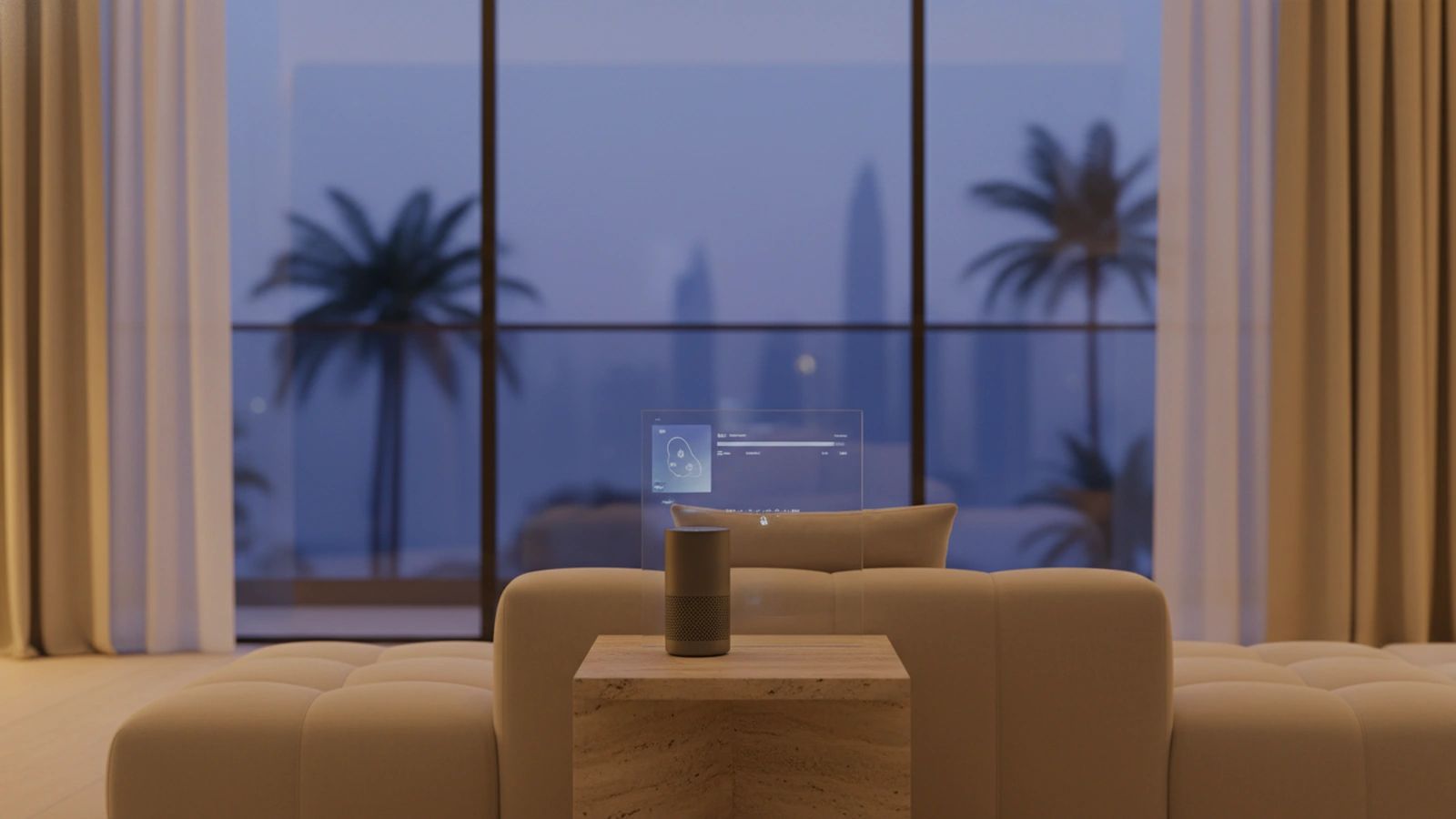
The layer distinction matters from the first hour. Sensors and keypads put messages on the wired bus. Actuators in the electrical panel switch the circuits, drive the motors and set the air conditioning. Each device carries its own logic, so a bedroom keypad talks to a bedroom dimmer without any server in the loop. The dashboard sits above that, holding the schedules, the energy figures and the family's view of the house. For the standard beneath it, our explainer on how KNX works covers the cable, the telegram and the tool.
07:00 to 09:00: bathrooms, stairs, and the door
The bathrooms in this house have no light switch in practice. A door contact and a presence check bring the lights up; a timer takes them down. The staircase step lights come on for movement and drop three minutes after the last person has passed. None of it needs a phone. A presence detector sends one message when the room becomes occupied and one when it empties, and the lighting actuator does the rest.
At the front door the routine is different because the risk is different. Ring the bell and a snapshot lands on both parents' phones. The wall dashboards show the person at the gate with an unlock control beside them; one tap and a known driver is inside. The cameras run on the villa's own network with local storage; the JVT villa's portfolio record describes the 26-camera design and why a non-gated community called for it.
09:00 to 12:00: the empty house
By nine the family has left and the quiet economy begins. Six rooms are held at five allowed temperatures and no others: 23.5 degrees when occupied, 25 when a room has been empty for fifteen minutes. That difference sounds small. DEWA's own conservation guidance is that each degree added to a set point can save up to five percent of air-conditioning consumption, so a house that reliably lifts empty rooms, all day, every day, is trimming the largest line on the bill without anyone noticing.
The word reliably is doing real work. The house restates its climate intent every fifteen to thirty minutes, so a thermostat's factory schedule can never quietly take a room back; override a setpoint by hand twice and it concedes for an hour, then resumes.
12:00 to 15:00: the sun and the glass
This block decides the DEWA bill. Dubai's residential electricity tariff is banded: 23 fils per kilowatt-hour for the first 2,000 units in a month, 28 fils to 4,000, 32 fils to 6,000, and 38 fils above that, plus a fuel surcharge. Every unit avoided at the top of that scale is worth more than one avoided at the bottom.
The cheapest cooling is heat that never enters. The KNX Association makes the same argument for European summers: external shading stops solar gain at the glass, while cooling has to remove heat that has already accumulated inside, so prevention is usually more efficient than correction. In this villa the rule is concrete. When the living room is empty and the outdoor temperature reads above 34 degrees, the curtains close against direct sun; when someone walks in, the room is theirs again. The dashboard also knows the bands: it prices each kilowatt-hour the rooftop solar array displaces at the tariff band it would otherwise have landed in, so the owner reads the array's value in dirhams.
Our piece on the DEWA slab tariff and what Slab 4 means walks the arithmetic, and our energy management page explains how we meter a villa by use case rather than as one lump.
15:00 to 18:00: arrivals, gym, garden
In the garage, a vibration sensor on the treadmill knows the moment a workout starts; the garage cooling comes on and the master bathroom water heater begins a fifteen-minute cycle, so the run ends in a cool room with a hot shower waiting. Nothing was pressed. That is automation done properly: a sensor that already exists, a rule that reflects how one family lives, and actuators that were already in the panel.
Outside, the lawn has its own logic. Cameras watch the grass through daylight, and an irrigation zone runs for thirty-two seconds only when the vision system confirms a pigeon, zone two first and then zone one so the birds are moved off rather than chased around. Any run past fifteen minutes cuts itself off, and because the water is metered per use case the owner sees exactly what the habit costs.
18:00 to 22:00: the evening the family sees
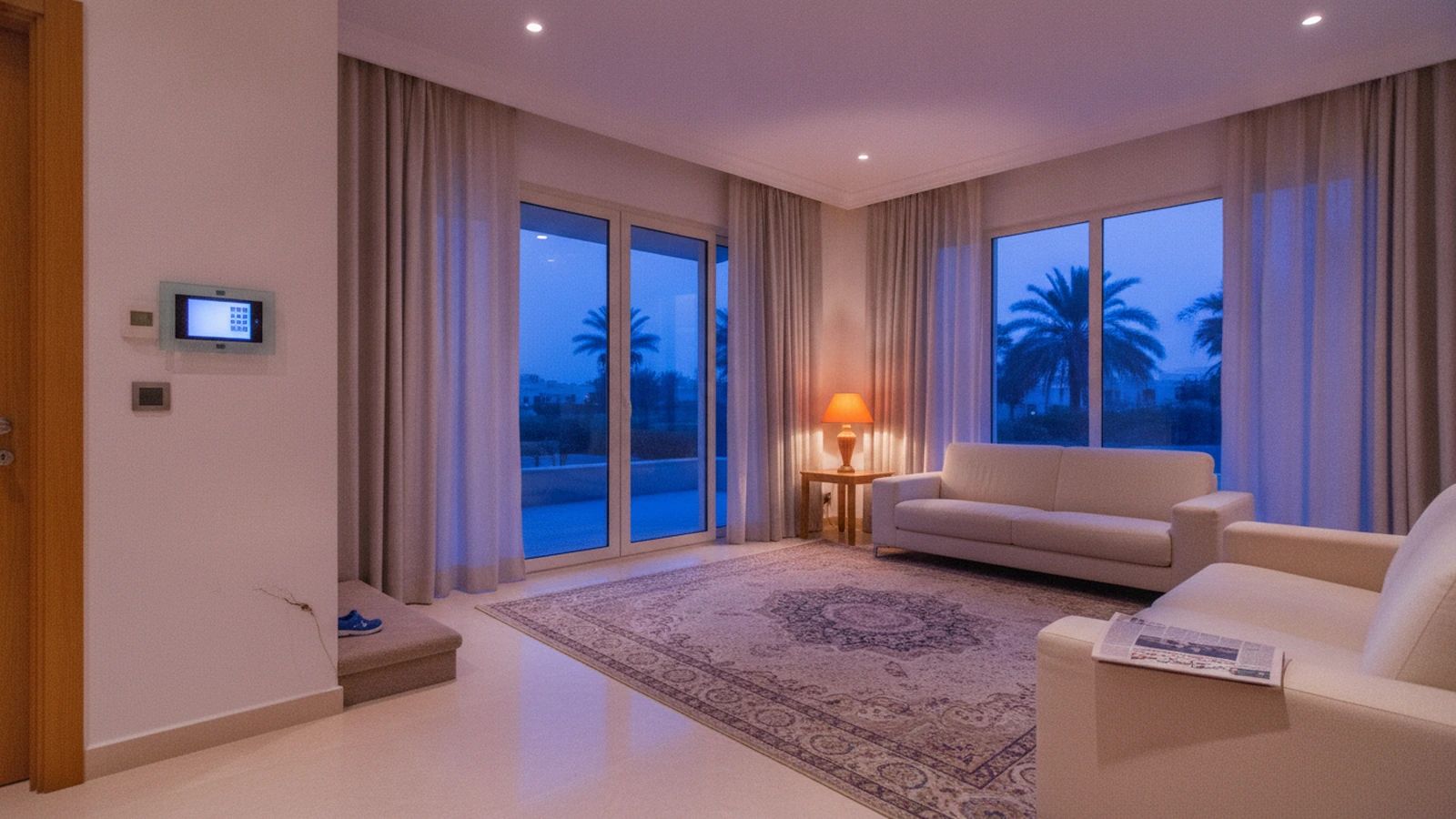
Sunset is a bus event. The perimeter lighting comes on, the curtains close, and the evening rooms settle to their occupied setpoints. A single keypad press in the majlis sets the scene: dimmed ceiling wash, low wall lights, blinds down, the audio zone awake. This is where the four levels of lighting control become visible to guests, and where the choice of KNX pays off in a way that is easy to describe: the scene runs on the bus, so it runs the same way on the night the internet is down as on the night it is not.
A child's room heating past 30 degrees while occupied reaches both parents' phones within fifteen minutes. Known faults are logged; only the unexpected is pushed. These are small rules, and they are the difference between a house that feels looked after and one that feels like a demo.
22:00 to 05:40: the quiet hours
At ten the perimeter lights go off. Three dehumidifiers hold the house just under fifty percent humidity; a full tank stops the unit before it overflows and says which room needs emptying. The electricity meter checks itself hourly so the bill estimate stays honest. If the network drops, the access points and router restart themselves and escalate to a person only when the automatic fix did not work. After any restart the house waits for all six thermostats to return, corrects any that came back wrong, and checks again ten minutes later.
Then it is 5:40 again.
How does smart home automation work in a villa, then?
Strip the day back and three layers appear. A wired KNX backbone with the intelligence spread across every device: keypads, presence detectors, dimmers, blind actuators, climate controllers. A dashboard layer above it that holds the schedules, the energy pricing and the family's view, and watches the house on the family's behalf. And a set of rules, written for one family's routine, that use the sensors already in the walls. The first layer is what the standard gives you. The second and third are what an integrator gives you, and they are where villas differ.
That is why the measurements matter. Adjusted for the loads added after the solar array went in, the JVT house buys 56.2 percent fewer units than before, and its fabric is ordinary. We publish the working because a number without its method is marketing. At a larger family villa in Abu Dhabi the same approach runs across a pool house, a majlis and landscaped gardens on 63 KNX devices with tactile keypads in every room. The hardware scales with the house; the rules scale with the family.
We design, install and maintain this layering across villa automation in Dubai and Abu Dhabi, and we keep the routines honest under a residential maintenance contract that re-reads the configuration rather than the brochure. If you would like to see a day like this one running in a real house before you plan your own, we are happy to arrange it.
Sources
1. DEWA, annual peak load reduction campaign (air conditioning about 60 percent of peak load; peak period 12 to 5 pm). https://www.dewa.gov.ae/en/about-us/media-publications/latest-news/2016/08/dewa-launches-annual-peak-load-reduction-campaign
2. DEWA, Slab Tariff (residential electricity bands 0.230, 0.280, 0.320 and 0.380 AED per kWh; fuel surcharge; 5 percent VAT). https://www.dewa.gov.ae/en/consumer/billing/slab-tariff
3. DEWA, Cooling conservation tips (24 degree set point; each degree increase can save up to 5 percent of AC consumption). https://www.dewa.gov.ae/en/consumer/sustainability/sustainability-and-conservation/cooling
4. KNX Association, The Summer Overheating Problem: Why Shading Should Come Before Cooling (external shading prevents solar gain; prevention more efficient than correction). https://www.knx.org/news/summer-overheating-problem-why-shading-should-come-cooling
5. KNX Association, KNX Technology (TP devices, power supply, line couplers, decentralised certified devices). https://www.knx.org/manufacturers-hub/knx-technology
6. Haus Logic, A fully automated villa in JVT, measured for a year (389 devices, 90 routines, climate, lighting, shade, gym, door, lawn, network and meter rules; 56.2 percent adjusted reduction). https://hauslogic.ae/case-studies/private-villa-jvt
7. Haus Logic, Family Villa, Abu Dhabi (63 KNX devices, keypads in every room, pool house, majlis, gardens). https://hauslogic.ae/portfolio/family-villa-abu-dhabi